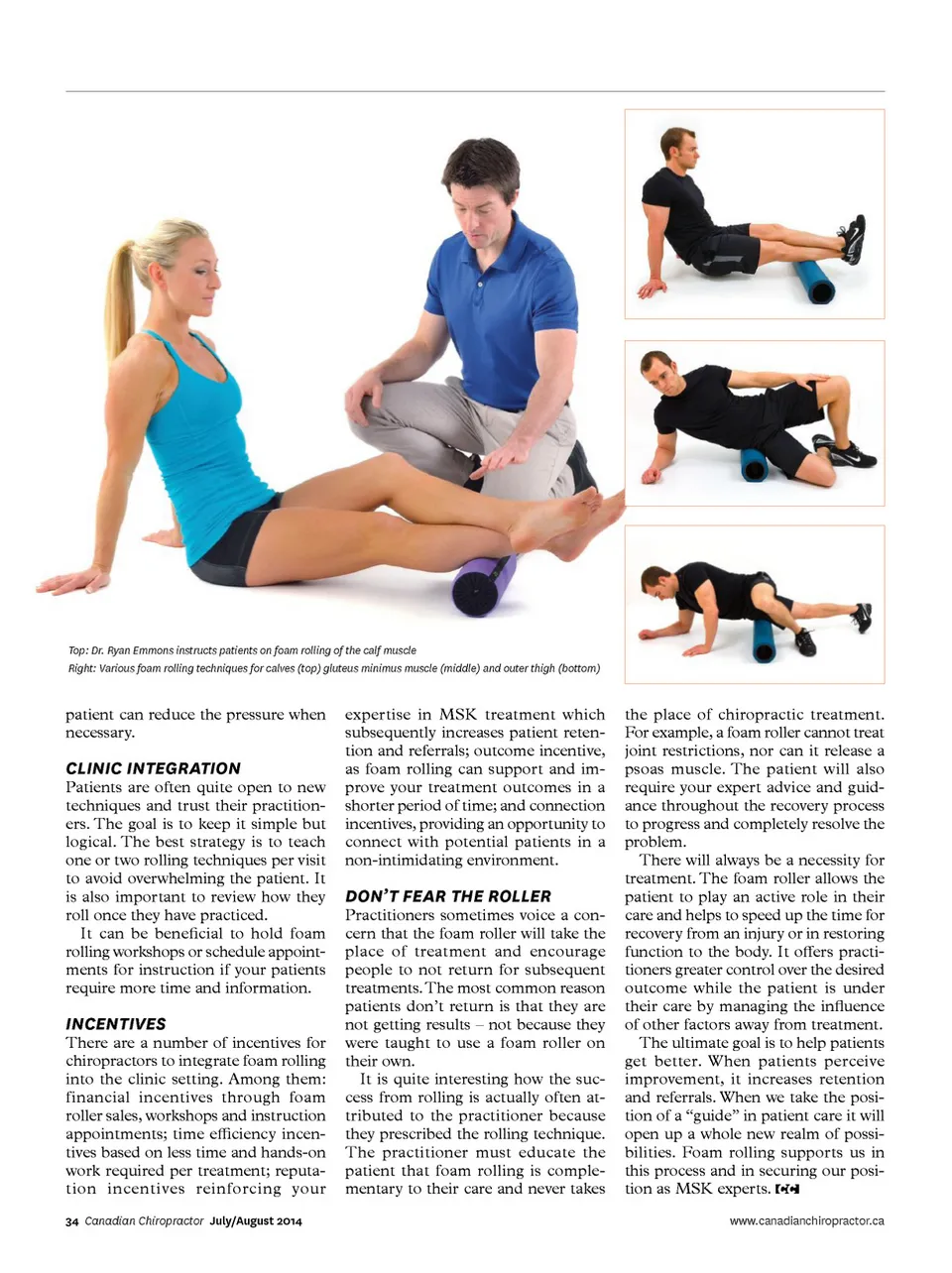
Top: Dr. Ryan Emmons instructs patients on foam rolling of the calf muscle Right: Various foam rolling techniques for calves (top) gluteus minimus muscle (middle) and outer thigh (bottom) patient can reduce the pressure when necessary. CLINIC INTEGRATION Patients are often quite open to new techniques and trust their practition-ers. The goal is to keep it simple but logical. The best strategy is to teach one or two rolling techniques per visit to avoid overwhelming the patient. It is also important to review how they roll once they have practiced. It can be beneficial to hold foam rolling workshops or schedule appoint-ments for instruction if your patients require more time and information. expertise in MSK treatment which subsequently increases patient reten-tion and referrals; outcome incentive, as foam rolling can support and im-prove your treatment outcomes in a shorter period of time; and connection incentives, providing an opportunity to connect with potential patients in a non-intimidating environment. Practitioners sometimes voice a con-cern that the foam roller will take the place of treatment and encourage people to not return for subsequent treatments. The most common reason patients don’t return is that they are not getting results – not because they were taught to use a foam roller on their own. It is quite interesting how the suc-cess from rolling is actually often at-tributed to the practitioner because they prescribed the rolling technique. The practitioner must educate the patient that foam rolling is comple-mentary to their care and never takes DON’T FEAR THE ROLLER INCENTIVES There are a number of incentives for chiropractors to integrate foam rolling into the clinic setting. Among them: financial incentives through foam roller sales, workshops and instruction appointments; time efficiency incen-tives based on less time and hands-on work required per treatment; reputa-tion incentives reinforcing your 34 Canadian Chiropractor July/August 2014 the place of chiropractic treatment. For example, a foam roller cannot treat joint restrictions, nor can it release a psoas muscle. The patient will also require your expert advice and guid-ance throughout the recovery process to progress and completely resolve the problem. There will always be a necessity for treatment. The foam roller allows the patient to play an active role in their care and helps to speed up the time for recovery from an injury or in restoring function to the body. It offers practi-tioners greater control over the desired outcome while the patient is under their care by managing the influence of other factors away from treatment. The ultimate goal is to help patients get better. When patients perceive improvement, it increases retention and referrals. When we take the posi-tion of a “guide” in patient care it will open up a whole new realm of possi-bilities. Foam rolling supports us in this process and in securing our posi-tion as MSK experts. www.canadianchiropractor.ca
Chiropractic + Naturopathic Doctor July August 2014: Page 34