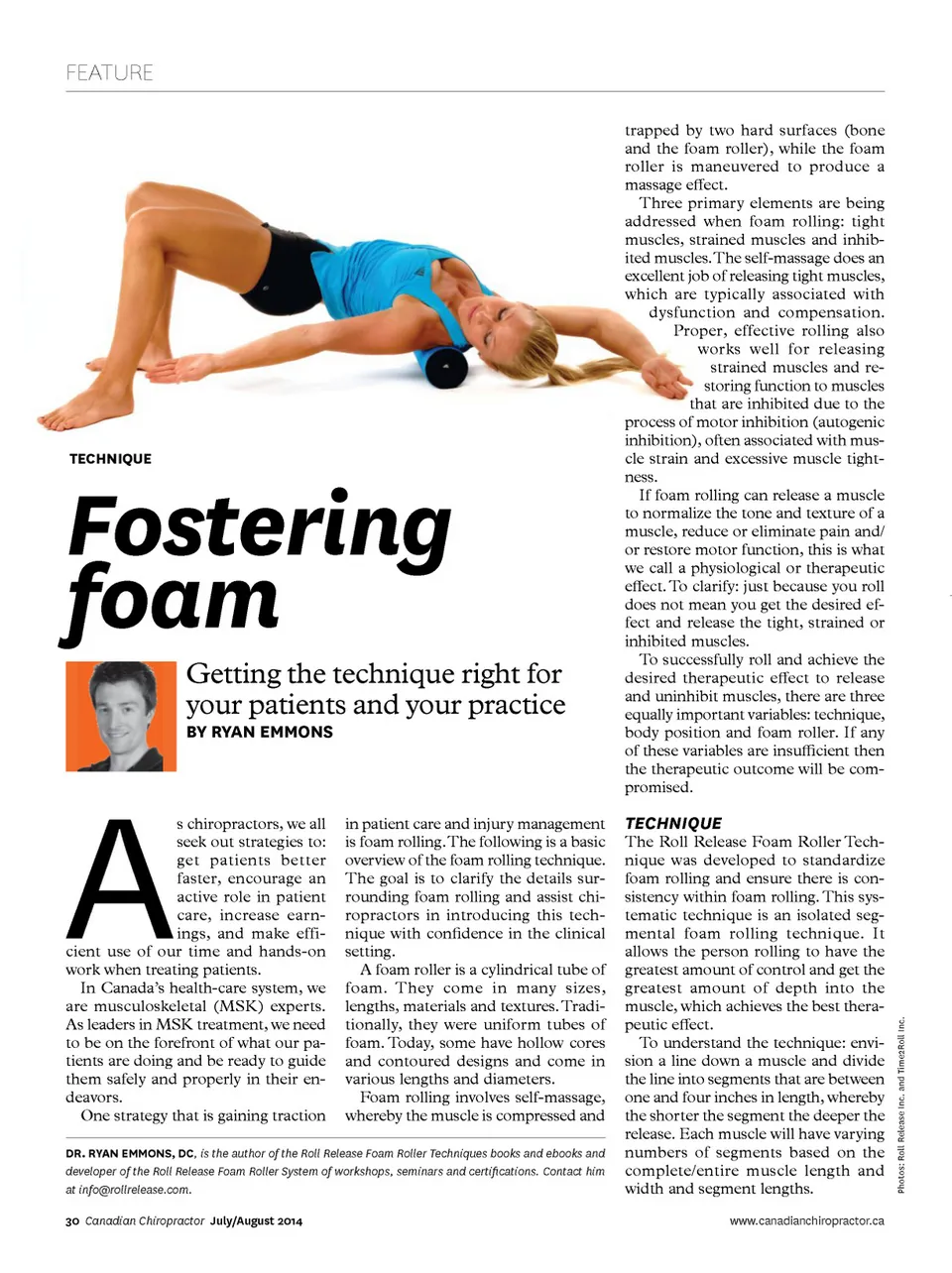
FEATURE trapped by two hard surfaces (bone and the foam roller), while the foam roller is maneuvered to produce a massage effect. Three primary elements are being addressed when foam rolling: tight muscles, strained muscles and inhib-ited muscles. The self-massage does an excellent job of releasing tight muscles, which are typically associated with dysfunction and compensation. Proper, effective rolling also works well for releasing strained muscles and re-storing function to muscles that are inhibited due to the process of motor inhibition (autogenic inhibition), often associated with mus-cle strain and excessive muscle tight-ness. If foam rolling can release a muscle to normalize the tone and texture of a muscle, reduce or eliminate pain and/ or restore motor function, this is what we call a physiological or therapeutic effect. To clarify: just because you roll does not mean you get the desired ef-fect and release the tight, strained or inhibited muscles. To successfully roll and achieve the desired therapeutic effect to release and uninhibit muscles, there are three equally important variables: technique, body position and foam roller. If any of these variables are insufficient then the therapeutic outcome will be com-promised. The Roll Release Foam Roller Tech-nique was developed to standardize foam rolling and ensure there is con-sistency within foam rolling. This sys-tematic technique is an isolated seg-mental foam rolling technique. It allows the person rolling to have the greatest amount of control and get the greatest amount of depth into the muscle, which achieves the best thera-peutic effect. To understand the technique: envi-sion a line down a muscle and divide the line into segments that are between one and four inches in length, whereby the shorter the segment the deeper the release. Each muscle will have varying numbers of segments based on the complete/entire muscle length and width and segment lengths. www.canadianchiropractor.ca Fostering foam Getting the technique right for your patients and your practice BY RYAN EMMONS TECHNIQUE A DR. RYAN EMMONS, DC , is the author of the Roll Release Foam Roller Techniques books and ebooks and developer of the Roll Release Foam Roller System of workshops, seminars and certifications. Contact him at [email protected]. 30 Canadian Chiropractor July/August 2014 Photos: Roll Release Inc. and Time2Roll Inc. s chiropractors, we all seek out strategies to: get patients better faster, encourage an active role in patient care, increase earn-ings, and make effi-cient use of our time and hands-on work when treating patients. In Canada’s health-care system, we are musculoskeletal (MSK) experts. As leaders in MSK treatment, we need to be on the forefront of what our pa-tients are doing and be ready to guide them safely and properly in their en-deavors. One strategy that is gaining traction in patient care and injury management is foam rolling. The following is a basic overview of the foam rolling technique. The goal is to clarify the details sur-rounding foam rolling and assist chi-ropractors in introducing this tech-nique with confidence in the clinical setting. A foam roller is a cylindrical tube of foam. They come in many sizes, lengths, materials and textures. Tradi-tionally, they were uniform tubes of foam. Today, some have hollow cores and contoured designs and come in various lengths and diameters. Foam rolling involves self-massage, whereby the muscle is compressed and TECHNIQUE
Chiropractic + Naturopathic Doctor July August 2014: Page 30