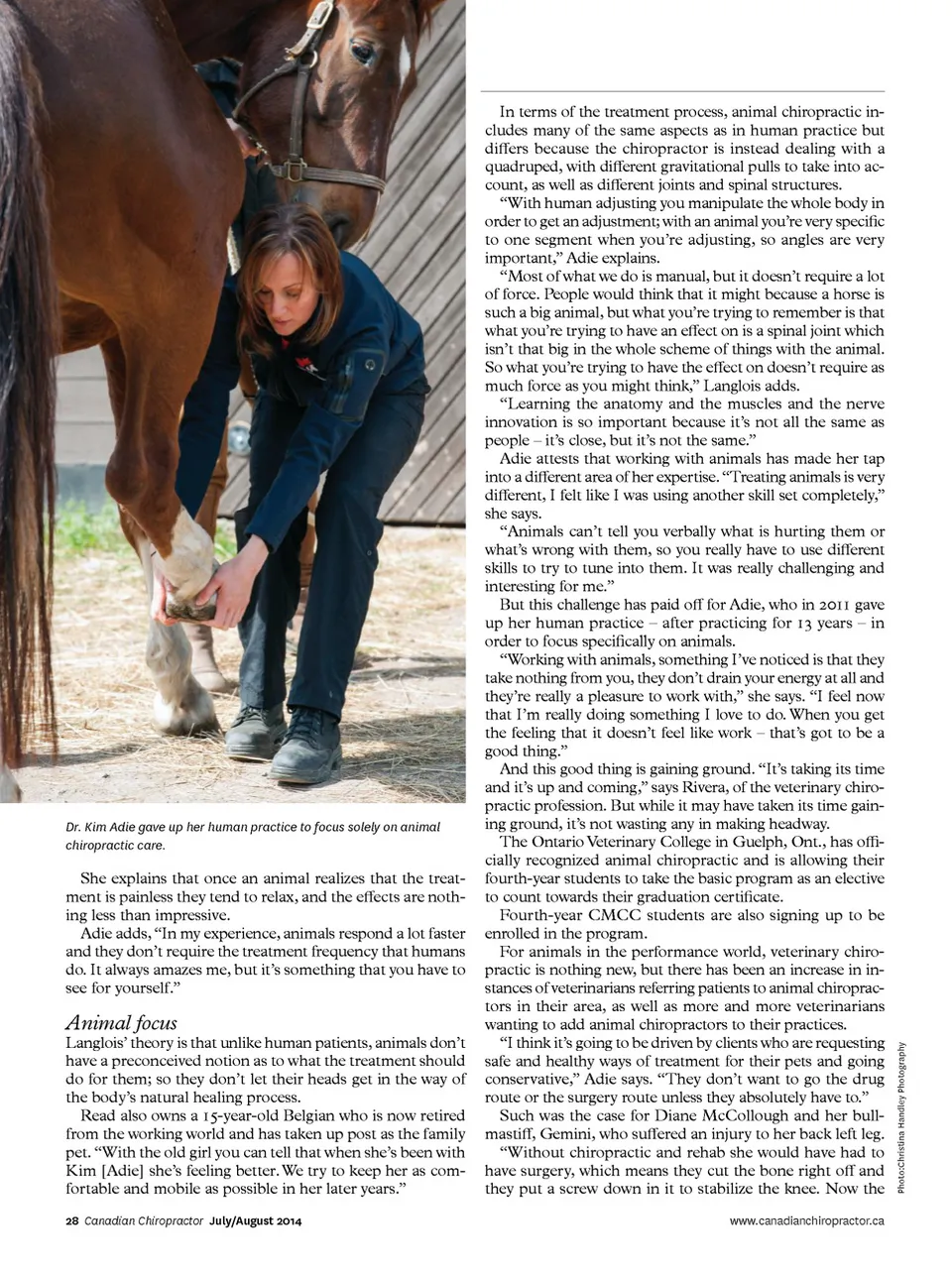
bigger the dog the higher the percentage that they blow the other side, just because they have to do all the weight bear-ing on the other side,” she explains. “And with rehab they don’t, they actually use the leg and try to build up the muscle around that area to support it. So Gemini never had to go through all of that horrible surgery, and never mind she probably would have had to have it twice.” “Personally I would feel that it would be incompetent and negligent if a veterinarian does not provide or give direction to the owner of where to go (for their pet) to be treated when it comes to chiropractic, or spinal manipula-tion or acupuncture or rehab,” says Rivera. A rising breed The College of Animal Chiropractors (COAC) was re-cently established to help build the profession’s reputation, raise awareness and provide member resources. Rivera, Adie and Langlois share a palpable passion for their work and an intense love for animals; however, the three practitioners also share a common concern. The trio stresses the need for the public to become aware and involved about the decision to see an animal chiroprac-tor. They warn against those practicing who have gone to weekend courses or those who have attended their program, or others like theirs, but have not passed. “There are a number of courses out there that are being offered for veterinarians, chiropractors and lay people and calling it animal chiropractic and they might be just weekend courses and that sort of thing,” Langlois said. “That’s out there and we are trying to set ourselves apart from that sort of weekend-warrior type of education, and let people know that there are certain standards that we are trying to establish in animal chiropractic.” Rivera echoes her sentiment, stating that all too often clients blindly accept that these people are suitable to per-form this type of treatment, and stresses the importance of asking to see proper certification. “You’d be surprised by the ignorance that is out there and the charlatans that are out there and the sad thing is that people think these are professionals,” he said. An interested client can pull up a list of licensed graduates on any of the accredited programs’ websites, or on the COAC site. If the person claiming to be an animal chiro-practor is not on that list, do not trust them to perform chiropractic care on an animal. With increased awareness and recognition, the veterinary chiropractic profession has a bright future ahead, and for chiropractors planning to make a future in the profession, it can be incredibly rewarding. “When you see what you can do for an animal and you see how many animals are euthanized before their time, when you know that there’s something you can do to help change the quality of life for an animal,” says Adie. “That’s huge.” To learn more about veterinary chiropractic or the VCLC go to veterinarychiropractic.ca or collegeofanimalchiro-practors.org. “For us, at VCLC, we want to keep evolving and keep bettering our program and eventually offer more continu-ing education opportunities and put animal chiropractic on the map,” says Langlois. July/August 2014 Canadian Chiropractor 29 Canadian Memorial Chiropractic College
Chiropractic + Naturopathic Doctor July August 2014: Page 29