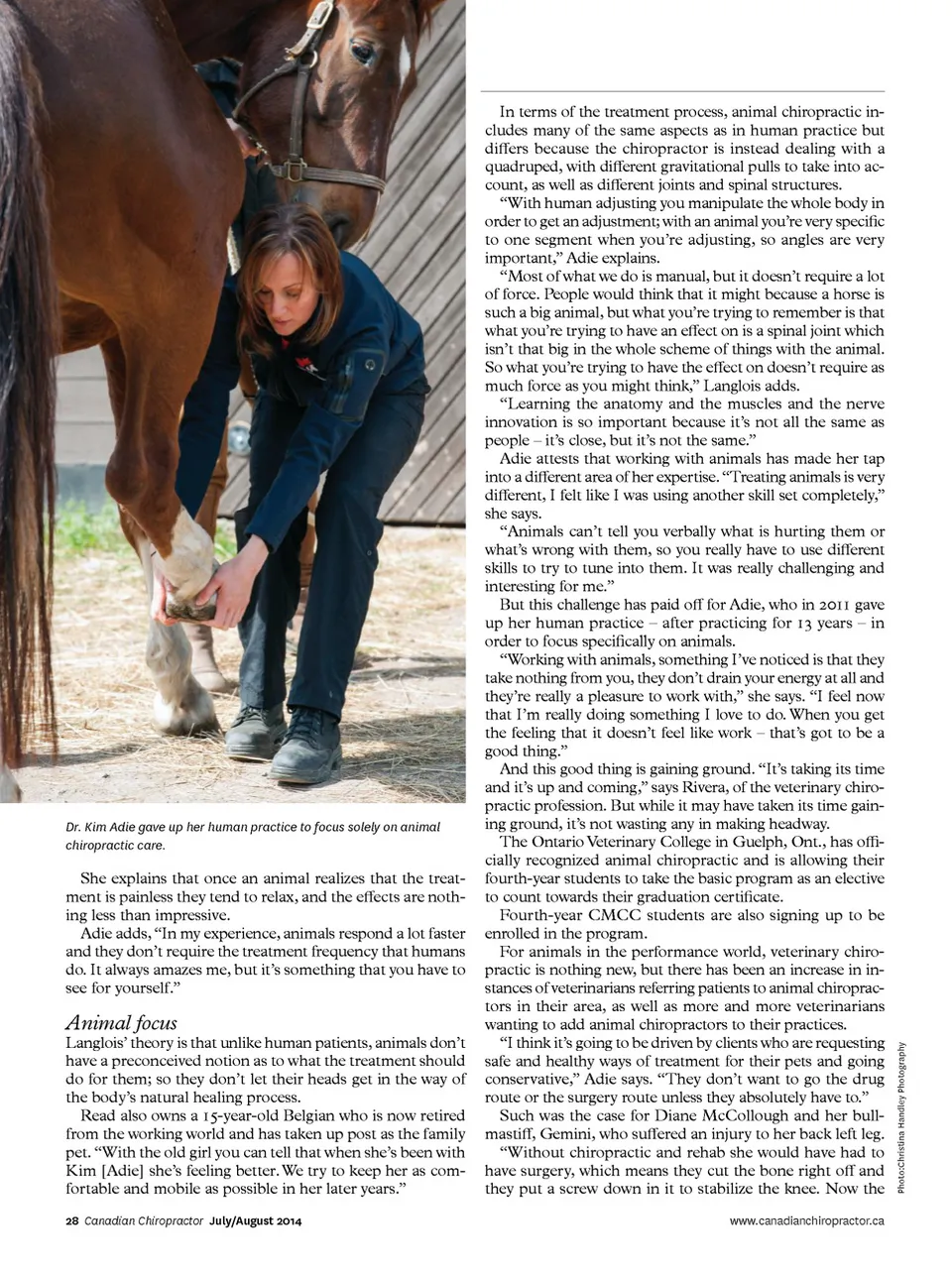
Dr. Kim Adie gave up her human practice to focus solely on animal chiropractic care. She explains that once an animal realizes that the treat-ment is painless they tend to relax, and the effects are noth-ing less than impressive. Adie adds, “In my experience, animals respond a lot faster and they don’t require the treatment frequency that humans do. It always amazes me, but it’s something that you have to see for yourself.” Animal focus Langlois’ theory is that unlike human patients, animals don’t have a preconceived notion as to what the treatment should do for them; so they don’t let their heads get in the way of the body’s natural healing process. Read also owns a 15-year-old Belgian who is now retired from the working world and has taken up post as the family pet. “With the old girl you can tell that when she’s been with Kim [Adie] she’s feeling better. We try to keep her as com-fortable and mobile as possible in her later years.” 28 Canadian Chiropractor July/August 2014 In terms of the treatment process, animal chiropractic in-cludes many of the same aspects as in human practice but differs because the chiropractor is instead dealing with a quadruped, with different gravitational pulls to take into ac-count, as well as different joints and spinal structures. “With human adjusting you manipulate the whole body in order to get an adjustment; with an animal you’re very specific to one segment when you’re adjusting, so angles are very important,” Adie explains. “Most of what we do is manual, but it doesn’t require a lot of force. People would think that it might because a horse is such a big animal, but what you’re trying to remember is that what you’re trying to have an effect on is a spinal joint which isn’t that big in the whole scheme of things with the animal. So what you’re trying to have the effect on doesn’t require as much force as you might think,” Langlois adds. “Learning the anatomy and the muscles and the nerve innovation is so important because it’s not all the same as people – it’s close, but it’s not the same.” Adie attests that working with animals has made her tap into a different area of her expertise. “Treating animals is very different, I felt like I was using another skill set completely,” she says. “Animals can’t tell you verbally what is hurting them or what’s wrong with them, so you really have to use different skills to try to tune into them. It was really challenging and interesting for me.” But this challenge has paid off for Adie, who in 2011 gave up her human practice – after practicing for 13 years – in order to focus specifically on animals. “Working with animals, something I’ve noticed is that they take nothing from you, they don’t drain your energy at all and they’re really a pleasure to work with,” she says. “I feel now that I’m really doing something I love to do. When you get the feeling that it doesn’t feel like work – that’s got to be a good thing.” And this good thing is gaining ground. “It’s taking its time and it’s up and coming,” says Rivera, of the veterinary chiro-practic profession. But while it may have taken its time gain-ing ground, it’s not wasting any in making headway. The Ontario Veterinary College in Guelph, Ont., has offi-cially recognized animal chiropractic and is allowing their fourth-year students to take the basic program as an elective to count towards their graduation certificate. Fourth-year CMCC students are also signing up to be enrolled in the program. For animals in the performance world, veterinary chiro-practic is nothing new, but there has been an increase in in-stances of veterinarians referring patients to animal chiroprac-tors in their area, as well as more and more veterinarians wanting to add animal chiropractors to their practices. “I think it’s going to be driven by clients who are requesting safe and healthy ways of treatment for their pets and going conservative,” Adie says. “They don’t want to go the drug route or the surgery route unless they absolutely have to.” Such was the case for Diane McCollough and her bull-mastiff, Gemini, who suffered an injury to her back left leg. “Without chiropractic and rehab she would have had to have surgery, which means they cut the bone right off and they put a screw down in it to stabilize the knee. Now the www.canadianchiropractor.ca Photo:Christina Handley Photography
Chiropractic + Naturopathic Doctor July August 2014: Page 28