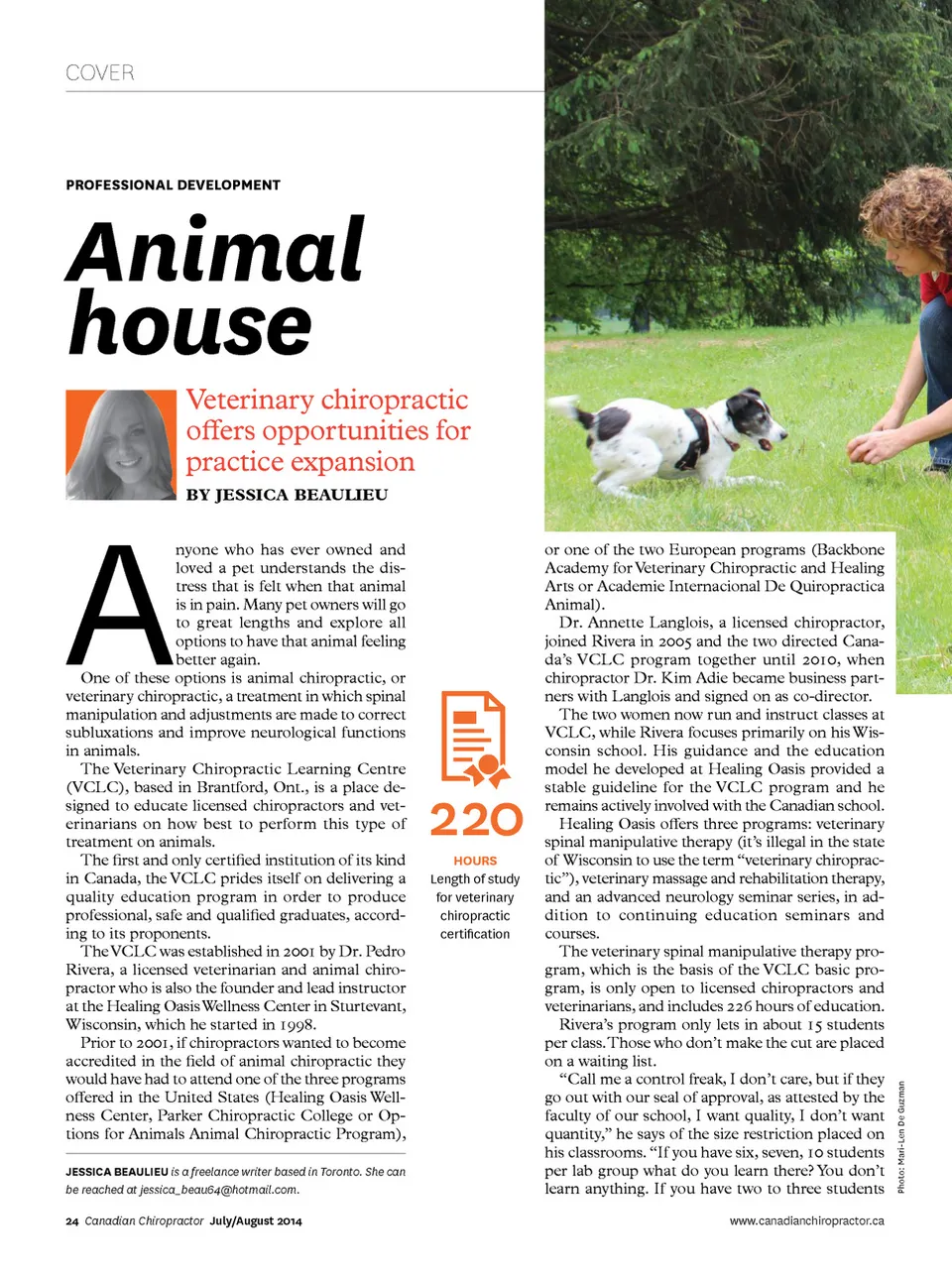
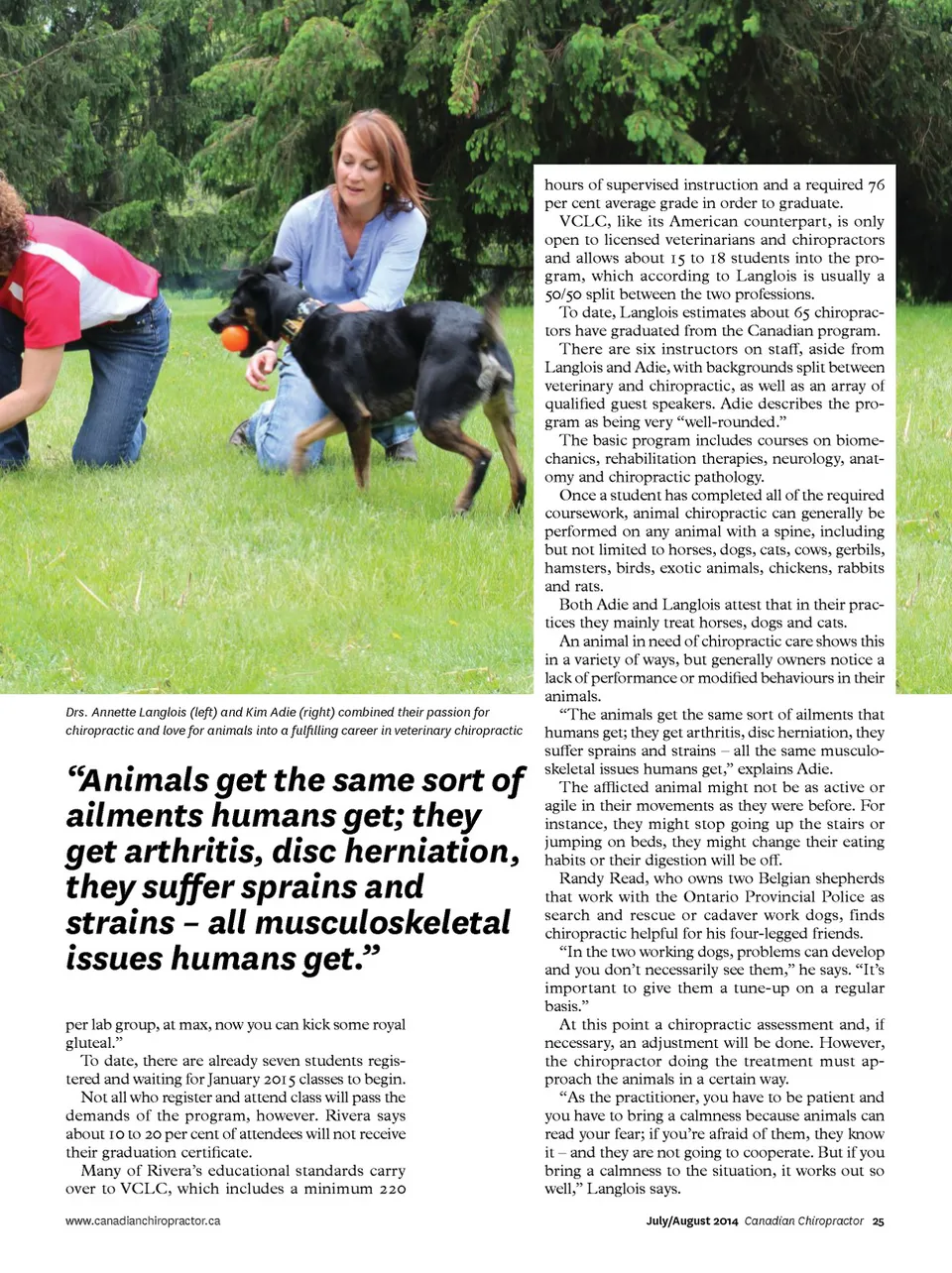
Drs. Annette Langlois (left) and Kim Adie (right) combined their passion for chiropractic and love for animals into a fulfilling career in veterinary chiropractic “Animals get the same sort of ailments humans get; they get arthritis, disc herniation, they suffer sprains and strains – all musculoskeletal issues humans get.” per lab group, at max, now you can kick some royal gluteal.” To date, there are already seven students regis-tered and waiting for January 2015 classes to begin. Not all who register and attend class will pass the demands of the program, however. Rivera says about 10 to 20 per cent of attendees will not receive their graduation certificate. Many of Rivera’s educational standards carry over to VCLC, which includes a minimum 220 www.canadianchiropractor.ca hours of supervised instruction and a required 76 per cent average grade in order to graduate. VCLC, like its American counterpart, is only open to licensed veterinarians and chiropractors and allows about 15 to 18 students into the pro-gram, which according to Langlois is usually a 50/50 split between the two professions. To date, Langlois estimates about 65 chiroprac-tors have graduated from the Canadian program. There are six instructors on staff, aside from Langlois and Adie, with backgrounds split between veterinary and chiropractic, as well as an array of qualified guest speakers. Adie describes the pro-gram as being very “well-rounded.” The basic program includes courses on biome-chanics, rehabilitation therapies, neurology, anat-omy and chiropractic pathology. Once a student has completed all of the required coursework, animal chiropractic can generally be performed on any animal with a spine, including but not limited to horses, dogs, cats, cows, gerbils, hamsters, birds, exotic animals, chickens, rabbits and rats. Both Adie and Langlois attest that in their prac-tices they mainly treat horses, dogs and cats. An animal in need of chiropractic care shows this in a variety of ways, but generally owners notice a lack of performance or modified behaviours in their animals. “The animals get the same sort of ailments that humans get; they get arthritis, disc herniation, they suffer sprains and strains – all the same musculo-skeletal issues humans get,” explains Adie. The afflicted animal might not be as active or agile in their movements as they were before. For instance, they might stop going up the stairs or jumping on beds, they might change their eating habits or their digestion will be off. Randy Read, who owns two Belgian shepherds that work with the Ontario Provincial Police as search and rescue or cadaver work dogs, finds chiropractic helpful for his four-legged friends. “In the two working dogs, problems can develop and you don’t necessarily see them,” he says. “It’s important to give them a tune-up on a regular basis.” At this point a chiropractic assessment and, if necessary, an adjustment will be done. However, the chiropractor doing the treatment must ap-proach the animals in a certain way. “As the practitioner, you have to be patient and you have to bring a calmness because animals can read your fear; if you’re afraid of them, they know it – and they are not going to cooperate. But if you bring a calmness to the situation, it works out so well,” Langlois says. July/August 2014 Canadian Chiropractor 25
Chiropractic + Naturopathic Doctor July August 2014: Page 25