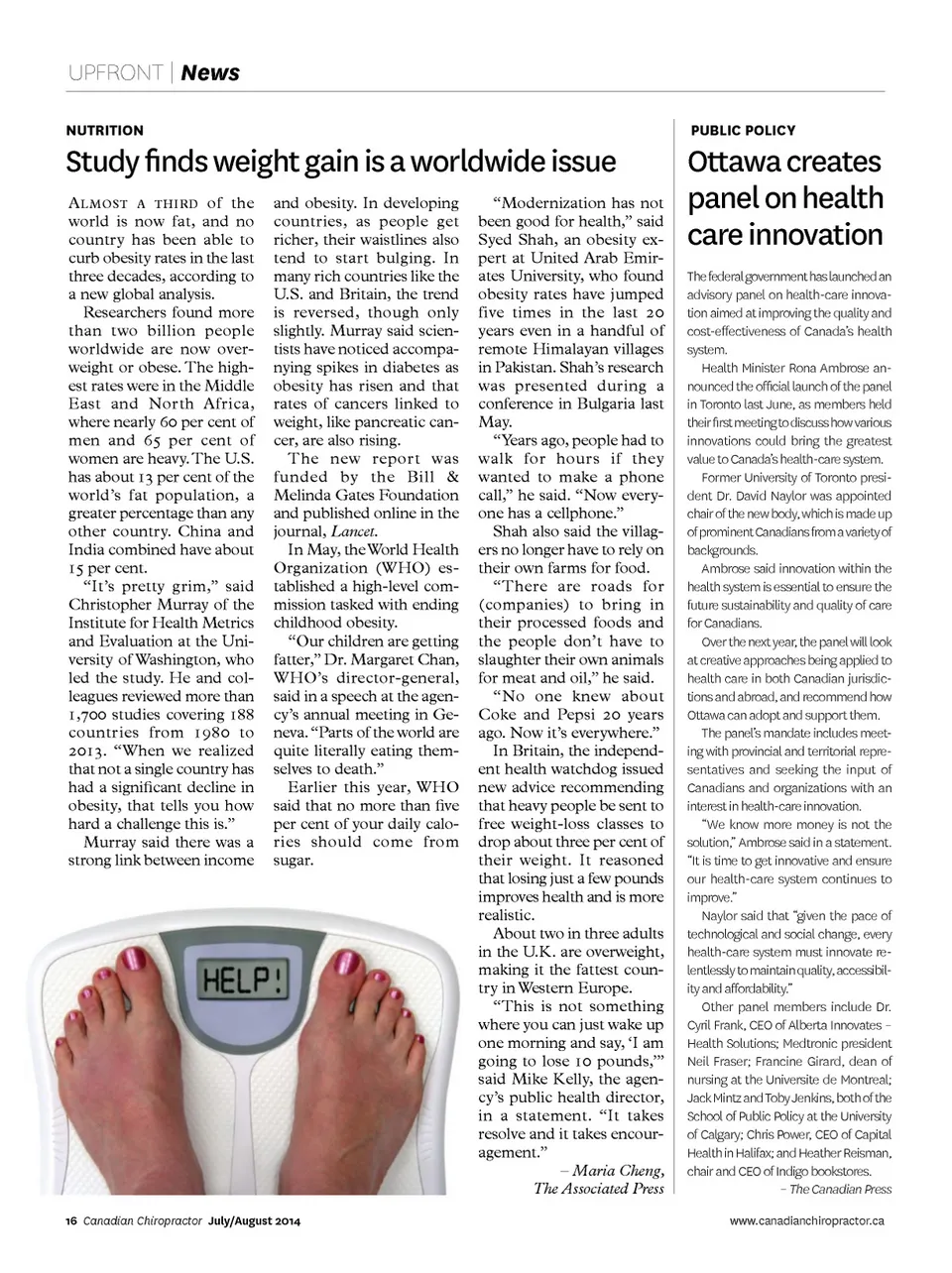
UPFRONT | News NUTRITION Study finds weight gain is a worldwide issue Almost a third of the world is now fat, and no country has been able to curb obesity rates in the last three decades, according to a new global analysis. Researchers found more than two billion people worldwide are now over-weight or obese. The high-est rates were in the Middle East and North Africa, where nearly 60 per cent of men and 65 per cent of women are heavy. The U.S. has about 13 per cent of the world’s fat population, a greater percentage than any other country. China and India combined have about 15 per cent. “It’s pretty grim,” said Christopher Murray of the Institute for Health Metrics and Evaluation at the Uni-versity of Washington, who led the study. He and col-leagues reviewed more than 1,700 studies covering 188 countries from 1980 to 2013. “When we realized that not a single country has had a significant decline in obesity, that tells you how hard a challenge this is.” Murray said there was a strong link between income and obesity. In developing countries, as people get richer, their waistlines also tend to start bulging. In many rich countries like the U.S. and Britain, the trend is reversed, though only slightly. Murray said scien-tists have noticed accompa-nying spikes in diabetes as obesity has risen and that rates of cancers linked to weight, like pancreatic can-cer, are also rising. The new repor t was funded by the Bill & Melinda Gates Foundation and published online in the journal, Lancet. In May, the World Health Organization (WHO) es-tablished a high-level com-mission tasked with ending childhood obesity. “Our children are getting fatter,” Dr. Margaret Chan, WHO’s director-general, said in a speech at the agen-cy’s annual meeting in Ge-neva. “Parts of the world are quite literally eating them-selves to death.” Earlier this year, WHO said that no more than five per cent of your daily calo-ries should come from sugar. “Modernization has not been good for health,” said Syed Shah, an obesity ex-pert at United Arab Emir-ates University, who found obesity rates have jumped five times in the last 20 years even in a handful of remote Himalayan villages in Pakistan. Shah’s research was presented during a conference in Bulgaria last May. “Years ago, people had to walk for hours if they wanted to make a phone call,” he said. “Now every-one has a cellphone.” Shah also said the villag-ers no longer have to rely on their own farms for food. “There are roads for (companies) to bring in their processed foods and the people don’t have to slaughter their own animals for meat and oil,” he said. “No one knew about Coke and Pepsi 20 years ago. Now it’s everywhere.” In Britain, the independ-ent health watchdog issued new advice recommending that heavy people be sent to free weight-loss classes to drop about three per cent of their weight. It reasoned that losing just a few pounds improves health and is more realistic. About two in three adults in the U.K. are overweight, making it the fattest coun-try in Western Europe. “This is not something where you can just wake up one morning and say, ‘I am going to lose 10 pounds,’” said Mike Kelly, the agen-cy’s public health director, in a statement. “It takes resolve and it takes encour-agement.” – Maria Cheng, The Associated Press Ottawa creates panel on health care innovation The federal government has launched an advisory panel on health-care innova-tion aimed at improving the quality and cost-effectiveness of Canada’s health system. Health Minister Rona Ambrose an-nounced the official launch of the panel in Toronto last June, as members held their first meeting to discuss how various innovations could bring the greatest value to Canada’s health-care system. Former University of Toronto presi-dent Dr. David Naylor was appointed chair of the new body, which is made up of prominent Canadians from a variety of backgrounds. Ambrose said innovation within the health system is essential to ensure the future sustainability and quality of care for Canadians. Over the next year, the panel will look at creative approaches being applied to health care in both Canadian jurisdic-tions and abroad, and recommend how Ottawa can adopt and support them. The panel’s mandate includes meet-ing with provincial and territorial repre-sentatives and seeking the input of Canadians and organizations with an interest in health-care innovation. “We know more money is not the solution,” Ambrose said in a statement. “It is time to get innovative and ensure our health-care system continues to improve.” Naylor said that “given the pace of technological and social change, every health-care system must innovate re-lentlessly to maintain quality, accessibil-ity and affordability.” Other panel members include Dr. Cyril Frank, CEO of Alberta Innovates – Health Solutions; Medtronic president Neil Fraser; Francine Girard, dean of nursing at the Universite de Montreal; Jack Mintz and Toby Jenkins, both of the School of Public Policy at the University of Calgary; Chris Power, CEO of Capital Health in Halifax; and Heather Reisman, chair and CEO of Indigo bookstores. – The Canadian Press www.canadianchiropractor.ca PUBLIC POLICY 16 Canadian Chiropractor July/August 2014
Chiropractic + Naturopathic Doctor July August 2014: Page 16