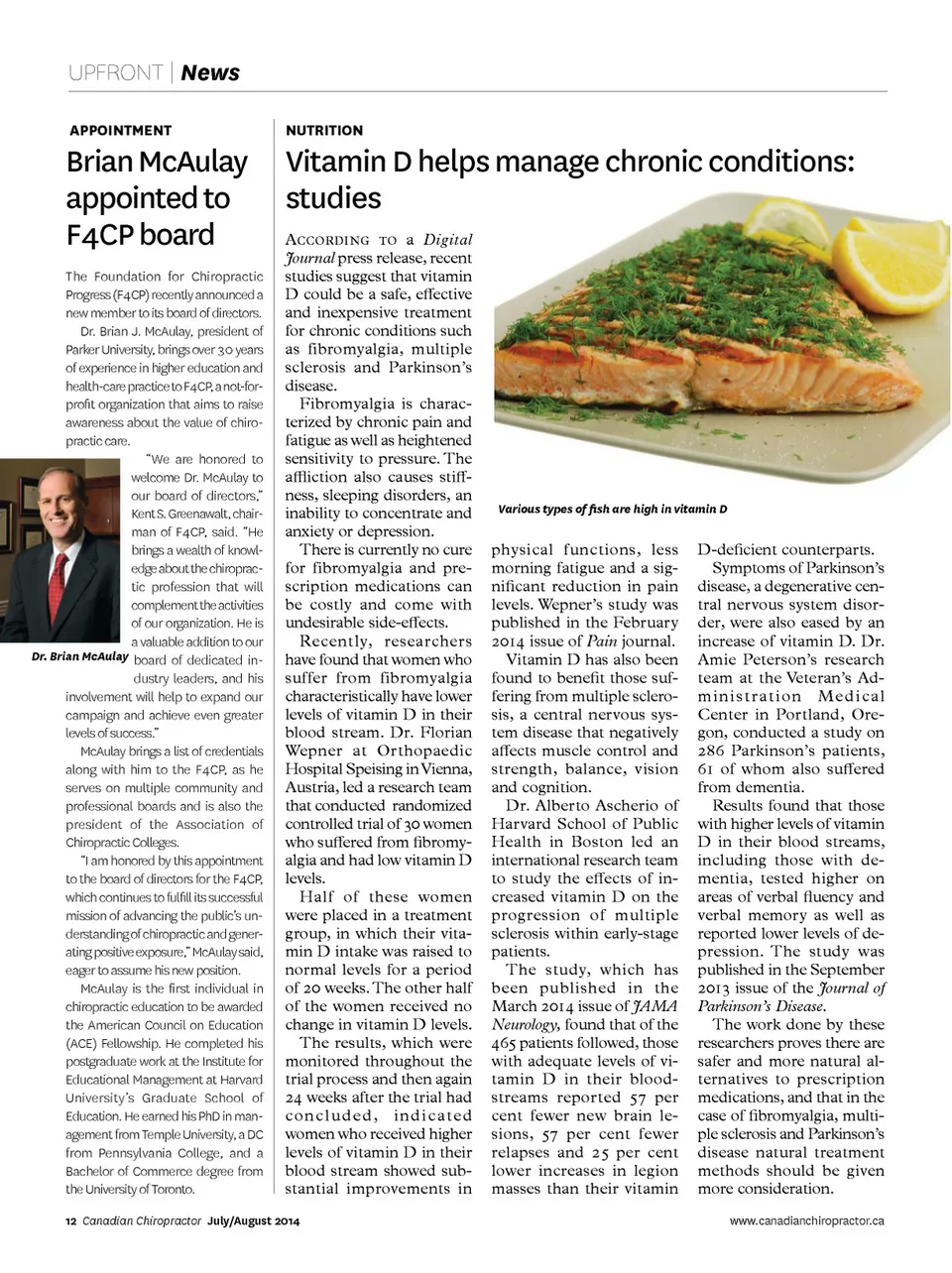
UPFRONT | News Brian McAulay appointed to F4CP board The Foundation for Chiropractic Progress (F4CP) recently announced a new member to its board of directors. Dr. Brian J. McAulay, president of Parker University, brings over 30 years of experience in higher education and health-care practice to F4CP, a not-for-profit organization that aims to raise awareness about the value of chiro-practic care. “We are honored to welcome Dr. McAulay to our board of directors,” Kent S. Greenawalt, chair-man of F4CP, said. “He brings a wealth of knowl-edge about the chiroprac-tic profession that will complement the activities of our organization. He is a valuable addition to our Dr. Brian McAulay board of dedicated in-dustry leaders, and his involvement will help to expand our campaign and achieve even greater levels of success.” McAulay brings a list of credentials along with him to the F4CP, as he serves on multiple community and professional boards and is also the president of the Association of Chiropractic Colleges. “I am honored by this appointment to the board of directors for the F4CP, which continues to fulfill its successful mission of advancing the public’s un-derstanding of chiropractic and gener-ating positive exposure,” McAulay said, eager to assume his new position. McAulay is the first individual in chiropractic education to be awarded the American Council on Education (ACE) Fellowship. He completed his postgraduate work at the Institute for Educational Management at Harvard University’s Graduate School of Education. He earned his PhD in man-agement from Temple University, a DC from Pennsylvania College, and a Bachelor of Commerce degree from the University of Toronto. APPOINTMENT NUTRITION Vitamin D helps manage chronic conditions: studies According to a Digital Journal press release, recent studies suggest that vitamin D could be a safe, effective and inexpensive treatment for chronic conditions such as fibromyalgia, multiple sclerosis and Parkinson’s disease. Fibromyalgia is charac-terized by chronic pain and fatigue as well as heightened sensitivity to pressure. The affliction also causes stiff-ness, sleeping disorders, an inability to concentrate and anxiety or depression. There is currently no cure for fibromyalgia and pre-scription medications can be costly and come with undesirable side-effects. Recently, researchers have found that women who suffer from fibromyalgia characteristically have lower levels of vitamin D in their blood stream. Dr. Florian Wepner at Orthopaedic Hospital Speising in Vienna, Austria, led a research team that conducted randomized controlled trial of 30 women who suffered from fibromy-algia and had low vitamin D levels. Half of these women were placed in a treatment group, in which their vita-min D intake was raised to normal levels for a period of 20 weeks. The other half of the women received no change in vitamin D levels. The results, which were monitored throughout the trial process and then again 24 weeks after the trial had concluded, indicated women who received higher levels of vitamin D in their blood stream showed sub-stantial improvements in Various types of fish are high in vitamin D physical functions, less morning fatigue and a sig-nificant reduction in pain levels. Wepner’s study was published in the February 2014 issue of Pain journal . Vitamin D has also been found to benefit those suf-fering from multiple sclero-sis, a central nervous sys-tem disease that negatively affects muscle control and strength, balance, vision and cognition. Dr. Alberto Ascherio of Harvard School of Public Health in Boston led an international research team to study the effects of in-creased vitamin D on the progression of multiple sclerosis within early-stage patients. The study, which has been published in the March 2014 issue of JAMA Neurology, found that of the 465 patients followed, those with adequate levels of vi-tamin D in their blood-streams reported 57 per cent fewer new brain le-sions, 57 per cent fewer relapses and 25 per cent lower increases in legion masses than their vitamin D-deficient counterparts. Symptoms of Parkinson’s disease, a degenerative cen-tral nervous system disor-der, were also eased by an increase of vitamin D. Dr. Amie Peterson’s research team at the Veteran’s Ad-ministration Medical Center in Portland, Ore-gon, conducted a study on 286 Parkinson’s patients, 61 of whom also suffered from dementia. Results found that those with higher levels of vitamin D in their blood streams, including those with de-mentia, tested higher on areas of verbal fluency and verbal memory as well as reported lower levels of de-pression. The study was published in the September 2013 issue of the Journal of Parkinson’s Disease. The work done by these researchers proves there are safer and more natural al-ternatives to prescription medications, and that in the case of fibromyalgia, multi-ple sclerosis and Parkinson’s disease natural treatment methods should be given more consideration. www.canadianchiropractor.ca 12 Canadian Chiropractor July/August 2014
Chiropractic + Naturopathic Doctor July August 2014: Page 12