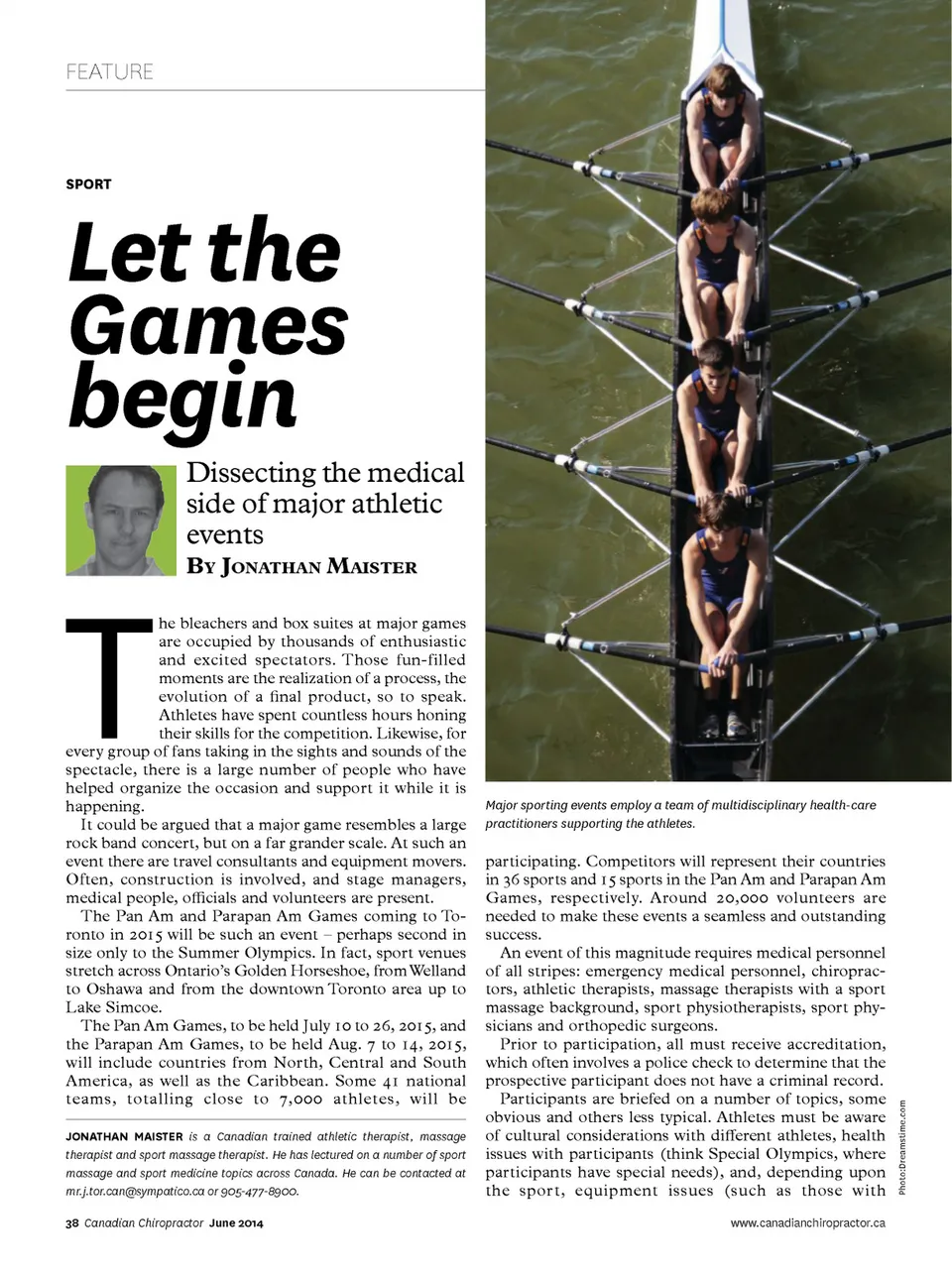
FEATURE SPORT Let the Games begin T Dissecting the medical side of major athletic events B y J onathan M aister JONATHAN MAISTER is a Canadian trained athletic therapist, massage therapist and sport massage therapist. He has lectured on a number of sport massage and sport medicine topics across Canada. He can be contacted at [email protected] or 905-477-8900. 38 Canadian Chiropractor June 2014 www.canadianchiropractor.ca Photo:Dreamstime.com he bleachers and box suites at major games are occupied by thousands of enthusiastic and excited spectators. Those fun-filled moments are the realization of a process, the evolution of a final product, so to speak. Athletes have spent countless hours honing their skills for the competition. Likewise, for every group of fans taking in the sights and sounds of the spectacle, there is a large number of people who have helped organize the occasion and support it while it is happening. It could be argued that a major game resembles a large rock band concert, but on a far grander scale. At such an event there are travel consultants and equipment movers. Often, construction is involved, and stage managers, medical people, officials and volunteers are present. The Pan Am and Parapan Am Games coming to To-ronto in 2015 will be such an event – perhaps second in size only to the Summer Olympics. In fact, sport venues stretch across Ontario’s Golden Horseshoe, from Welland to Oshawa and from the downtown Toronto area up to Lake Simcoe. The Pan Am Games, to be held July 10 to 26, 2015, and the Parapan Am Games, to be held Aug. 7 to 14, 2015, will include countries from North, Central and South America, as well as the Caribbean. Some 41 national teams, totalling close to 7,000 athletes, will be Major sporting events employ a team of multidisciplinary health-care practitioners supporting the athletes. participating. Competitors will represent their countries in 36 sports and 15 sports in the Pan Am and Parapan Am Games, respectively. Around 20,000 volunteers are needed to make these events a seamless and outstanding success. An event of this magnitude requires medical personnel of all stripes: emergency medical personnel, chiroprac-tors, athletic therapists, massage therapists with a sport massage background, sport physiotherapists, sport phy-sicians and orthopedic surgeons. Prior to participation, all must receive accreditation, which often involves a police check to determine that the prospective participant does not have a criminal record. Participants are briefed on a number of topics, some obvious and others less typical. Athletes must be aware of cultural considerations with different athletes, health issues with participants (think Special Olympics, where participants have special needs), and, depending upon the spor t, equipment issues (such as those with
Chiropractic + Naturopathic Doctor June 2014: Page 38