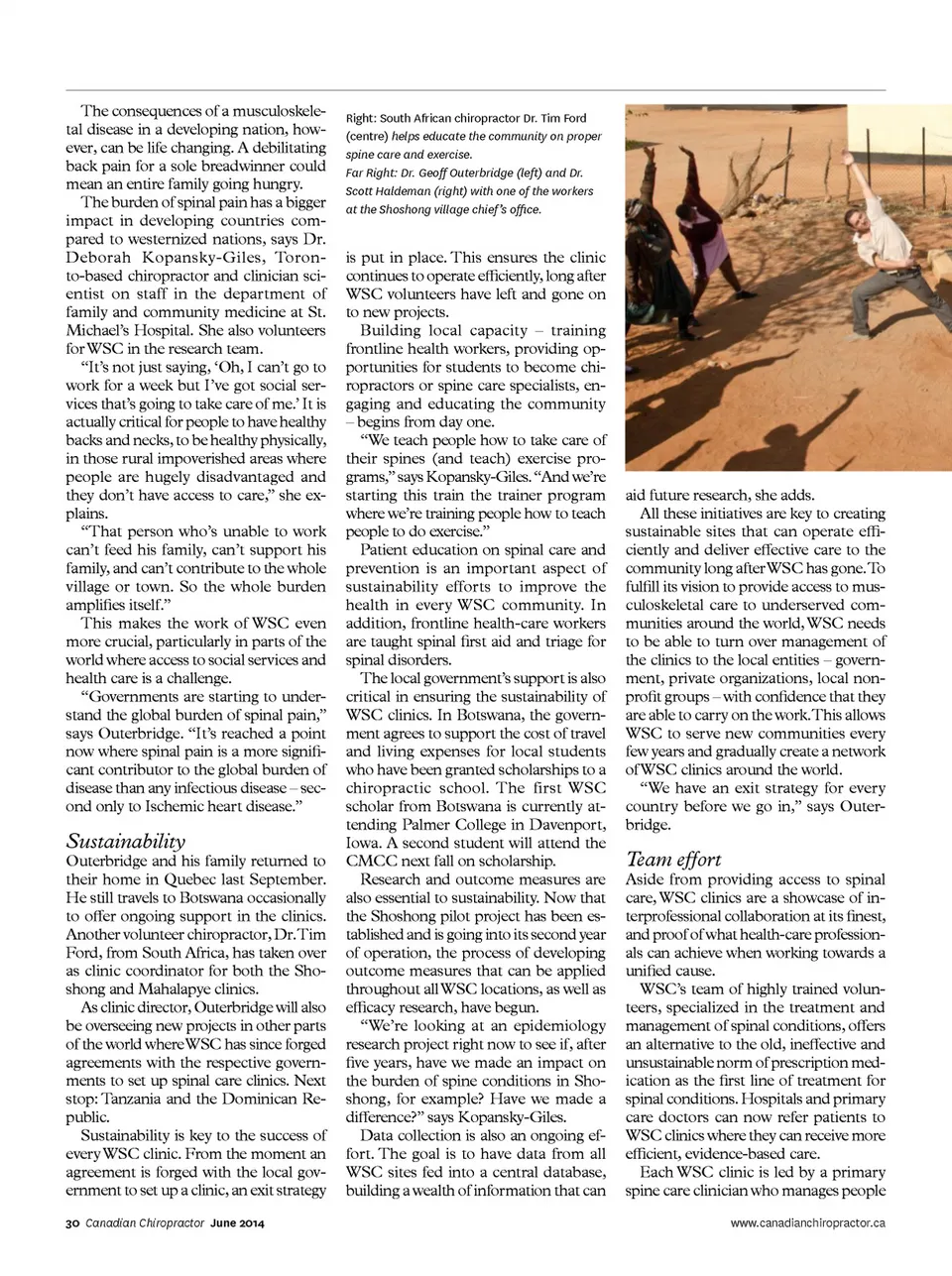
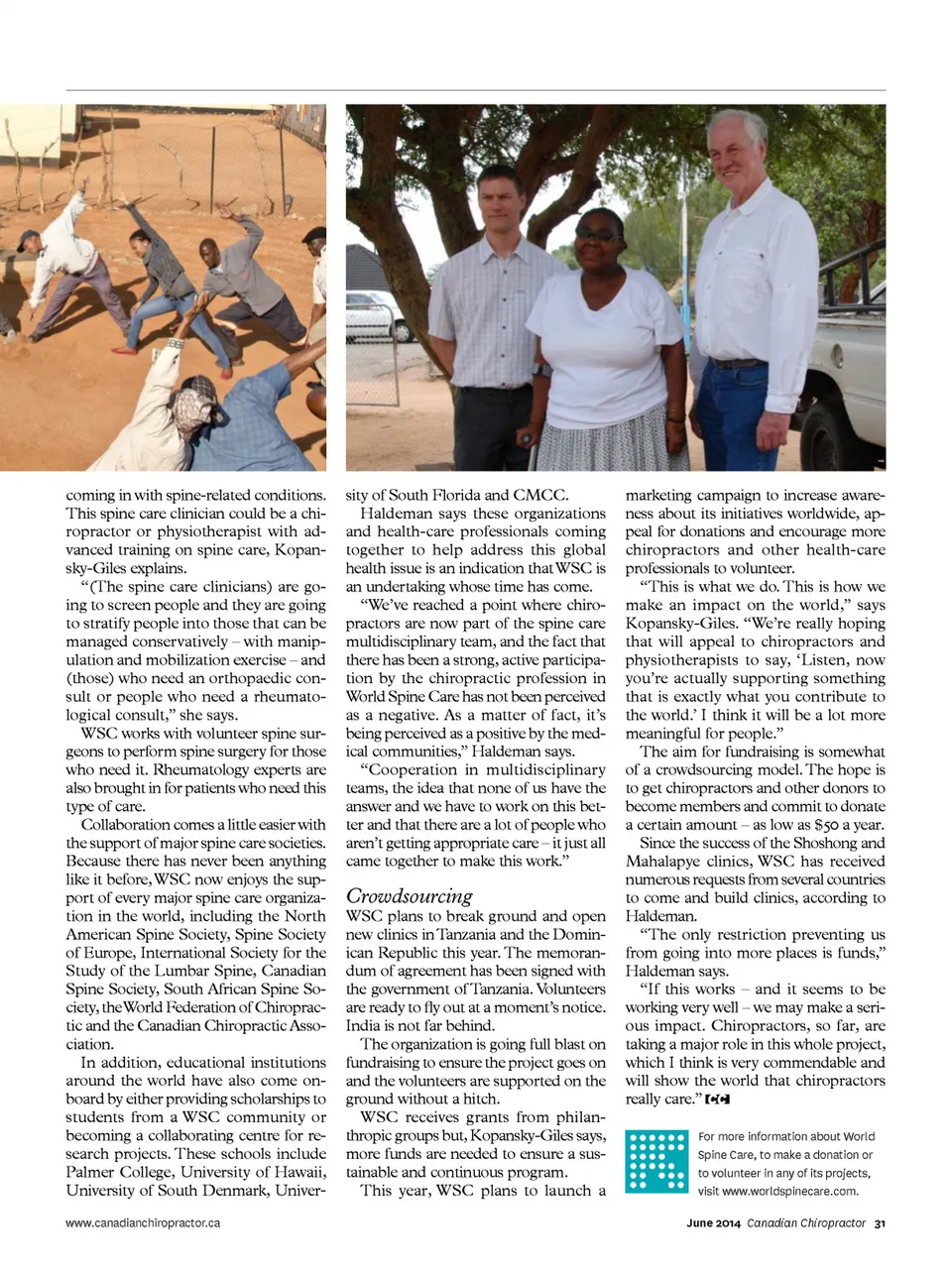
The consequences of a musculoskele-tal disease in a developing nation, how-ever, can be life changing. A debilitating back pain for a sole breadwinner could mean an entire family going hungry. The burden of spinal pain has a bigger impact in developing countries com-pared to westernized nations, says Dr. Deborah Kopansky-Giles, Toron-to-based chiropractor and clinician sci-entist on staff in the department of family and community medicine at St. Michael’s Hospital. She also volunteers for WSC in the research team. “It’s not just saying, ‘Oh, I can’t go to work for a week but I’ve got social ser-vices that’s going to take care of me.’ It is actually critical for people to have healthy backs and necks, to be healthy physically, in those rural impoverished areas where people are hugely disadvantaged and they don’t have access to care,” she ex-plains. “That person who’s unable to work can’t feed his family, can’t support his family, and can’t contribute to the whole village or town. So the whole burden amplifies itself.” This makes the work of WSC even more crucial, particularly in parts of the world where access to social services and health care is a challenge. “Governments are starting to under-stand the global burden of spinal pain,” says Outerbridge. “It’s reached a point now where spinal pain is a more signifi-cant contributor to the global burden of disease than any infectious disease – sec-ond only to Ischemic heart disease.” Right: South African chiropractor Dr. Tim Ford (centre) helps educate the community on proper spine care and exercise. Far Right: Dr. Geoff Outerbridge (left) and Dr. Scott Haldeman (right) with one of the workers at the Shoshong village chief’s office. Sustainability Outerbridge and his family returned to their home in Quebec last September. He still travels to Botswana occasionally to offer ongoing support in the clinics. Another volunteer chiropractor, Dr. Tim Ford, from South Africa, has taken over as clinic coordinator for both the Sho-shong and Mahalapye clinics. As clinic director, Outerbridge will also be overseeing new projects in other parts of the world where WSC has since forged agreements with the respective govern-ments to set up spinal care clinics. Next stop: Tanzania and the Dominican Re-public. Sustainability is key to the success of every WSC clinic. From the moment an agreement is forged with the local gov-ernment to set up a clinic, an exit strategy 30 Canadian Chiropractor June 2014 is put in place. This ensures the clinic continues to operate efficiently, long after WSC volunteers have left and gone on to new projects. Building local capacity – training frontline health workers, providing op-portunities for students to become chi-ropractors or spine care specialists, en-gaging and educating the community – begins from day one. “We teach people how to take care of their spines (and teach) exercise pro-grams,” says Kopansky-Giles. “And we’re starting this train the trainer program where we’re training people how to teach people to do exercise.” Patient education on spinal care and prevention is an important aspect of sustainability efforts to improve the health in every WSC community. In addition, frontline health-care workers are taught spinal first aid and triage for spinal disorders. The local government’s support is also critical in ensuring the sustainability of WSC clinics. In Botswana, the govern-ment agrees to support the cost of travel and living expenses for local students who have been granted scholarships to a chiropractic school. The first WSC scholar from Botswana is currently at-tending Palmer College in Davenport, Iowa. A second student will attend the CMCC next fall on scholarship. Research and outcome measures are also essential to sustainability. Now that the Shoshong pilot project has been es-tablished and is going into its second year of operation, the process of developing outcome measures that can be applied throughout all WSC locations, as well as efficacy research, have begun. “We’re looking at an epidemiology research project right now to see if, after five years, have we made an impact on the burden of spine conditions in Sho-shong, for example? Have we made a difference?” says Kopansky-Giles. Data collection is also an ongoing ef-fort. The goal is to have data from all WSC sites fed into a central database, building a wealth of information that can aid future research, she adds. All these initiatives are key to creating sustainable sites that can operate effi-ciently and deliver effective care to the community long after WSC has gone. To fulfill its vision to provide access to mus-culoskeletal care to underserved com-munities around the world, WSC needs to be able to turn over management of the clinics to the local entities – govern-ment, private organizations, local non-profit groups – with confidence that they are able to carry on the work. This allows WSC to serve new communities every few years and gradually create a network of WSC clinics around the world. “We have an exit strategy for every country before we go in,” says Outer-bridge. Aside from providing access to spinal care, WSC clinics are a showcase of in-terprofessional collaboration at its finest, and proof of what health-care profession-als can achieve when working towards a unified cause. WSC’s team of highly trained volun-teers, specialized in the treatment and management of spinal conditions, offers an alternative to the old, ineffective and unsustainable norm of prescription med-ication as the first line of treatment for spinal conditions. Hospitals and primary care doctors can now refer patients to WSC clinics where they can receive more efficient, evidence-based care. Each WSC clinic is led by a primary spine care clinician who manages people www.canadianchiropractor.ca Team effort
Chiropractic + Naturopathic Doctor June 2014: Page 30