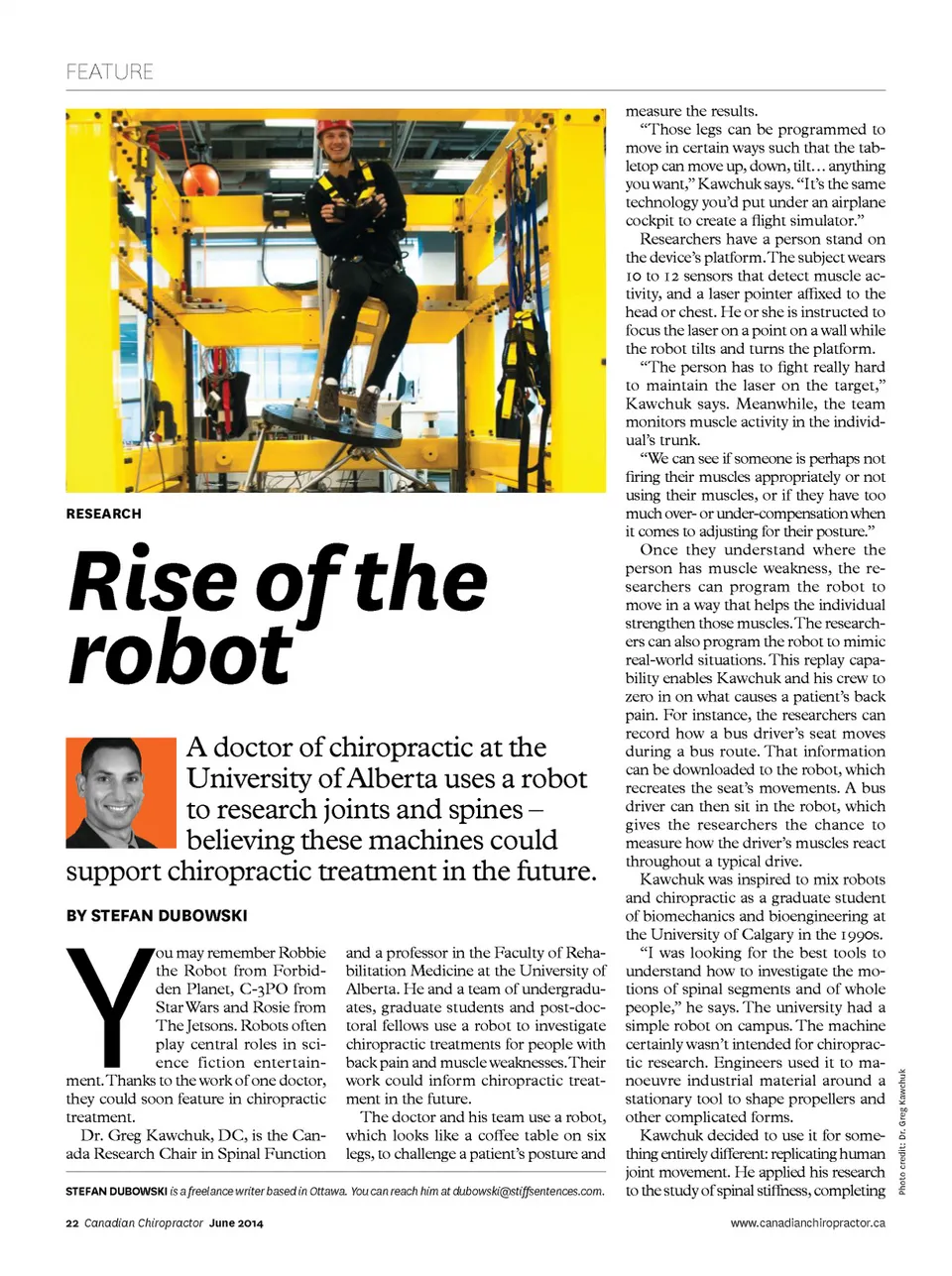
FEATURE measure the results. “Those legs can be programmed to move in certain ways such that the tab-letop can move up, down, tilt… anything you want,” Kawchuk says. “It’s the same technology you’d put under an airplane cockpit to create a flight simulator.” Researchers have a person stand on the device’s platform. The subject wears 10 to 12 sensors that detect muscle ac-tivity, and a laser pointer affixed to the head or chest. He or she is instructed to focus the laser on a point on a wall while the robot tilts and turns the platform. “The person has to fight really hard to maintain the laser on the target,” Kawchuk says. Meanwhile, the team monitors muscle activity in the individ-ual’s trunk. “We can see if someone is perhaps not firing their muscles appropriately or not using their muscles, or if they have too much over-or under-compensation when it comes to adjusting for their posture.” Once they understand where the person has muscle weakness, the re-searchers can program the robot to move in a way that helps the individual strengthen those muscles. The research-ers can also program the robot to mimic real-world situations. This replay capa-bility enables Kawchuk and his crew to zero in on what causes a patient’s back pain. For instance, the researchers can record how a bus driver’s seat moves during a bus route. That information can be downloaded to the robot, which recreates the seat’s movements. A bus driver can then sit in the robot, which gives the researchers the chance to measure how the driver’s muscles react throughout a typical drive. Kawchuk was inspired to mix robots and chiropractic as a graduate student of biomechanics and bioengineering at the University of Calgary in the 1990s. “I was looking for the best tools to understand how to investigate the mo-tions of spinal segments and of whole people,” he says. The university had a simple robot on campus. The machine certainly wasn’t intended for chiroprac-tic research. Engineers used it to ma-noeuvre industrial material around a stationary tool to shape propellers and other complicated forms. Kawchuk decided to use it for some-thing entirely different: replicating human joint movement. He applied his research to the study of spinal stiffness, completing www.canadianchiropractor.ca RESEARCH Rise of the robot STEFAN DUBOWSKI is a freelance writer based in Ottawa. You can reach him at [email protected]. 22 Canadian Chiropractor June 2014 Photo credit: Dr. Greg Kawchuk Y A doctor of chiropractic at the University of Alberta uses a robot to research joints and spines – believing these machines could support chiropractic treatment in the future. BY STEFAN DUBOWSKI and a professor in the Faculty of Reha-bilitation Medicine at the University of Alberta. He and a team of undergradu-ates, graduate students and post-doc-toral fellows use a robot to investigate chiropractic treatments for people with back pain and muscle weaknesses. Their work could inform chiropractic treat-ment in the future. The doctor and his team use a robot, which looks like a coffee table on six legs, to challenge a patient’s posture and ou may remember Robbie the Robot from Forbid-den Planet, C-3PO from Star Wars and Rosie from The Jetsons. Robots often play central roles in sci-ence fiction entertain-ment. Thanks to the work of one doctor, they could soon feature in chiropractic treatment. Dr. Greg Kawchuk, DC, is the Can-ada Research Chair in Spinal Function
Chiropractic + Naturopathic Doctor June 2014: Page 22