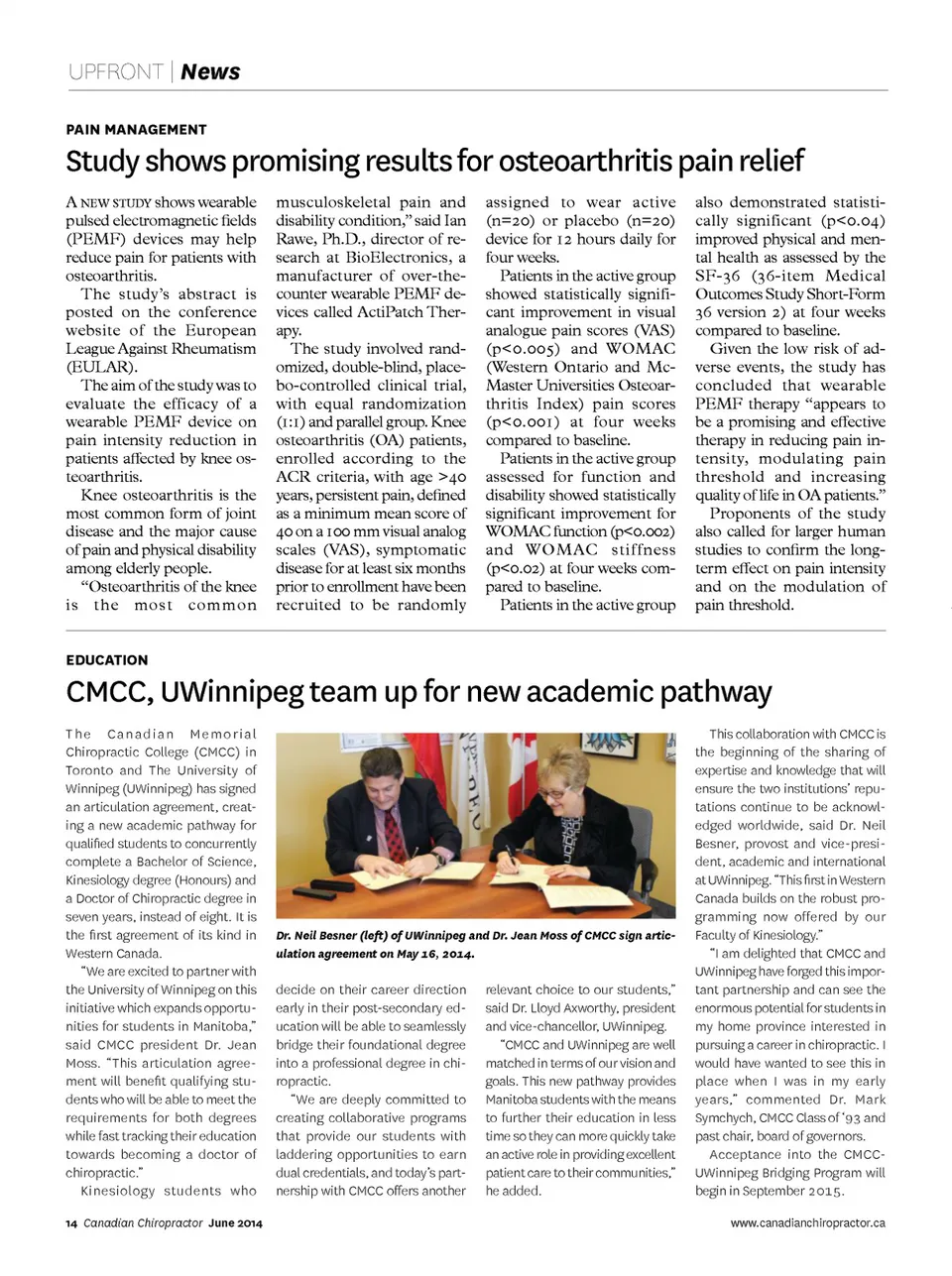
UPFRONT | News PAIN MANAGEMENT Study shows promising results for osteoarthritis pain relief A new study shows wearable pulsed electromagnetic fields (PEMF) devices may help reduce pain for patients with osteoarthritis. The study’s abstract is posted on the conference website of the European League Against Rheumatism (EULAR). The aim of the study was to evaluate the efficacy of a wearable PEMF device on pain intensity reduction in patients affected by knee os-teoarthritis. Knee osteoarthritis is the most common form of joint disease and the major cause of pain and physical disability among elderly people. “Osteoarthritis of the knee is the most common musculoskeletal pain and disability condition,” said Ian Rawe, Ph.D., director of re-search at BioElectronics, a manufacturer of over-the-counter wearable PEMF de-vices called ActiPatch Ther-apy. The study involved rand-omized, double-blind, place-bo-controlled clinical trial, with equal randomization (1:1) and parallel group. Knee osteoarthritis (OA) patients, enrolled according to the ACR criteria, with age >40 years, persistent pain, defined as a minimum mean score of 40 on a 100 mm visual analog scales (VAS), symptomatic disease for at least six months prior to enrollment have been recruited to be randomly assigned to wear active (n=20) or placebo (n=20) device for 12 hours daily for four weeks. Patients in the active group showed statistically signifi-cant improvement in visual analogue pain scores (VAS) (p<0.005) and WOMAC (Western Ontario and Mc-Master Universities Osteoar-thritis Index) pain scores (p<0.001) at four weeks compared to baseline. Patients in the active group assessed for function and disability showed statistically significant improvement for WOMAC function (p<0.002) and WOMAC stiffness (p<0.02) at four weeks com-pared to baseline. Patients in the active group also demonstrated statisti-cally significant (p<0.04) improved physical and men-tal health as assessed by the SF-36 (36-item Medical Outcomes Study Short-Form 36 version 2) at four weeks compared to baseline. Given the low risk of ad-verse events, the study has concluded that wearable PEMF therapy “appears to be a promising and effective therapy in reducing pain in-tensity, modulating pain threshold and increasing quality of life in OA patients.” Proponents of the study also called for larger human studies to confirm the long-term effect on pain intensity and on the modulation of pain threshold. EDUCATION CMCC, UWinnipeg team up for new academic pathway The Canadian Memorial Chiropractic College (CMCC) in Toronto and The University of Winnipeg (UWinnipeg) has signed an articulation agreement, creat-ing a new academic pathway for qualified students to concurrently complete a Bachelor of Science, Kinesiology degree (Honours) and a Doctor of Chiropractic degree in seven years, instead of eight. It is the first agreement of its kind in Western Canada. “We are excited to partner with the University of Winnipeg on this initiative which expands opportu-nities for students in Manitoba,” said CMCC president Dr. Jean Moss. “This articulation agree-ment will benefit qualifying stu-dents who will be able to meet the requirements for both degrees while fast tracking their education towards becoming a doctor of chiropractic.” Kinesiology students who 14 Canadian Chiropractor June 2014 Dr. Neil Besner (left) of UWinnipeg and Dr. Jean Moss of CMCC sign artic-ulation agreement on May 16, 2014. decide on their career direction early in their post-secondary ed-ucation will be able to seamlessly bridge their foundational degree into a professional degree in chi-ropractic. “We are deeply committed to creating collaborative programs that provide our students with laddering opportunities to earn dual credentials, and today’s part-nership with CMCC offers another relevant choice to our students,” said Dr. Lloyd Axworthy, president and vice-chancellor, UWinnipeg. “CMCC and UWinnipeg are well matched in terms of our vision and goals. This new pathway provides Manitoba students with the means to further their education in less time so they can more quickly take an active role in providing excellent patient care to their communities,” he added. This collaboration with CMCC is the beginning of the sharing of expertise and knowledge that will ensure the two institutions’ repu-tations continue to be acknowl-edged worldwide, said Dr. Neil Besner, provost and vice-presi-dent, academic and international at UWinnipeg. “This first in Western Canada builds on the robust pro-gramming now offered by our Faculty of Kinesiology.” “I am delighted that CMCC and UWinnipeg have forged this impor-tant partnership and can see the enormous potential for students in my home province interested in pursuing a career in chiropractic. I would have wanted to see this in place when I was in my early years,” commented Dr. Mark Symchych, CMCC Class of ‘93 and past chair, board of governors. Acceptance into the CMCC-UWinnipeg Bridging Program will begin in September 2015. www.canadianchiropractor.ca
Chiropractic + Naturopathic Doctor June 2014: Page 14