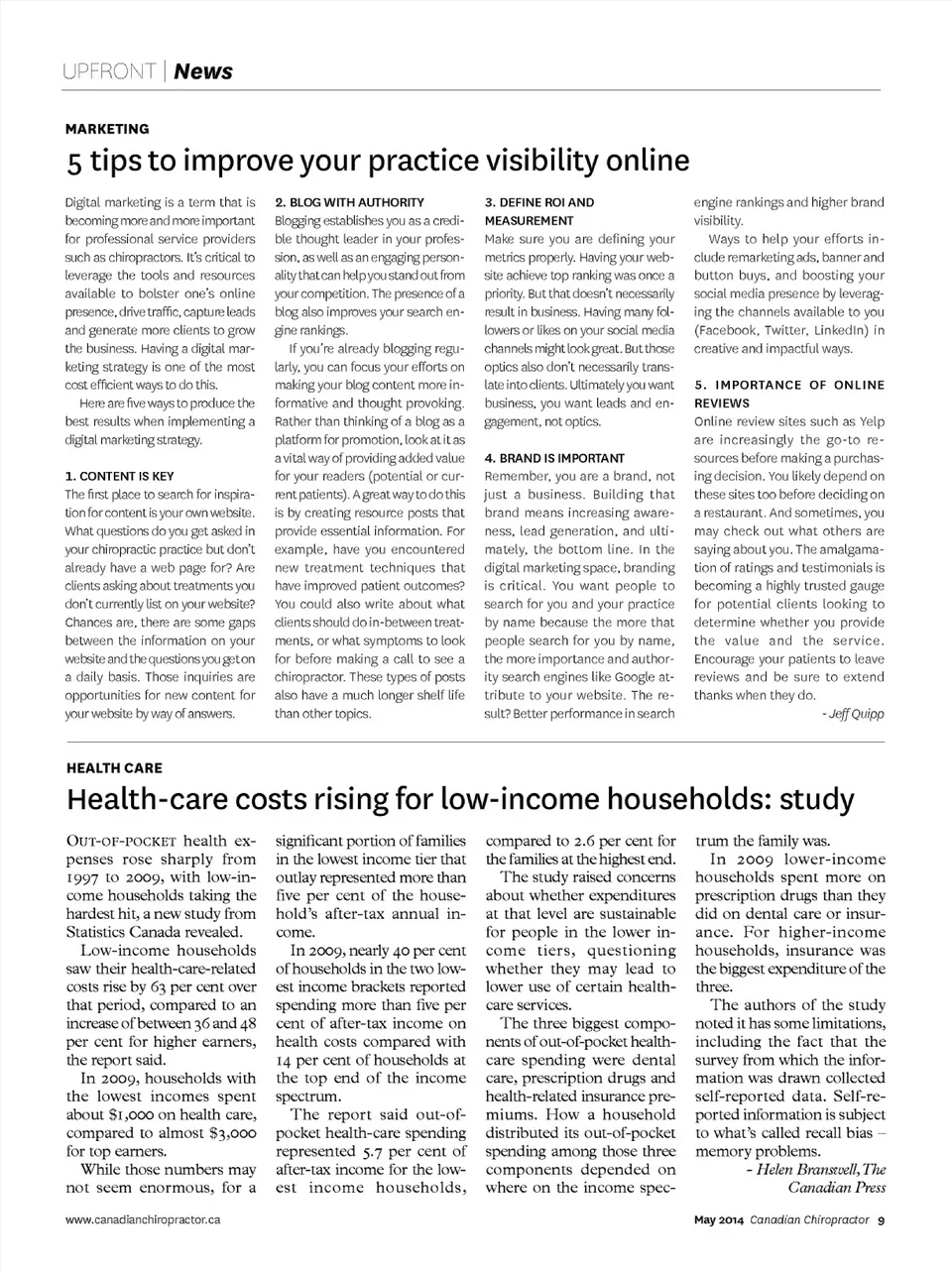
UPFRONT | News MARKETING 5 tips to improve your practice visibility online Digital marketing is a term that is becoming more and more important for professional service providers such as chiropractors. It’s critical to leverage the tools and resources available to bolster one’s online presence, drive traffic, capture leads and generate more clients to grow the business. Having a digital mar-keting strategy is one of the most cost efficient ways to do this. Here are five ways to produce the best results when implementing a digital marketing strategy. 1. CONTENT IS KEY The first place to search for inspira-tion for content is your own website. What questions do you get asked in your chiropractic practice but don’t already have a web page for? Are clients asking about treatments you don’t currently list on your website? Chances are, there are some gaps between the information on your website and the questions you get on a daily basis. Those inquiries are opportunities for new content for your website by way of answers. 2. BLOG WITH AUTHORITY Blogging establishes you as a credi-ble thought leader in your profes-sion, as well as an engaging person-ality that can help you stand out from your competition. The presence of a blog also improves your search en-gine rankings. If you’re already blogging regu-larly, you can focus your efforts on making your blog content more in-formative and thought provoking. Rather than thinking of a blog as a platform for promotion, look at it as a vital way of providing added value for your readers (potential or cur-rent patients). A great way to do this is by creating resource posts that provide essential information. For example, have you encountered new treatment techniques that have improved patient outcomes? You could also write about what clients should do in-between treat-ments, or what symptoms to look for before making a call to see a chiropractor. These types of posts also have a much longer shelf life than other topics. 3. DEFINE ROI AND MEASUREMENT Make sure you are defining your metrics properly. Having your web-site achieve top ranking was once a priority. But that doesn’t necessarily result in business. Having many fol-lowers or likes on your social media channels might look great. But those optics also don’t necessarily trans-late into clients. Ultimately you want business, you want leads and en-gagement, not optics. 4. BRAND IS IMPORTANT Remember, you are a brand, not just a business. Building that brand means increasing aware-ness, lead generation, and ulti-mately, the bottom line. In the digital marketing space, branding is critical. You want people to search for you and your practice by name because the more that people search for you by name, the more importance and author-ity search engines like Google at-tribute to your website. The re-sult? Better performance in search engine rankings and higher brand visibility. Ways to help your efforts in-clude remarketing ads, banner and button buys, and boosting your social media presence by leverag-ing the channels available to you (Facebook, Twitter, LinkedIn) in creative and impactful ways. 5. IMPORTANCE OF ONLINE REVIEWS Online review sites such as Yelp are increasingly the go-to re-sources before making a purchas-ing decision. You likely depend on these sites too before deciding on a restaurant. And sometimes, you may check out what others are saying about you. The amalgama-tion of ratings and testimonials is becoming a highly trusted gauge for potential clients looking to determine whether you provide the value and the service. Encourage your patients to leave reviews and be sure to extend thanks when they do. -Jeff Quipp HEALTH CARE Health-care costs rising for low-income households: study Out-of-pocket health ex-penses rose sharply from 1997 to 2009, with low-in-come households taking the hardest hit, a new study from Statistics Canada revealed. Low-income households saw their health-care-related costs rise by 63 per cent over that period, compared to an increase of between 36 and 48 per cent for higher earners, the report said. In 2009, households with the lowest incomes spent about $1,000 on health care, compared to almost $3,000 for top earners. While those numbers may not seem enormous, for a www.canadianchiropractor.ca significant portion of families in the lowest income tier that outlay represented more than five per cent of the house-hold’s after-tax annual in-come. In 2009, nearly 40 per cent of households in the two low-est income brackets reported spending more than five per cent of after-tax income on health costs compared with 14 per cent of households at the top end of the income spectrum. The report said out-of-pocket health-care spending represented 5.7 per cent of after-tax income for the low-est income households, compared to 2.6 per cent for the families at the highest end. The study raised concerns about whether expenditures at that level are sustainable for people in the lower in-come tiers, questioning whether they may lead to lower use of certain health-care services. The three biggest compo-nents of out-of-pocket health-care spending were dental care, prescription drugs and health-related insurance pre-miums. How a household distributed its out-of-pocket spending among those three components depended on where on the income spec-trum the family was. In 2009 lower-income households spent more on prescription drugs than they did on dental care or insur-ance. For higher-income households, insurance was the biggest expenditure of the three. The authors of the study noted it has some limitations, including the fact that the survey from which the infor-mation was drawn collected self-reported data. Self-re-ported information is subject to what’s called recall bias – memory problems. -Helen Branswell, The Canadian Press May 2014 Canadian Chiropractor 9
Chiropractic + Naturopathic Doctor May 2014: Page 9