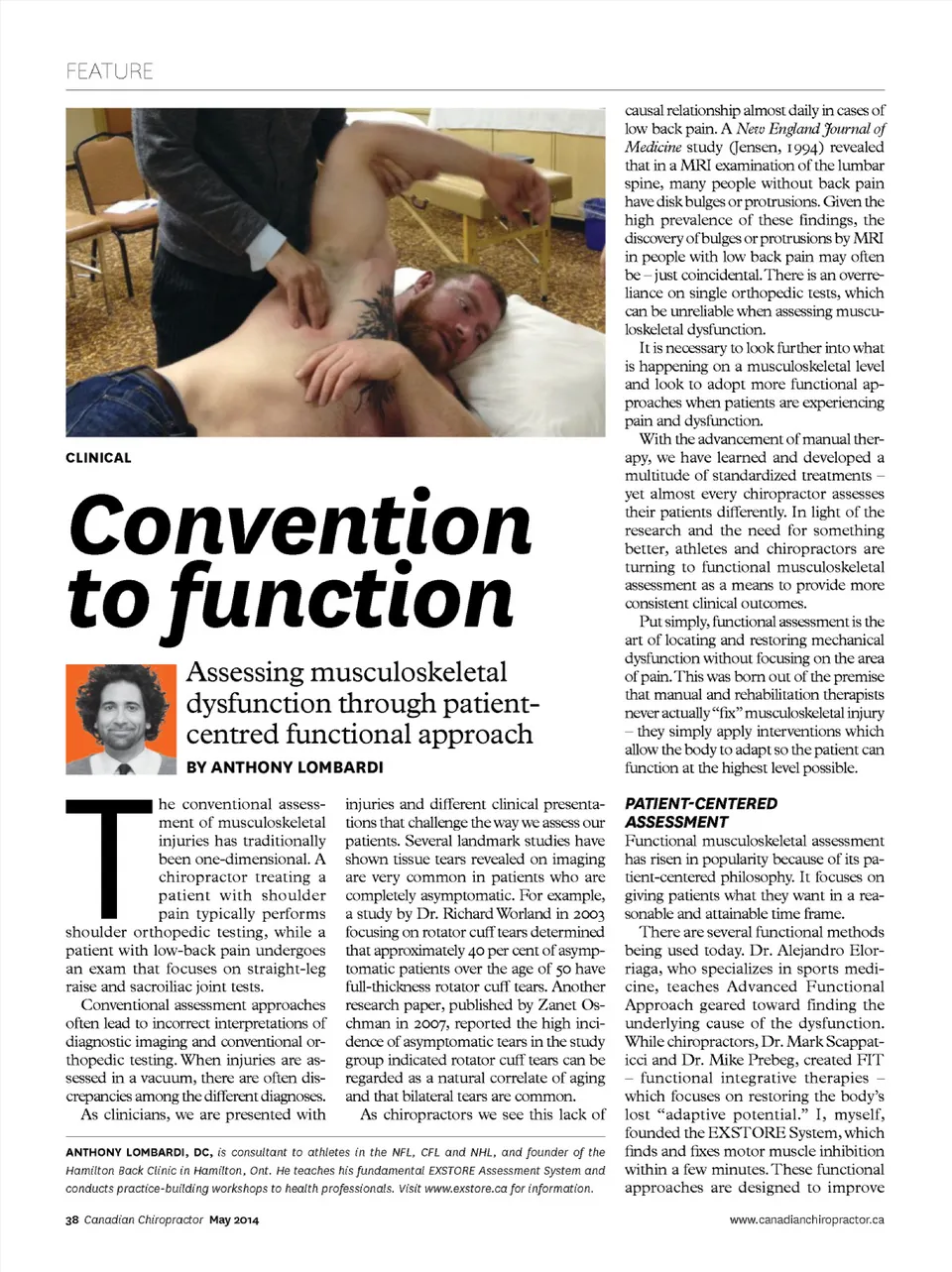
FEATURE causal relationship almost daily in cases of low back pain. A New England Journal of Medicine study (Jensen, 1994) revealed that in a MRI examination of the lumbar spine, many people without back pain have disk bulges or protrusions. Given the high prevalence of these findings, the discovery of bulges or protrusions by MRI in people with low back pain may often be – just coincidental. There is an overre-liance on single orthopedic tests, which can be unreliable when assessing muscu-loskeletal dysfunction. It is necessary to look further into what is happening on a musculoskeletal level and look to adopt more functional ap-proaches when patients are experiencing pain and dysfunction. With the advancement of manual ther-apy, we have learned and developed a multitude of standardized treatments – yet almost every chiropractor assesses their patients differently. In light of the research and the need for something better, athletes and chiropractors are turning to functional musculoskeletal assessment as a means to provide more consistent clinical outcomes. Put simply, functional assessment is the art of locating and restoring mechanical dysfunction without focusing on the area of pain. This was born out of the premise that manual and rehabilitation therapists never actually “fix” musculoskeletal injury – they simply apply interventions which allow the body to adapt so the patient can function at the highest level possible. CLINICAL Convention to function T Assessing musculoskeletal dysfunction through patient-centred functional approach BY ANTHONY LOMBARDI injuries and different clinical presenta-tions that challenge the way we assess our patients. Several landmark studies have shown tissue tears revealed on imaging are very common in patients who are completely asymptomatic. For example, a study by Dr. Richard Worland in 2003 focusing on rotator cuff tears determined that approximately 40 per cent of asymp-tomatic patients over the age of 50 have full-thickness rotator cuff tears. Another research paper, published by Zanet Os-chman in 2007, reported the high inci-dence of asymptomatic tears in the study group indicated rotator cuff tears can be regarded as a natural correlate of aging and that bilateral tears are common. As chiropractors we see this lack of he conventional assess-ment of musculoskeletal injuries has traditionally been one-dimensional. A chiropractor treating a patient with shoulder pain typically performs shoulder orthopedic testing, while a patient with low-back pain undergoes an exam that focuses on straight-leg raise and sacroiliac joint tests. Conventional assessment approaches often lead to incorrect interpretations of diagnostic imaging and conventional or-thopedic testing. When injuries are as-sessed in a vacuum, there are often dis-crepancies among the different diagnoses. As clinicians, we are presented with PATIENT-CENTERED ASSESSMENT ANTHONY LOMBARDI, DC, is consultant to athletes in the NFL, CFL and NHL, and founder of the Hamilton Back Clinic in Hamilton, Ont. He teaches his fundamental EXSTORE Assessment System and conducts practice-building workshops to health professionals. Visit www.exstore.ca for information. 38 Canadian Chiropractor May 2014 Functional musculoskeletal assessment has risen in popularity because of its pa-tient-centered philosophy. It focuses on giving patients what they want in a rea-sonable and attainable time frame. There are several functional methods being used today. Dr. Alejandro Elor-riaga, who specializes in sports medi-cine, teaches Advanced Functional Approach geared toward finding the underlying cause of the dysfunction. While chiropractors, Dr. Mark Scappat-icci and Dr. Mike Prebeg, created FIT – functional integrative therapies – which focuses on restoring the body’s lost “adaptive potential.” I, myself, founded the EXSTORE System, which finds and fixes motor muscle inhibition within a few minutes. These functional approaches are designed to improve www.canadianchiropractor.ca
Chiropractic + Naturopathic Doctor May 2014: Page 38