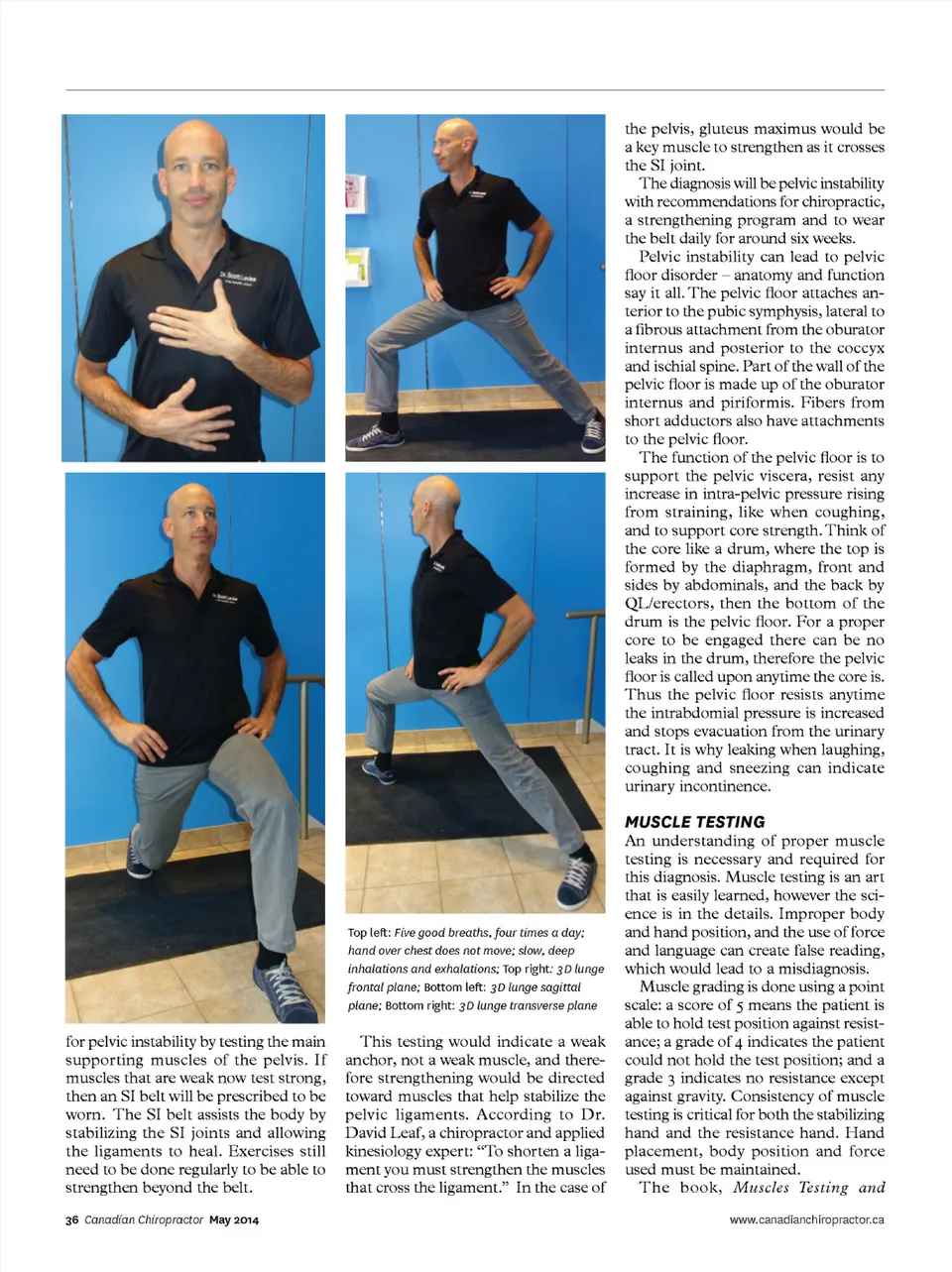
Function by Kendall, MccReary, Provance can provide additional information about muscle testing. Taking a beginners course on Applied Kinesiology may also be helpful. Patient supine test: gluteus medius, adductor, rectus femoris 1. Gluteus medius functions to abduct the leg and, when planted, stabilize the pelvis in single leg stance. 2. Adductor – long and short. Testing the adductors is important because they act as a functional reaction muscle with the pelvic floor. 3. Rectus femoris will go weak when the pelvis is not anchored. Patient prone test: gluteus maximus and piriformis 1. Gluteus maximus is an important extensor and crosses the SI joint 2. Piriformis can overreact in any sacral dysfunction, leading to sciatic symptoms. It crosses the SI joint and must be tested for pelvic instability. Patient sitting test: oburator internus Otorator internus is a lateral rotator the pelvic floor blends with. It is best tested in the sitting position. After testing have the patient put on a SI belt, and re-test. In a diagnosis of pelvic instability, the patient will now test stronger. This would not be the case if the patient was simply presenting de-conditioned or with a nerve entrap-ment. ® Strong on inflammation, gentle on patients PROGRAM 1. 2. • Effective relief of muscle and joint pain, as well as inflammation associated with injuries. Supported by over two dozen scientific studies, Traumeel S is a clinically proven preparation formulated to help regulate inflammation. ® Dispense the SI belt if instability is diagnosed. Give home care exercise to strengthen the pelvic floor Get your patients to do breathing exercises. Teach abdominal breathing to start to activate the pelvic floor by increasing the intra-abdominal pressure (top left image). Get your patients moving. Start with a sumo squat, legs wide apart with internal external toe movement and progress to moving in all three planes with a 3D Lunge (top right, bottom left, bottom right images). Give a balanced exercise to help stimulate the plan-tar muscles of the feet and activate the stabilizers of the spine. Time the exercises with different levels of liquid. Think of the bladder like a weight. As it fills the weight gets heavier. Instruct your patients to drink a half liter prior to performing the 3-D lunge by a half hour, then increase over time to a litre. This will help get the muscle to react to challenges of gravity and ground forces on the kinetic chain. • • • Traumeel S relieves muscle pain, bruising and inflammation associated with injuries such as sprains and contusions, as well as joint pain. ® 3. Adjust subluxation. Correction of subluxations is necessary to activate the pelvic floor through propri-oception and improved joint functions. Coupled with stabilization exercises and the stability belt, this will heal and reverse pelvic floor weakness, thus eliminat-ing the whispered disease. www.heel.ca www.traumeel.ca www.canadianchiropractor.ca May 2014 Canadian Chiropractor 37
Chiropractic + Naturopathic Doctor May 2014: Page 37