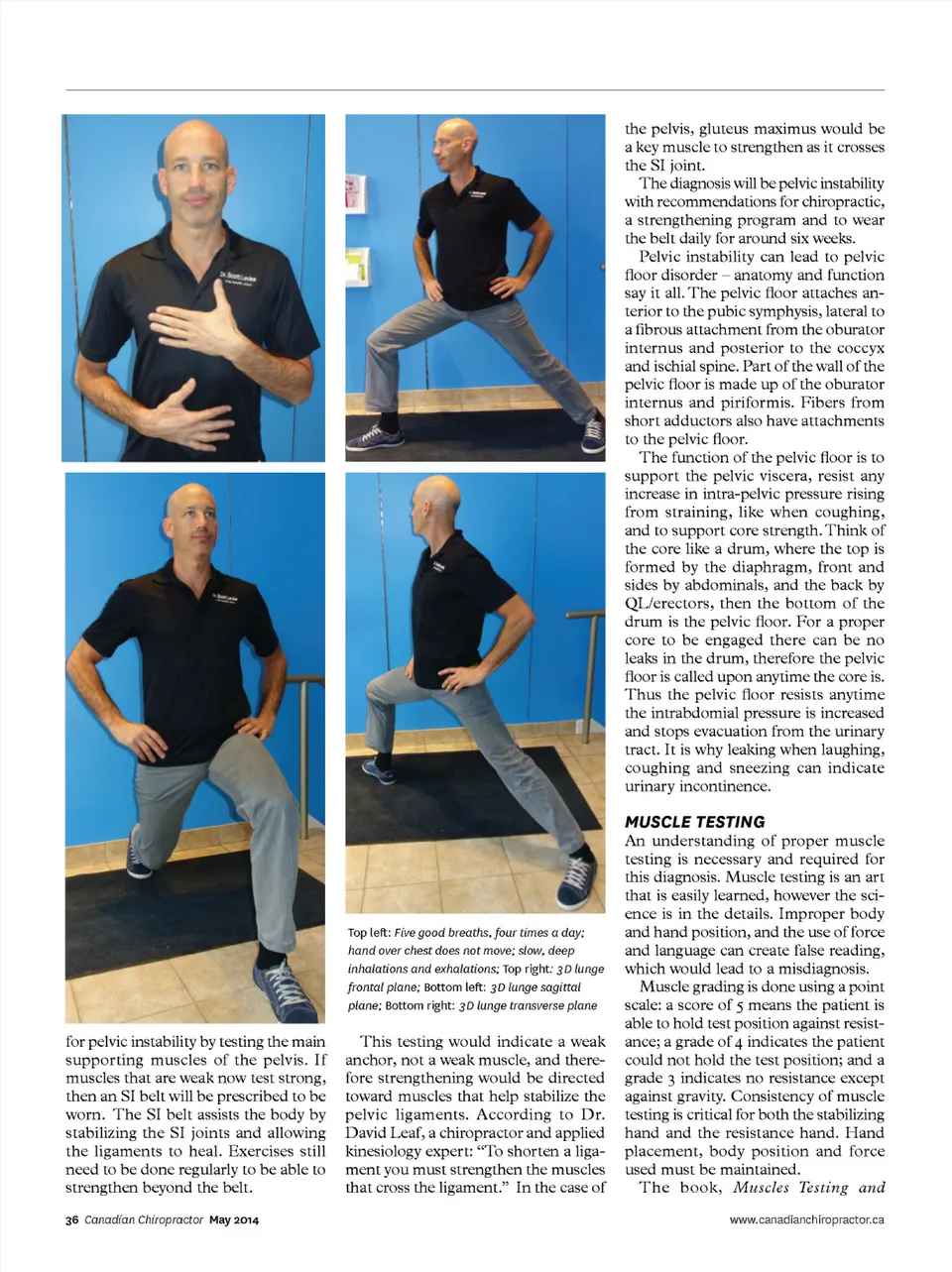
the pelvis, gluteus maximus would be a key muscle to strengthen as it crosses the SI joint. The diagnosis will be pelvic instability with recommendations for chiropractic, a strengthening program and to wear the belt daily for around six weeks. Pelvic instability can lead to pelvic floor disorder – anatomy and function say it all. The pelvic floor attaches an-terior to the pubic symphysis, lateral to a fibrous attachment from the oburator internus and posterior to the coccyx and ischial spine. Part of the wall of the pelvic floor is made up of the oburator internus and piriformis. Fibers from short adductors also have attachments to the pelvic floor. The function of the pelvic floor is to support the pelvic viscera, resist any increase in intra-pelvic pressure rising from straining, like when coughing, and to support core strength. Think of the core like a drum, where the top is formed by the diaphragm, front and sides by abdominals, and the back by QL/erectors, then the bottom of the drum is the pelvic floor. For a proper core to be engaged there can be no leaks in the drum, therefore the pelvic floor is called upon anytime the core is. Thus the pelvic floor resists anytime the intrabdomial pressure is increased and stops evacuation from the urinary tract. It is why leaking when laughing, coughing and sneezing can indicate urinary incontinence. MUSCLE TESTING Top left: Five good breaths, four times a day; hand over chest does not move; slow, deep inhalations and exhalations; Top right : 3D lunge frontal plane; Bottom left: 3D lunge sagittal plane; Bottom right: 3D lunge transverse plane for pelvic instability by testing the main supporting muscles of the pelvis. If muscles that are weak now test strong, then an SI belt will be prescribed to be worn. The SI belt assists the body by stabilizing the SI joints and allowing the ligaments to heal. Exercises still need to be done regularly to be able to strengthen beyond the belt. 36 Canadian Chiropractor May 2014 This testing would indicate a weak anchor, not a weak muscle, and there-fore strengthening would be directed toward muscles that help stabilize the pelvic ligaments. According to Dr. David Leaf, a chiropractor and applied kinesiology expert: “To shorten a liga-ment you must strengthen the muscles that cross the ligament.” In the case of An understanding of proper muscle testing is necessary and required for this diagnosis. Muscle testing is an art that is easily learned, however the sci-ence is in the details. Improper body and hand position, and the use of force and language can create false reading, which would lead to a misdiagnosis. Muscle grading is done using a point scale: a score of 5 means the patient is able to hold test position against resist-ance; a grade of 4 indicates the patient could not hold the test position; and a grade 3 indicates no resistance except against gravity. Consistency of muscle testing is critical for both the stabilizing hand and the resistance hand. Hand placement, body position and force used must be maintained. The book, Muscles Testing and www.canadianchiropractor.ca
Chiropractic + Naturopathic Doctor May 2014: Page 36