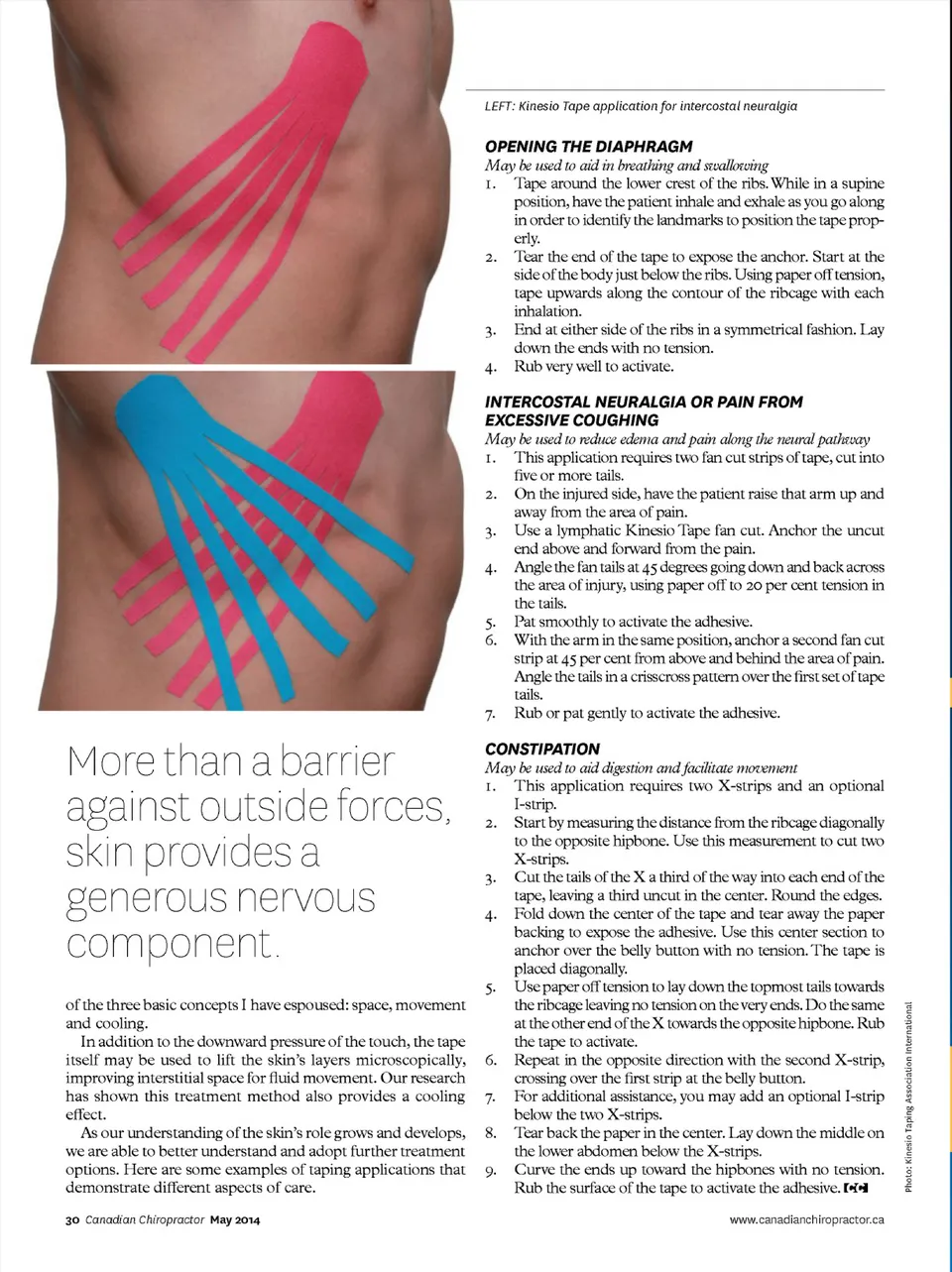
LEFT: Kinesio Tape application for intercostal neuralgia OPENING THE DIAPHRAGM May be used to aid in breathing and swallowing 1. Tape around the lower crest of the ribs. While in a supine position, have the patient inhale and exhale as you go along in order to identify the landmarks to position the tape prop-erly. 2. Tear the end of the tape to expose the anchor. Start at the side of the body just below the ribs. Using paper off tension, tape upwards along the contour of the ribcage with each inhalation. 3. End at either side of the ribs in a symmetrical fashion. Lay down the ends with no tension. 4. Rub very well to activate. INTERCOSTAL NEURALGIA OR PAIN FROM EXCESSIVE COUGHING May be used to reduce edema and pain along the neural pathway 1. This application requires two fan cut strips of tape, cut into five or more tails. 2. On the injured side, have the patient raise that arm up and away from the area of pain. 3. Use a lymphatic Kinesio Tape fan cut. Anchor the uncut end above and forward from the pain. 4. Angle the fan tails at 45 degrees going down and back across the area of injury, using paper off to 20 per cent tension in the tails. 5. Pat smoothly to activate the adhesive. 6. With the arm in the same position, anchor a second fan cut strip at 45 per cent from above and behind the area of pain. Angle the tails in a crisscross pattern over the first set of tape tails. 7. Rub or pat gently to activate the adhesive. More than a barrier against outside forces, skin provides a generous nervous component. of the three basic concepts I have espoused: space, movement and cooling. In addition to the downward pressure of the touch, the tape itself may be used to lift the skin’s layers microscopically, improving interstitial space for fluid movement. Our research has shown this treatment method also provides a cooling effect. As our understanding of the skin’s role grows and develops, we are able to better understand and adopt further treatment options. Here are some examples of taping applications that demonstrate different aspects of care. 30 Canadian Chiropractor May 2014 CONSTIPATION May be used to aid digestion and facilitate movement 1. This application requires two X-strips and an optional I-strip. 2. Start by measuring the distance from the ribcage diagonally to the opposite hipbone. Use this measurement to cut two X-strips. 3. Cut the tails of the X a third of the way into each end of the tape, leaving a third uncut in the center. Round the edges. 4. Fold down the center of the tape and tear away the paper backing to expose the adhesive. Use this center section to anchor over the belly button with no tension. The tape is placed diagonally. 5. Use paper off tension to lay down the topmost tails towards the ribcage leaving no tension on the very ends. Do the same at the other end of the X towards the opposite hipbone. Rub the tape to activate. 6. Repeat in the opposite direction with the second X-strip, crossing over the first strip at the belly button. 7. For additional assistance, you may add an optional I-strip below the two X-strips. 8. Tear back the paper in the center. Lay down the middle on the lower abdomen below the X-strips. 9. Curve the ends up toward the hipbones with no tension. Rub the surface of the tape to activate the adhesive. www.canadianchiropractor.ca Photo: Kinesio Taping Association International
Chiropractic + Naturopathic Doctor May 2014: Page 30