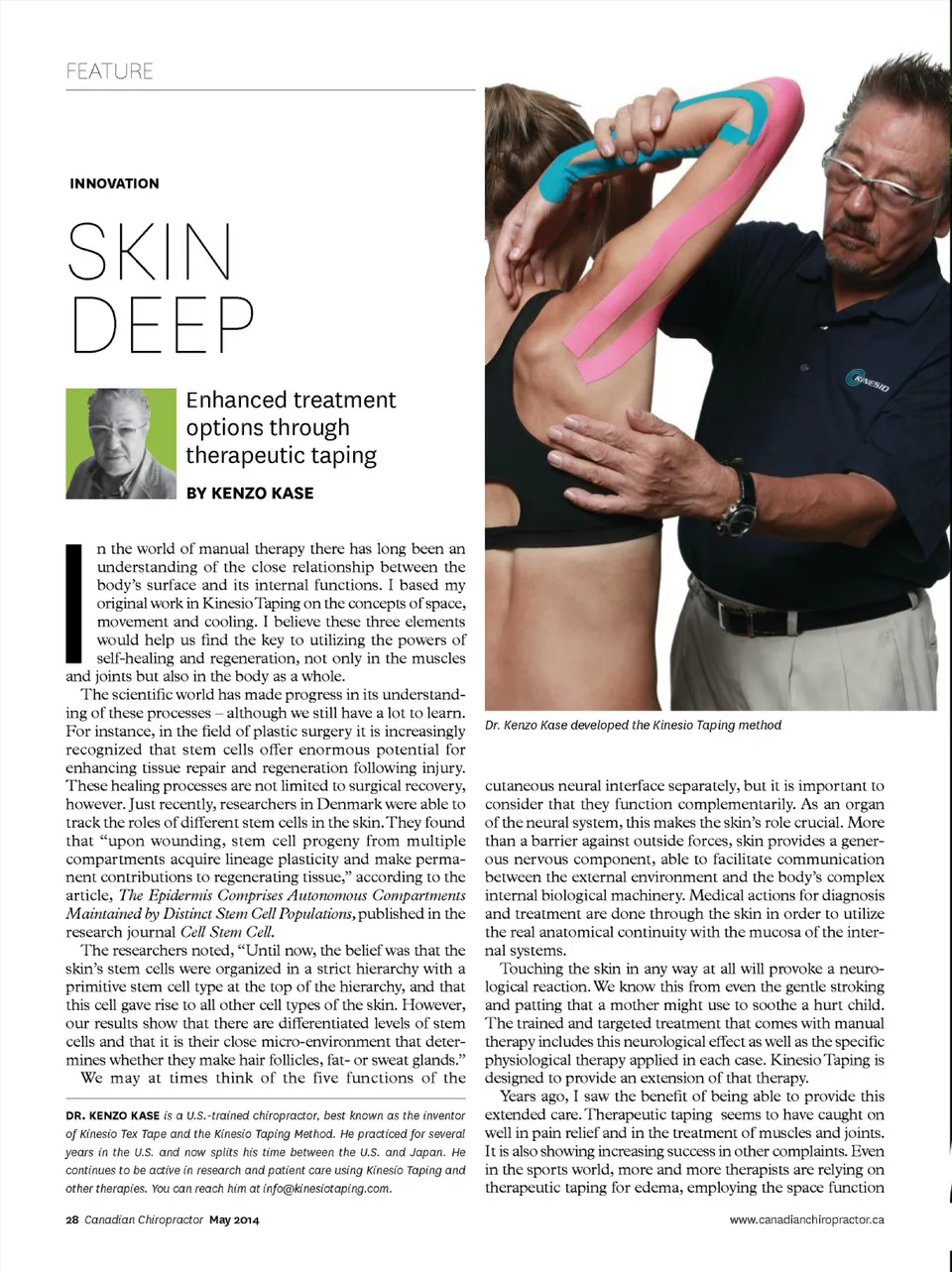
FEATURE INNOVATION SKIN DEEP Enhanced treatment options through therapeutic taping I BY KENZO KASE n the world of manual therapy there has long been an understanding of the close relationship between the body’s surface and its internal functions. I based my original work in Kinesio Taping on the concepts of space, movement and cooling. I believe these three elements would help us find the key to utilizing the powers of self-healing and regeneration, not only in the muscles and joints but also in the body as a whole. The scientific world has made progress in its understand-ing of these processes – although we still have a lot to learn. For instance, in the field of plastic surgery it is increasingly recognized that stem cells offer enormous potential for enhancing tissue repair and regeneration following injury. These healing processes are not limited to surgical recovery, however. Just recently, researchers in Denmark were able to track the roles of different stem cells in the skin. They found that “upon wounding, stem cell progeny from multiple compartments acquire lineage plasticity and make perma-nent contributions to regenerating tissue,” according to the article, The Epidermis Comprises Autonomous Compartments Maintained by Distinct Stem Cell Populations, published in the research journal Cell Stem Cell. The researchers noted, “Until now, the belief was that the skin’s stem cells were organized in a strict hierarchy with a primitive stem cell type at the top of the hierarchy, and that this cell gave rise to all other cell types of the skin. However, our results show that there are differentiated levels of stem cells and that it is their close micro-environment that deter-mines whether they make hair follicles, fat-or sweat glands.” We may at times think of the five functions of the DR. KENZO KASE is a U.S.-trained chiropractor, best known as the inventor of Kinesio Tex Tape and the Kinesio Taping Method. He practiced for several years in the U.S. and now splits his time between the U.S. and Japan. He continues to be active in research and patient care using Kinesio Taping and other therapies. You can reach him at [email protected]. 28 Canadian Chiropractor May 2014 Dr. Kenzo Kase developed the Kinesio Taping method cutaneous neural interface separately, but it is important to consider that they function complementarily. As an organ of the neural system, this makes the skin’s role crucial. More than a barrier against outside forces, skin provides a gener-ous nervous component, able to facilitate communication between the external environment and the body’s complex internal biological machinery. Medical actions for diagnosis and treatment are done through the skin in order to utilize the real anatomical continuity with the mucosa of the inter-nal systems. Touching the skin in any way at all will provoke a neuro-logical reaction. We know this from even the gentle stroking and patting that a mother might use to soothe a hurt child. The trained and targeted treatment that comes with manual therapy includes this neurological effect as well as the specific physiological therapy applied in each case. Kinesio Taping is designed to provide an extension of that therapy. Years ago, I saw the benefit of being able to provide this extended care. Therapeutic taping seems to have caught on well in pain relief and in the treatment of muscles and joints. It is also showing increasing success in other complaints. Even in the sports world, more and more therapists are relying on therapeutic taping for edema, employing the space function www.canadianchiropractor.ca
Chiropractic + Naturopathic Doctor May 2014: Page 28