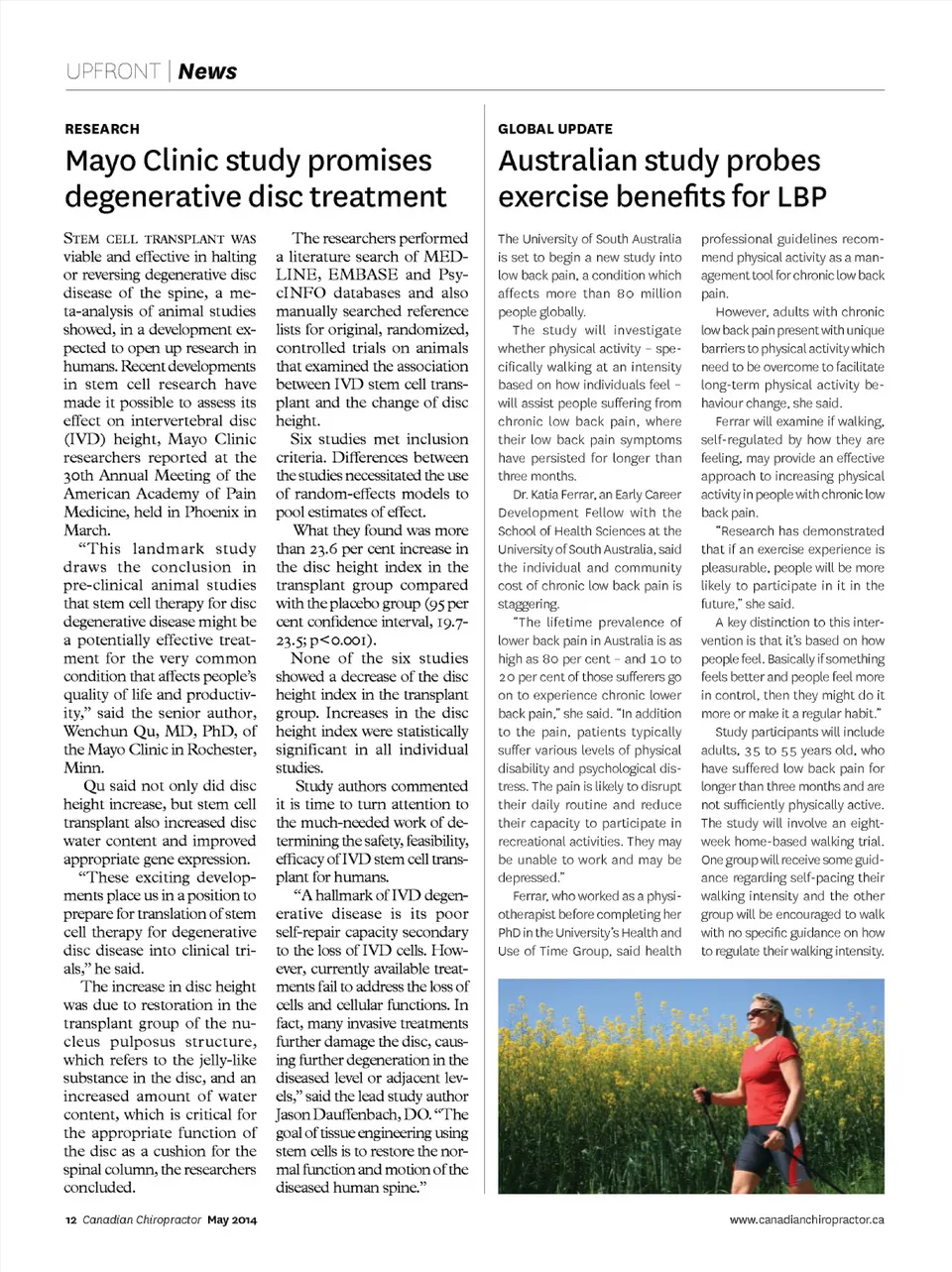
UPFRONT | News RESEARCH Mayo Clinic study promises degenerative disc treatment Stem cell transplant was viable and effective in halting or reversing degenerative disc disease of the spine, a me-ta-analysis of animal studies showed, in a development ex-pected to open up research in humans. Recent developments in stem cell research have made it possible to assess its effect on intervertebral disc (IVD) height, Mayo Clinic researchers reported at the 30th Annual Meeting of the American Academy of Pain Medicine, held in Phoenix in March. “This landmark study draws the conclusion in pre-clinical animal studies that stem cell therapy for disc degenerative disease might be a potentially effective treat-ment for the very common condition that affects people’s quality of life and productiv-ity,” said the senior author, Wenchun Qu, MD, PhD, of the Mayo Clinic in Rochester, Minn. Qu said not only did disc height increase, but stem cell transplant also increased disc water content and improved appropriate gene expression. “These exciting develop-ments place us in a position to prepare for translation of stem cell therapy for degenerative disc disease into clinical tri-als,” he said. The increase in disc height was due to restoration in the transplant group of the nu-cleus pulposus structure, which refers to the jelly-like substance in the disc, and an increased amount of water content, which is critical for the appropriate function of the disc as a cushion for the spinal column, the researchers concluded. 12 Canadian Chiropractor May 2014 GLOBAL UPDATE Australian study probes exercise benefits for LBP The University of South Australia is set to begin a new study into low back pain, a condition which affects more than 80 million people globally. The study will investigate whether physical activity – spe-cifically walking at an intensity based on how individuals feel – will assist people suffering from chronic low back pain, where their low back pain symptoms have persisted for longer than three months. Dr. Katia Ferrar, an Early Career Development Fellow with the School of Health Sciences at the University of South Australia, said the individual and community cost of chronic low back pain is staggering. “The lifetime prevalence of lower back pain in Australia is as high as 80 per cent – and 10 to 20 per cent of those sufferers go on to experience chronic lower back pain,” she said. “In addition to the pain, patients typically suffer various levels of physical disability and psychological dis-tress. The pain is likely to disrupt their daily routine and reduce their capacity to participate in recreational activities. They may be unable to work and may be depressed.” Ferrar, who worked as a physi-otherapist before completing her PhD in the University’s Health and Use of Time Group, said health professional guidelines recom-mend physical activity as a man-agement tool for chronic low back pain. However, adults with chronic low back pain present with unique barriers to physical activity which need to be overcome to facilitate long-term physical activity be-haviour change, she said. Ferrar will examine if walking, self-regulated by how they are feeling, may provide an effective approach to increasing physical activity in people with chronic low back pain. “Research has demonstrated that if an exercise experience is pleasurable, people will be more likely to participate in it in the future,” she said. A key distinction to this inter-vention is that it’s based on how people feel. Basically if something feels better and people feel more in control, then they might do it more or make it a regular habit.” Study participants will include adults, 35 to 55 years old, who have suffered low back pain for longer than three months and are not sufficiently physically active. The study will involve an eight-week home-based walking trial. One group will receive some guid-ance regarding self-pacing their walking intensity and the other group will be encouraged to walk with no specific guidance on how to regulate their walking intensity. The researchers performed a literature search of MED-LINE, EMBASE and Psy-cINFO databases and also manually searched reference lists for original, randomized, controlled trials on animals that examined the association between IVD stem cell trans-plant and the change of disc height. Six studies met inclusion criteria. Differences between the studies necessitated the use of random-effects models to pool estimates of effect. What they found was more than 23.6 per cent increase in the disc height index in the transplant group compared with the placebo group (95 per cent confidence interval, 19.7-23.5; p < 0.001). None of the six studies showed a decrease of the disc height index in the transplant group. Increases in the disc height index were statistically significant in all individual studies. Study authors commented it is time to turn attention to the much-needed work of de-termining the safety, feasibility, efficacy of IVD stem cell trans-plant for humans. “A hallmark of IVD degen-erative disease is its poor self-repair capacity secondary to the loss of IVD cells. How-ever, currently available treat-ments fail to address the loss of cells and cellular functions. In fact, many invasive treatments further damage the disc, caus-ing further degeneration in the diseased level or adjacent lev-els,” said the lead study author Jason Dauffenbach, DO. “The goal of tissue engineering using stem cells is to restore the nor-mal function and motion of the diseased human spine.” www.canadianchiropractor.ca
Chiropractic + Naturopathic Doctor May 2014: Page 12