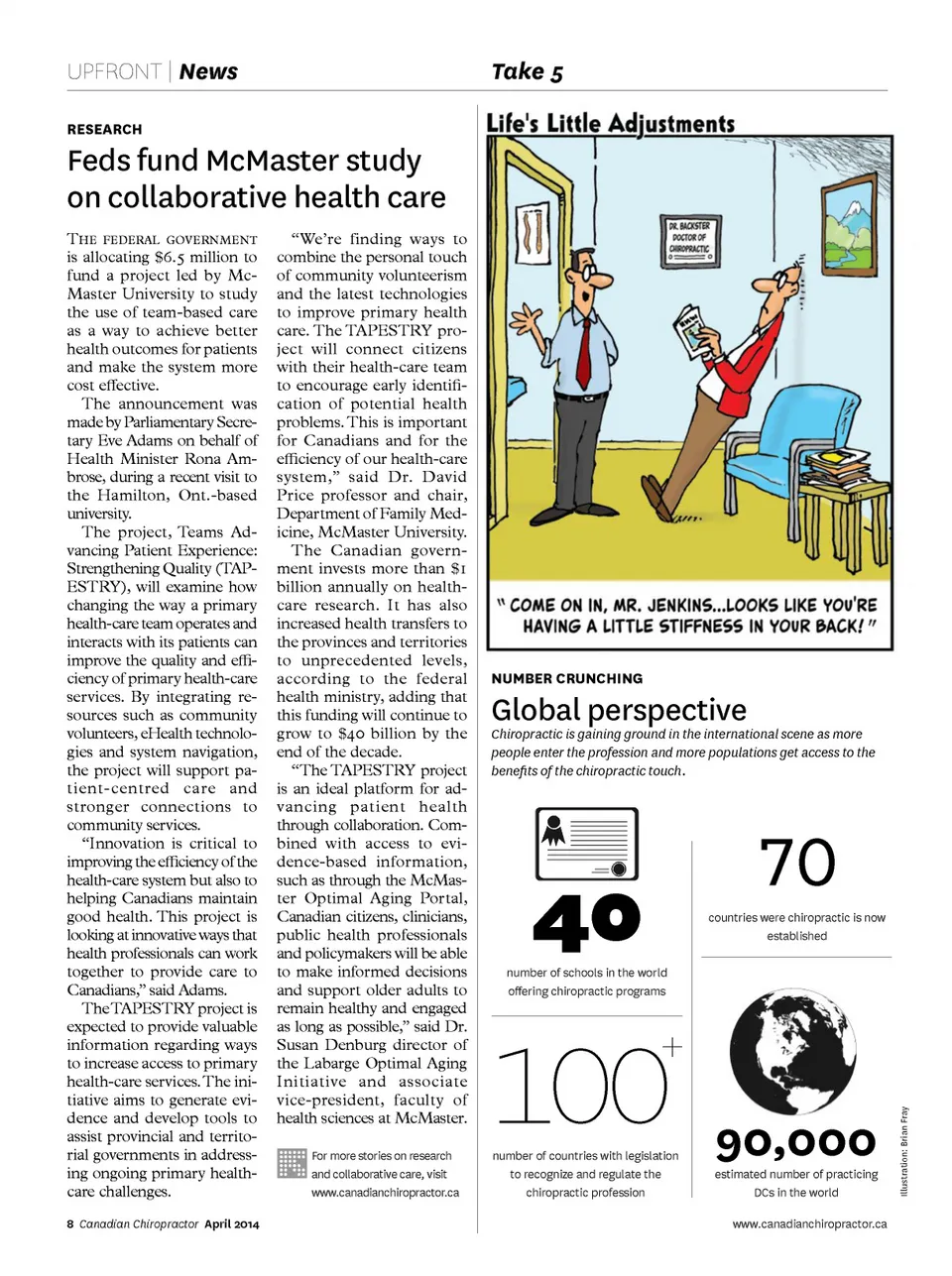
UPFRONT | News RESEARCH Take 5 Feds fund McMaster study on collaborative health care The federal government is allocating $6.5 million to fund a project led by Mc-Master University to study the use of team-based care as a way to achieve better health outcomes for patients and make the system more cost effective. The announcement was made by Parliamentary Secre-tary Eve Adams on behalf of Health Minister Rona Am-brose, during a recent visit to the Hamilton, Ont.-based university. The project, Teams Ad-vancing Patient Experience: Strengthening Quality (TAP-ESTRY), will examine how changing the way a primary health-care team operates and interacts with its patients can improve the quality and effi-ciency of primary health-care services. By integrating re-sources such as community volunteers, eHealth technolo-gies and system navigation, the project will support pa-tient-centred care and stronger connections to community services. “Innovation is critical to improving the efficiency of the health-care system but also to helping Canadians maintain good health. This project is looking at innovative ways that health professionals can work together to provide care to Canadians,” said Adams. The TAPESTRY project is expected to provide valuable information regarding ways to increase access to primary health-care services. The ini-tiative aims to generate evi-dence and develop tools to assist provincial and territo-rial governments in address-ing ongoing primary health-care challenges. 8 Canadian Chiropractor April 2014 For more stories on research and collaborative care, visit www.canadianchiropractor.ca number of countries with legislation to recognize and regulate the chiropractic profession estimated number of practicing DCs in the world www.canadianchiropractor.ca Illustration: Brian Fray “We’re finding ways to combine the personal touch of community volunteerism and the latest technologies to improve primary health care. The TAPESTRY pro-ject will connect citizens with their health-care team to encourage early identifi-cation of potential health problems. This is important for Canadians and for the efficiency of our health-care system,” said Dr. David Price professor and chair, Department of Family Med-icine, McMaster University. The Canadian govern-ment invests more than $1 billion annually on health-care research. It has also increased health transfers to the provinces and territories to unprecedented levels, according to the federal health ministry, adding that this funding will continue to grow to $40 billion by the end of the decade. “The TAPESTRY project is an ideal platform for ad-vancing patient health through collaboration. Com-bined with access to evi-dence-based information, such as through the McMas-ter Optimal Aging Portal, Canadian citizens, clinicians, public health professionals and policymakers will be able to make informed decisions and support older adults to remain healthy and engaged as long as possible,” said Dr. Susan Denburg director of the Labarge Optimal Aging Initiative and associate vice-president, faculty of health sciences at McMaster. NUmBER CRUNCHINg Chiropractic is gaining ground in the international scene as more people enter the profession and more populations get access to the benefits of the chiropractic touch. Global perspective number of schools in the world offering chiropractic programs 40 70 countries were chiropractic is now established 100 + 90,000
Chiropractic + Naturopathic Doctor April 2014: Page 8