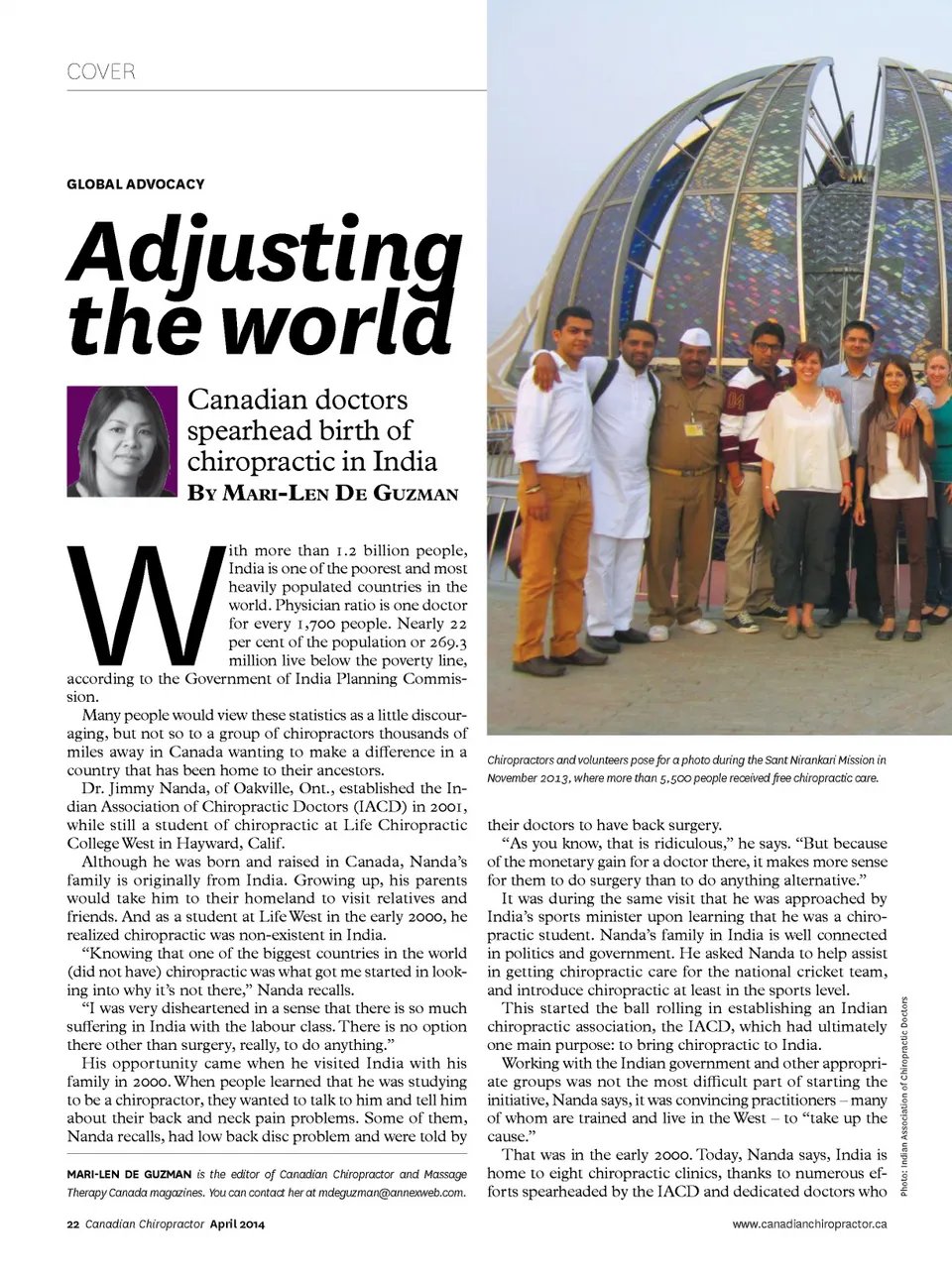
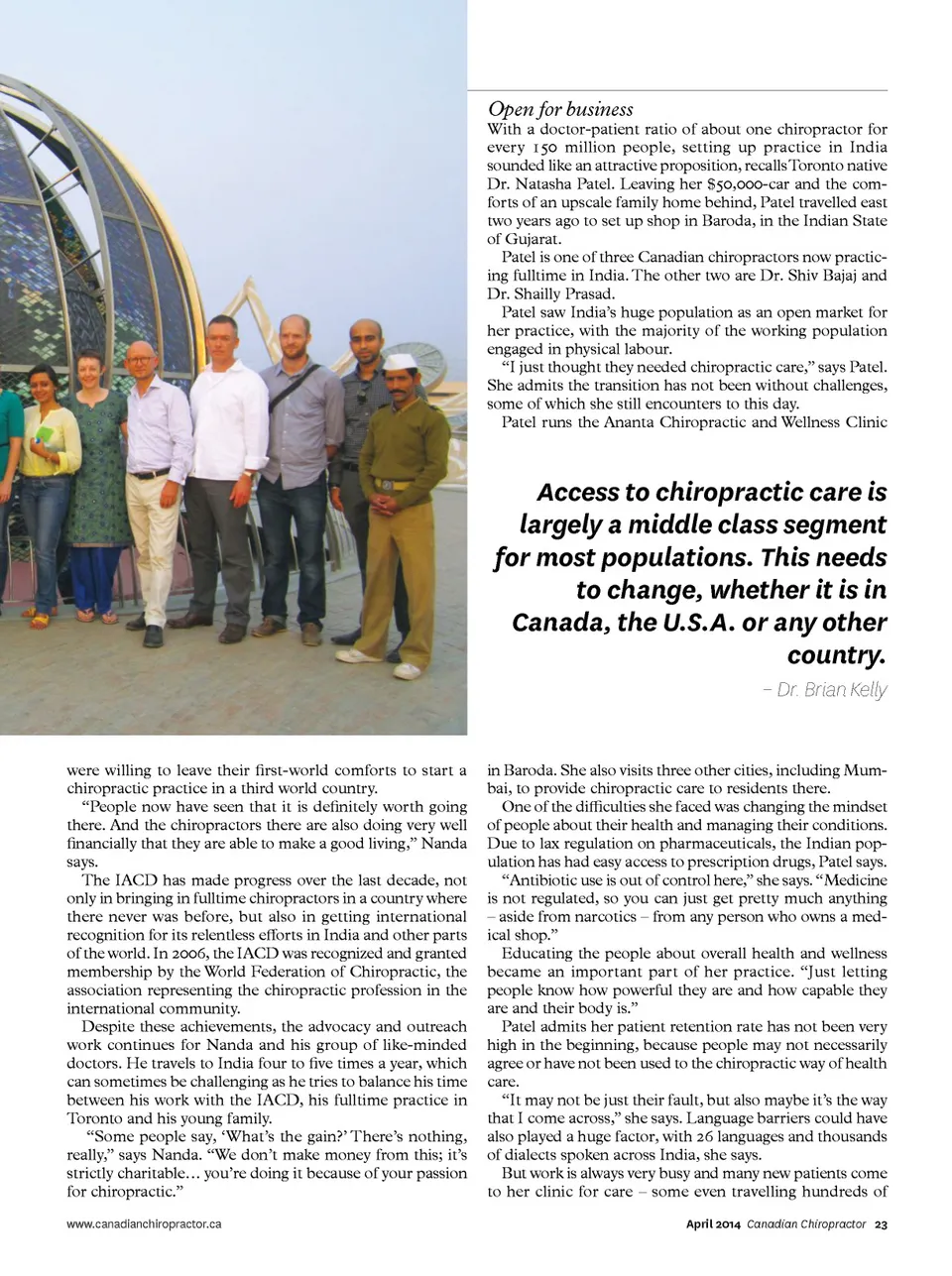
Open for business With a doctor-patient ratio of about one chiropractor for every 150 million people, setting up practice in India sounded like an attractive proposition, recalls Toronto native Dr. Natasha Patel. Leaving her $50,000-car and the com-forts of an upscale family home behind, Patel travelled east two years ago to set up shop in Baroda, in the Indian State of Gujarat. Patel is one of three Canadian chiropractors now practic-ing fulltime in India. The other two are Dr. Shiv Bajaj and Dr. Shailly Prasad. Patel saw India’s huge population as an open market for her practice, with the majority of the working population engaged in physical labour. “I just thought they needed chiropractic care,” says Patel. She admits the transition has not been without challenges, some of which she still encounters to this day. Patel runs the Ananta Chiropractic and Wellness Clinic Access to chiropractic care is largely a middle class segment for most populations. This needs to change, whether it is in Canada, the U.S.A. or any other country. – Dr. Brian Kelly were willing to leave their first-world comforts to start a chiropractic practice in a third world country. “People now have seen that it is definitely worth going there. And the chiropractors there are also doing very well financially that they are able to make a good living,” Nanda says. The IACD has made progress over the last decade, not only in bringing in fulltime chiropractors in a country where there never was before, but also in getting international recognition for its relentless efforts in India and other parts of the world. In 2006, the IACD was recognized and granted membership by the World Federation of Chiropractic, the association representing the chiropractic profession in the international community. Despite these achievements, the advocacy and outreach work continues for Nanda and his group of like-minded doctors. He travels to India four to five times a year, which can sometimes be challenging as he tries to balance his time between his work with the IACD, his fulltime practice in Toronto and his young family. “Some people say, ‘What’s the gain?’ There’s nothing, really,” says Nanda. “We don’t make money from this; it’s strictly charitable… you’re doing it because of your passion for chiropractic.” www.canadianchiropractor.ca in Baroda. She also visits three other cities, including Mum-bai, to provide chiropractic care to residents there. One of the difficulties she faced was changing the mindset of people about their health and managing their conditions. Due to lax regulation on pharmaceuticals, the Indian pop-ulation has had easy access to prescription drugs, Patel says. “Antibiotic use is out of control here,” she says. “Medicine is not regulated, so you can just get pretty much anything – aside from narcotics – from any person who owns a med-ical shop.” Educating the people about overall health and wellness became an important part of her practice. “Just letting people know how powerful they are and how capable they are and their body is.” Patel admits her patient retention rate has not been very high in the beginning, because people may not necessarily agree or have not been used to the chiropractic way of health care. “It may not be just their fault, but also maybe it’s the way that I come across,” she says. Language barriers could have also played a huge factor, with 26 languages and thousands of dialects spoken across India, she says. But work is always very busy and many new patients come to her clinic for care – some even travelling hundreds of April 2014 Canadian Chiropractor 23
Chiropractic + Naturopathic Doctor April 2014: Page 23