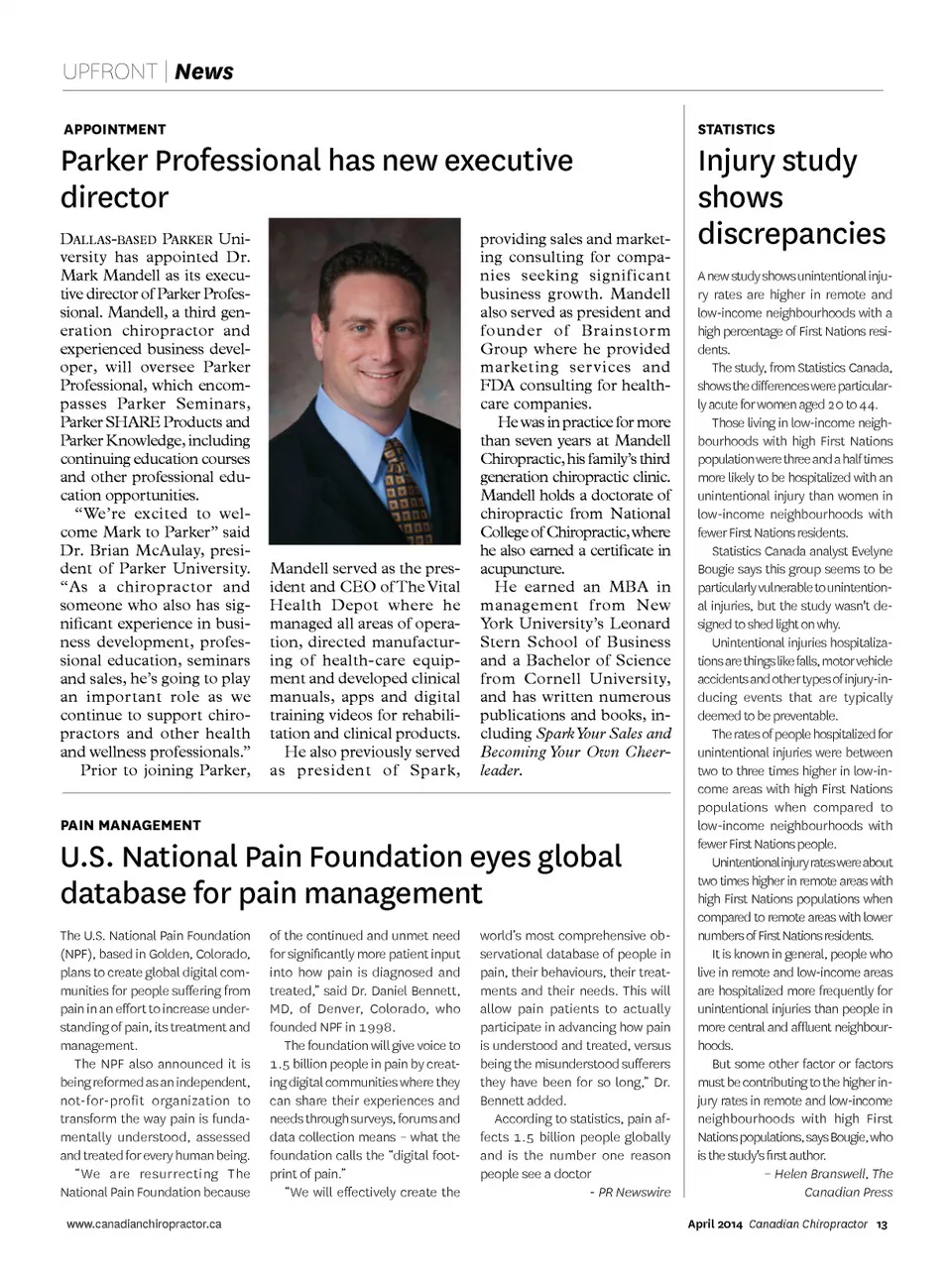
UPFRONT | News Parker Professional has new executive director Dallas-based Parker Uni-versity has appointed Dr. Mark Mandell as its execu-tive director of Parker Profes-sional. Mandell, a third gen-eration chiropractor and experienced business devel-oper, will oversee Parker Professional, which encom-passes Parker Seminars, Parker SHARE Products and Parker Knowledge, including continuing education courses and other professional edu-cation opportunities. “We’re excited to wel-come Mark to Parker” said Dr. Brian McAulay, presi-dent of Parker University. “As a chiropractor and someone who also has sig-nificant experience in busi-ness development, profes-sional education, seminars and sales, he’s going to play an important role as we continue to support chiro-practors and other health and wellness professionals.” Prior to joining Parker, providing sales and market-ing consulting for compa-nies seeking significant business growth. Mandell also served as president and founder of Brainstor m Group where he provided marketing ser vices and FDA consulting for health-care companies. He was in practice for more than seven years at Mandell Chiropractic, his family’s third generation chiropractic clinic. Mandell holds a doctorate of chiropractic from National College of Chiropractic, where he also earned a certificate in acupuncture. He earned an MBA in management from New York University’s Leonard Stern School of Business and a Bachelor of Science from Cornell University, and has written numerous publications and books, in-cluding Spark Your Sales and Becoming Your Own Cheer-leader . APPoINTmENT STATISTICS Injury study shows discrepancies A new study shows unintentional inju-ry rates are higher in remote and low-income neighbourhoods with a high percentage of First Nations resi-dents. The study, from Statistics Canada, shows the differences were particular-ly acute for women aged 20 to 44. Those living in low-income neigh-bourhoods with high First Nations population were three and a half times more likely to be hospitalized with an unintentional injury than women in low-income neighbourhoods with fewer First Nations residents. Statistics Canada analyst Evelyne Bougie says this group seems to be particularly vulnerable to unintention-al injuries, but the study wasn't de-signed to shed light on why. Unintentional injuries hospitaliza-tions are things like falls, motor vehicle accidents and other types of injury-in-ducing events that are typically deemed to be preventable. The rates of people hospitalized for unintentional injuries were between two to three times higher in low-in-come areas with high First Nations populations when compared to low-income neighbourhoods with fewer First Nations people. Unintentional injury rates were about two times higher in remote areas with high First Nations populations when compared to remote areas with lower numbers of First Nations residents. It is known in general, people who live in remote and low-income areas are hospitalized more frequently for unintentional injuries than people in more central and affluent neighbour-hoods. But some other factor or factors must be contributing to the higher in-jury rates in remote and low-income neighbourhoods with high First Nations populations, says Bougie, who is the study's first author. – Helen Branswell, The Canadian Press April 2014 Canadian Chiropractor 13 Mandell served as the pres-ident and CEO of The Vital Health Depot where he managed all areas of opera-tion, directed manufactur-ing of health-care equip-ment and developed clinical manuals, apps and digital training videos for rehabili-tation and clinical products. He also previously served as president of Spark, PAIN mANAgEmENT U.S. National Pain Foundation eyes global database for pain management The U.S. National Pain Foundation (NPF), based in Golden, Colorado, plans to create global digital com-munities for people suffering from pain in an effort to increase under-standing of pain, its treatment and management. The NPF also announced it is being reformed as an independent, not-for-profit organization to transform the way pain is funda-mentally understood, assessed and treated for every human being. “We are resurrecting The National Pain Foundation because www.canadianchiropractor.ca of the continued and unmet need for significantly more patient input into how pain is diagnosed and treated,” said Dr. Daniel Bennett, MD, of Denver, Colorado, who founded NPF in 1998. The foundation will give voice to 1.5 billion people in pain by creat-ing digital communities where they can share their experiences and needs through surveys, forums and data collection means – what the foundation calls the “digital foot-print of pain.” “We will effectively create the world’s most comprehensive ob-servational database of people in pain, their behaviours, their treat-ments and their needs. This will allow pain patients to actually participate in advancing how pain is understood and treated, versus being the misunderstood sufferers they have been for so long,” Dr. Bennett added. According to statistics, pain af-fects 1.5 billion people globally and is the number one reason people see a doctor -PR Newswire
Chiropractic + Naturopathic Doctor April 2014: Page 13