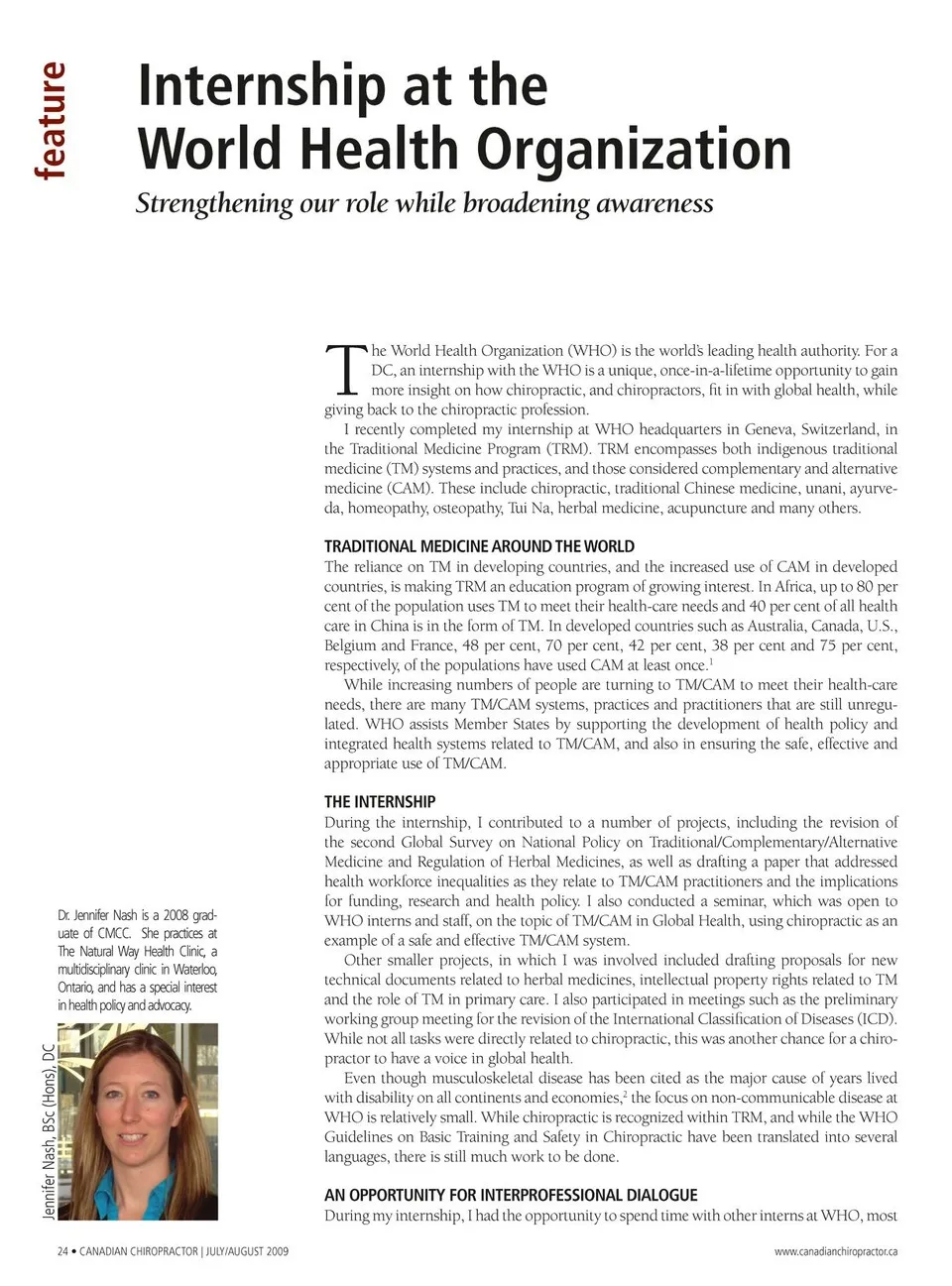
Internship at the World Health Organization Strengthening our role while broadening awareness T he World Health Organization (WHO) is the world’s leading health authority. For a DC, an internship with the WHO is a unique, once-in-a-lifetime opportunity to gain more insight on how chiropractic, and chiropractors, fi t in with global health, while giving back to the chiropractic profession. I recently completed my internship at WHO headquarters in Geneva, Switzerland, in the Traditional Medicine Program (TRM). TRM encompasses both indigenous traditional medicine (TM) systems and practices, and those considered complementary and alternative medicine (CAM). These include chiropractic, traditional Chinese medicine, unani, ayurve- da, homeopathy, osteopathy, Tui Na, herbal medicine, acupuncture and many others. TRADITIONAL MEDICINE AROUND THE WORLD The reliance on TM in developing countries, and the increased use of CAM in developed countries, is making TRM an education program of growing interest. In Africa, up to 80 per cent of the population uses TM to meet their health-care needs and 40 per cent of all health care in China is in the form of TM. In developed countries such as Australia, Canada, U.S., Belgium and France, 48 per cent, 70 per cent, 42 per cent, 38 per cent and 75 per cent, respectively, of the populations have used CAM at least once.1 While increasing numbers of people are turning to TM/CAM to meet their health-care needs, there are many TM/CAM systems, practices and practitioners that are still unregu- lated. WHO assists Member States by supporting the development of health policy and integrated health systems related to TM/CAM, and also in ensuring the safe, effective and appropriate use of TM/CAM. Dr. Jennifer Nash is a 2008 grad- uate of CMCC. She practices at The Natural Way Health Clinic, a multidisciplinary clinic in Waterloo, Ontario, and has a special interest in health policy and advocacy. THE INTERNSHIP During the internship, I contributed to a number of projects, including the revision of the second Global Survey on National Policy on Traditional/Complementary/Alternative Medicine and Regulation of Herbal Medicines, as well as drafting a paper that addressed health workforce inequalities as they relate to TM/CAM practitioners and the implications for funding, research and health policy. I also conducted a seminar, which was open to WHO interns and staff, on the topic of TM/CAM in Global Health, using chiropractic as an example of a safe and effective TM/CAM system. Other smaller projects, in which I was involved included drafting proposals for new technical documents related to herbal medicines, intellectual property rights related to TM and the role of TM in primary care. I also participated in meetings such as the preliminary working group meeting for the revision of the International Classifi cation of Diseases (ICD). While not all tasks were directly related to chiropractic, this was another chance for a chiro- practor to have a voice in global health. Even though musculoskeletal disease has been cited as the major cause of years lived with disability on all continents and economies,2 the focus on non-communicable disease at WHO is relatively small. While chiropractic is recognized within TRM, and while the WHO Guidelines on Basic Training and Safety in Chiropractic have been translated into several languages, there is still much work to be done. AN OPPORTUNITY FOR INTERPROFESSIONAL DIALOGUE During my internship, I had the opportunity to spend time with other interns at WHO, most 24 • CANADIAN CHIROPRACTOR | JULY/AUGUST 2009 www.canadianchiropractor.ca Jennifer Nash, BSc (Hons), DC feature
Chiropractic + Naturopathic Doctor July/August 2009: Page 24