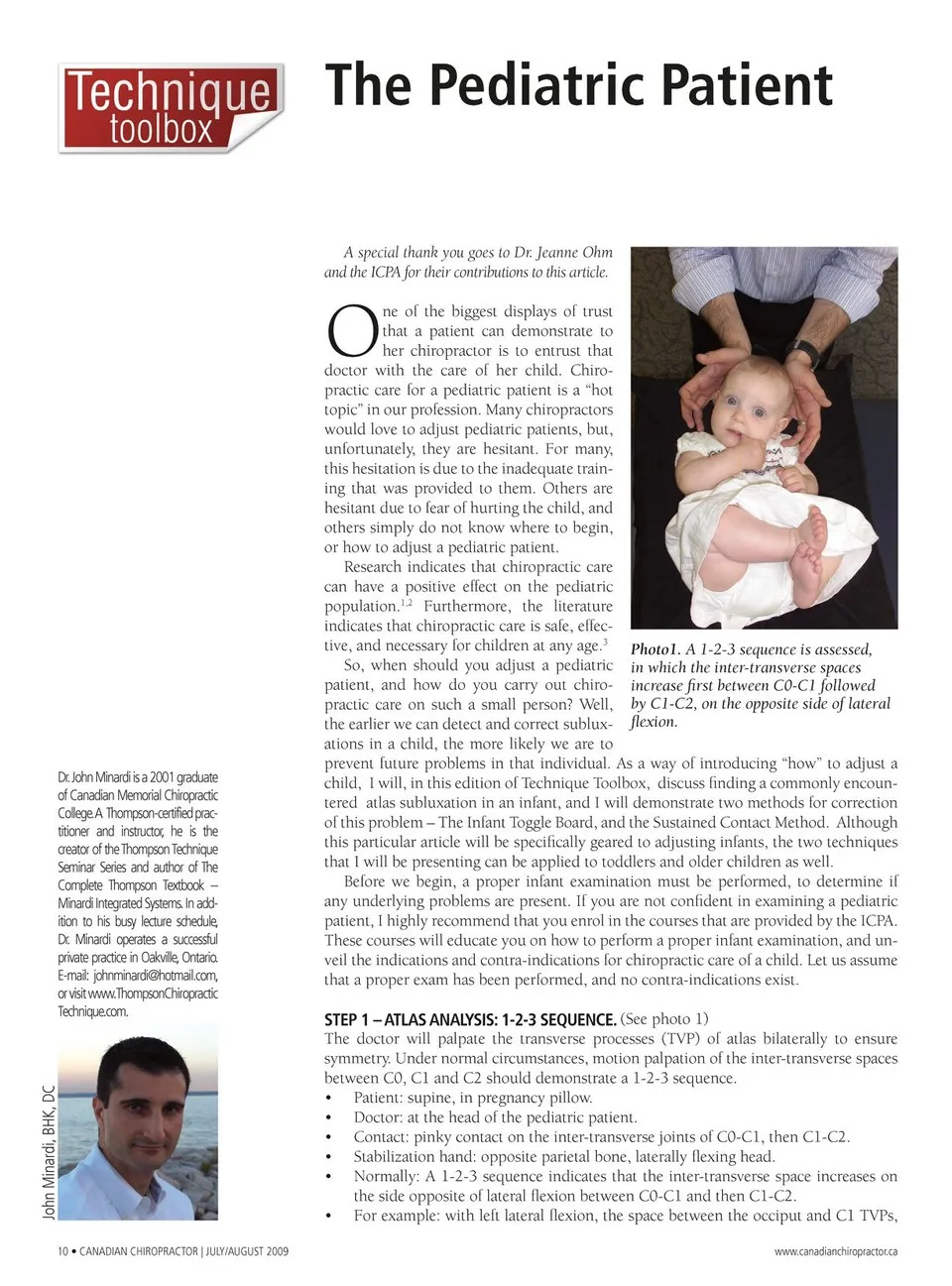
The Pediatric Patient A special thank you goes to Dr. Jeanne Ohm and the ICPA for their contributions to this article. doctor with the care of her child. Chiro- practic care for a pediatric patient is a “hot topic” in our profession. Many chiropractors would love to adjust pediatric patients, but, unfortunately, they are hesitant. For many, this hesitation is due to the inadequate train- ing that was provided to them. Others are hesitant due to fear of hurting the child, and others simply do not know where to begin, or how to adjust a pediatric patient. Research indicates that chiropractic care can have a positive effect on the pediatric population.1,2 O Furthermore, the literature Dr.John Minardi is a 2001 graduate of Canadian Memorial Chiropractic College. A Thompson-certified prac- titioner and instructor, he is the creator of the Thompson Technique Seminar Series and author of The Complete Thompson Textbook – Minardi Integrated Systems.In add- ition to his busy lecture schedule, Dr. Minardi operates a successful private practice in Oakville, Ontario. E-mail: [email protected], or visit www.ThompsonChiropractic Technique.com. indicates that chiropractic care is safe, effec- tive, and necessary for children at any age.3 So, when should you adjust a pediatric patient, and how do you carry out chiro- practic care on such a small person? Well, the earlier we can detect and correct sublux- ations in a child, the more likely we are to prevent future problems in that individual. As a way of introducing “how” to adjust a child, I will, in this edition of Technique Toolbox, discuss fi nding a commonly encoun- tered atlas subluxation in an infant, and I will demonstrate two methods for correction of this problem – The Infant Toggle Board, and the Sustained Contact Method. Although this particular article will be specifically geared to adjusting infants, the two techniques that I will be presenting can be applied to toddlers and older children as well. Before we begin, a proper infant examination must be performed, to determine if any underlying problems are present. If you are not confi dent in examining a pediatric patient, I highly recommend that you enrol in the courses that are provided by the ICPA. These courses will educate you on how to perform a proper infant examination, and un- veil the indications and contra-indications for chiropractic care of a child. Let us assume that a proper exam has been performed, and no contra-indications exist. Photo1. A 1-2-3 sequence is assessed, in which the inter-transverse spaces increase fi rst between C0-C1 followed by C1-C2, on the opposite side of lateral flexion. STEP 1 – ATLAS ANALYSIS: 1-2-3 SEQUENCE. (See photo 1) The doctor will palpate the transverse processes (TVP) of atlas bilaterally to ensure symmetry. Under normal circumstances, motion palpation of the inter-transverse spaces between C0, C1 and C2 should demonstrate a 1-2-3 sequence. Patient: supine, in pregnancy pillow. Doctor: at the head of the pediatric patient. Contact: pinky contact on the inter-transverse joints of C0-C1, then C1-C2. Stabilization hand: opposite parietal bone, laterally flexing head. Normally: A 1-2-3 sequence indicates that the inter-transverse space increases on the side opposite of lateral fl exion between C0-C1 and then C1-C2. For example: with left lateral fl exion, the space between the occiput and C1 TVPs, • • • • • • 10 • CANADIAN CHIROPRACTOR | JULY/AUGUST 2009 www.canadianchiropractor.ca ne of the biggest displays of trust that a patient can demonstrate to her chiropractor is to entrust that John Minardi, BHK, DC
Chiropractic + Naturopathic Doctor July/August 2009: Page 10