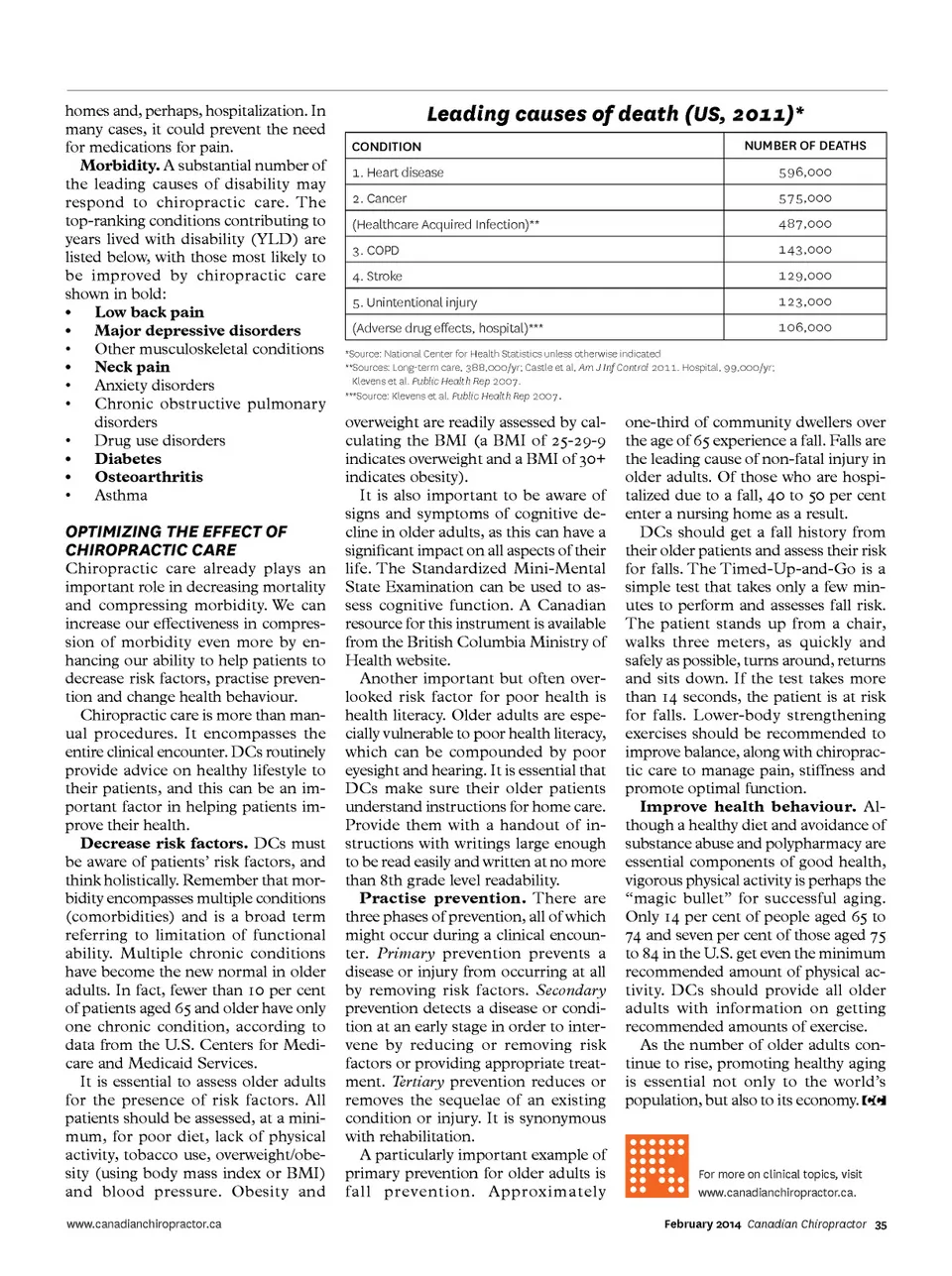
FEATURE about the health problems, risk factors and preventive care strategies that will promote successful aging in their pa-tient population. Most definitions of the term “success-ful aging” involve three components: low probability/presence of disease or disability; high cognitive and physical function; and active engagement in life. Another way successful aging is con-ceptualized is through researcher James Fries’s “compression of morbidity” model, in which morbidity is com-pressed so that one lives a greater pe-riod of time free of illness and disability. This model considers “morbidity” to be any impairment of function or de-crease in health-related quality of life. Morbidity is essentially related to abil-ity to function, rather than to any spe-cific disease process. This is highly relevant to chiropractic practice, since chiropractic care helps people function better, helping us make a case that chiropractic can contribute to the com-pression of morbidity. successFul agINg deFINed CLINICAL senior moment successFul agINg Measures W Chiropractic care for older patients plays an important role in promoting successful aging by CheryL hAWk presently served will increase, since spine-related musculoskeletal pain is a significant health issue in this age group. It is important to continue to increase public awareness that chiro-practic is both safe and effective for many conditions common in older adults, and that manipulation is not a risk factor for vertebrobasilar stroke. We should also proactively ensure the graduates of our training institu-tions are well prepared not only to provide relief for musculoskeletal con-ditions, but also to provide preventive services and promote wellness. This requires that DCs be knowledgeable orldwide, the proportion of older adults is increasing to the highest number ever recorded. By 2017, there will be more adults aged 65 and older than children under age five, according to the World Health Organ-ization. By 2050, over 20 per cent, or about two billion, of the world’s popu-lation will be older than age 60. As chiropractors, we might expect that the 15 per cent of the chiropractic patient population aged 65 and older CheryL hAWk, dC, phd, CheS is a professor and dean of research at Logan University in Chesterfield, Mo., and author of more than 90 publications in peer-reviewed scientific journals. She was named Researcher of the Year by both the American Chiropractic Association (2003) and the Foundation for Chiropractic Education and Research (2005). 34 Canadian Chiropractor February 2014 Besides defining “successful aging,” we also need to be able to measure it. In the “compression of morbidity” model, since morbidity is seen as a decrease in normal function or health-related qual-ity of life, measures of functional disa-bility and quality of life can be used as proxies for morbidity. Mortality. Using measures of both mortality and morbidity, we can iden-tify ways in which chiropractic can help people age more successfully. For ex-ample, it is instructive to look at overall causes of death. Table 1 shows the leading causes of death in the U.S. for 2011, but additional nonspecific causes have been inserted into the standard list to illustrate an important issue. These numbers show that health-care-acquired infections, primarily from long-term care facilities, are more nu-merous than any other causes of death, except cancer and heart disease. Fur-thermore, adverse drug effects in the hospital come in as a leading cause of death after unintentional injury. Chiropractic care can help people maintain their physical function, as well as help manage pain. This can help them stay independent, avoid nursing www.canadianchiropractor.ca Photo: Fotolia
Chiropractic + Naturopathic Doctor February 2014: Page 34