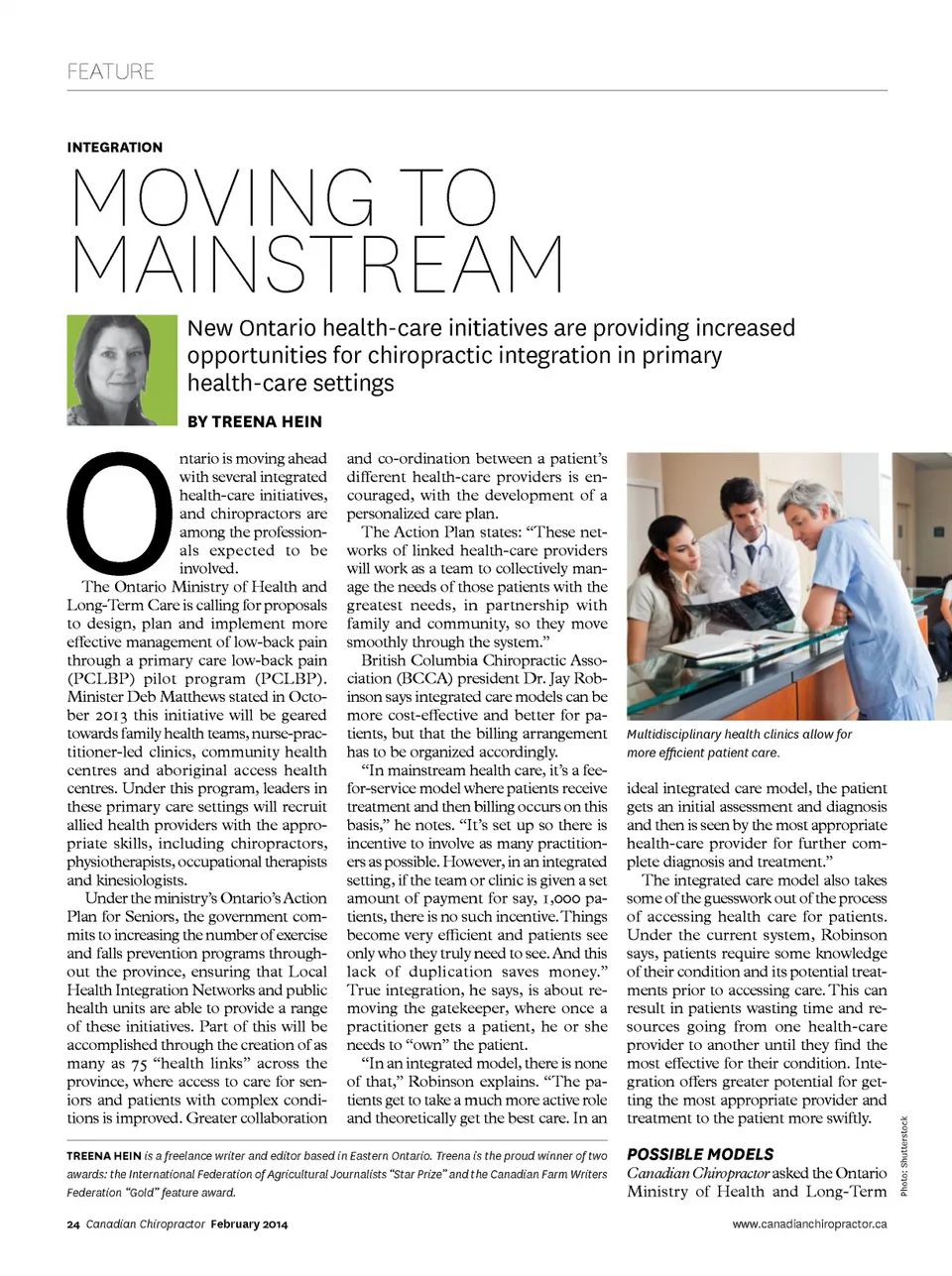
FEATURE INTEGRATION MOVINg TO MAINSTREAM O New Ontario health-care initiatives are providing increased opportunities for chiropractic integration in primary health-care settings by treenA hein and co-ordination between a patient’s different health-care providers is en-couraged, with the development of a personalized care plan. The Action Plan states: “These net-works of linked health-care providers will work as a team to collectively man-age the needs of those patients with the greatest needs, in partnership with family and community, so they move smoothly through the system.” British Columbia Chiropractic Asso-ciation (BCCA) president Dr. Jay Rob-inson says integrated care models can be more cost-effective and better for pa-tients, but that the billing arrangement has to be organized accordingly. “In mainstream health care, it’s a fee-for-service model where patients receive treatment and then billing occurs on this basis,” he notes. “It’s set up so there is incentive to involve as many practition-ers as possible. However, in an integrated setting, if the team or clinic is given a set amount of payment for say, 1,000 pa-tients, there is no such incentive. Things become very efficient and patients see only who they truly need to see. And this lack of duplication saves money.” True integration, he says, is about re-moving the gatekeeper, where once a practitioner gets a patient, he or she needs to “own” the patient. “In an integrated model, there is none of that,” Robinson explains. “The pa-tients get to take a much more active role and theoretically get the best care. In an treenA hein is a freelance writer and editor based in Eastern Ontario. Treena is the proud winner of two awards: the International Federation of Agricultural Journalists “Star Prize” and the Canadian Farm Writers Federation “Gold” feature award. 24 Canadian Chiropractor February 2014 PossIble Models Canadian Chiropractor asked the Ontario Ministry of Health and Long-Term www.canadianchiropractor.ca Photo: Shutterstock ntario is moving ahead with several integrated health-care initiatives, and chiropractors are among the profession-als expected to be involved. The Ontario Ministry of Health and Long-Term Care is calling for proposals to design, plan and implement more effective management of low-back pain through a primary care low-back pain (PCLBP) pilot program (PCLBP). Minister Deb Matthews stated in Octo-ber 2013 this initiative will be geared towards family health teams, nurse-prac-titioner-led clinics, community health centres and aboriginal access health centres. Under this program, leaders in these primary care settings will recruit allied health providers with the appro-priate skills, including chiropractors, physiotherapists, occupational therapists and kinesiologists. Under the ministry’s Ontario’s Action Plan for Seniors, the government com-mits to increasing the number of exercise and falls prevention programs through-out the province, ensuring that Local Health Integration Networks and public health units are able to provide a range of these initiatives. Part of this will be accomplished through the creation of as many as 75 “health links” across the province, where access to care for sen-iors and patients with complex condi-tions is improved. Greater collaboration Multidisciplinary health clinics allow for more efficient patient care. ideal integrated care model, the patient gets an initial assessment and diagnosis and then is seen by the most appropriate health-care provider for further com-plete diagnosis and treatment.” The integrated care model also takes some of the guesswork out of the process of accessing health care for patients. Under the current system, Robinson says, patients require some knowledge of their condition and its potential treat-ments prior to accessing care. This can result in patients wasting time and re-sources going from one health-care provider to another until they find the most effective for their condition. Inte-gration offers greater potential for get-ting the most appropriate provider and treatment to the patient more swiftly.
Chiropractic + Naturopathic Doctor February 2014: Page 24