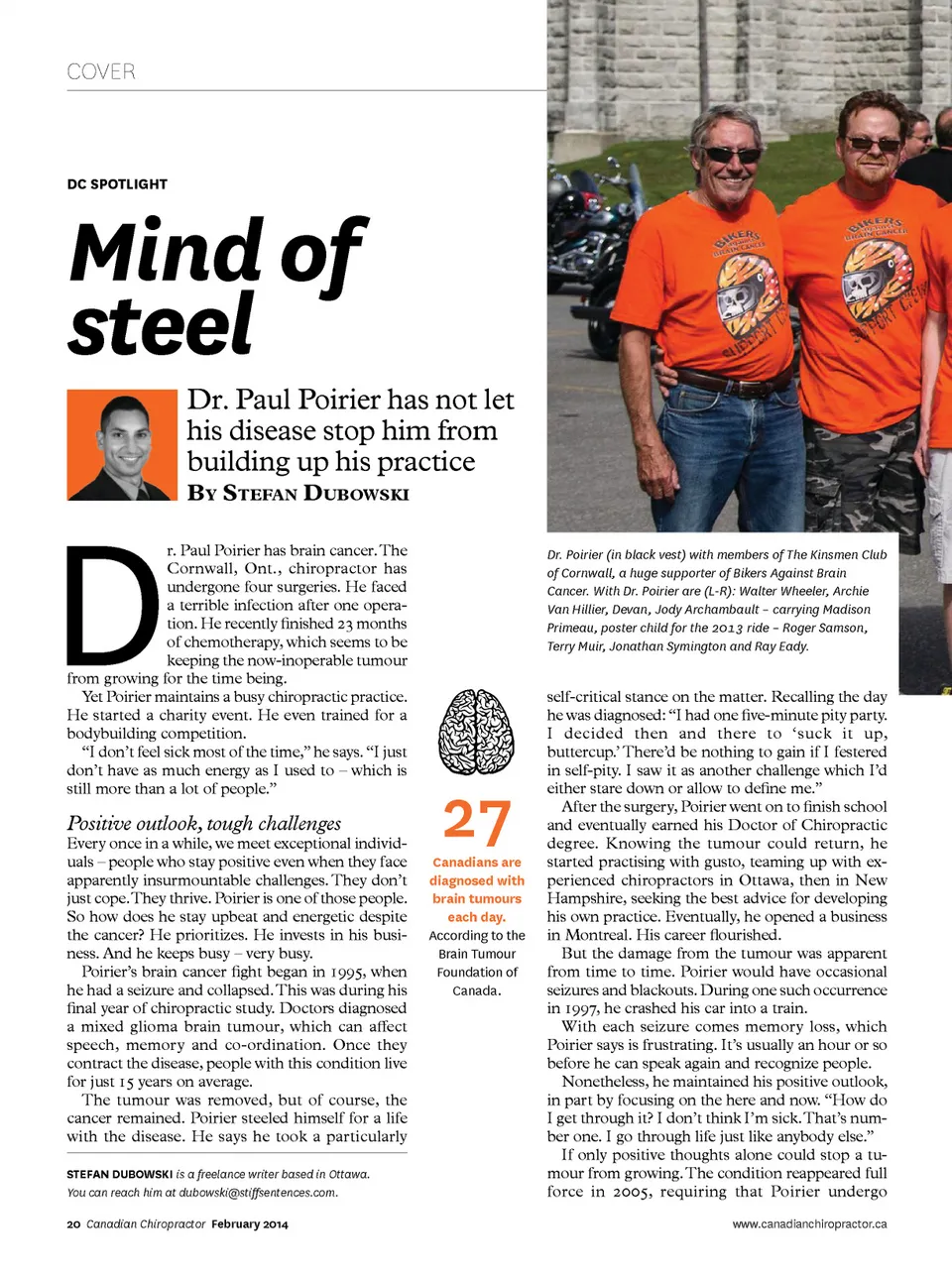
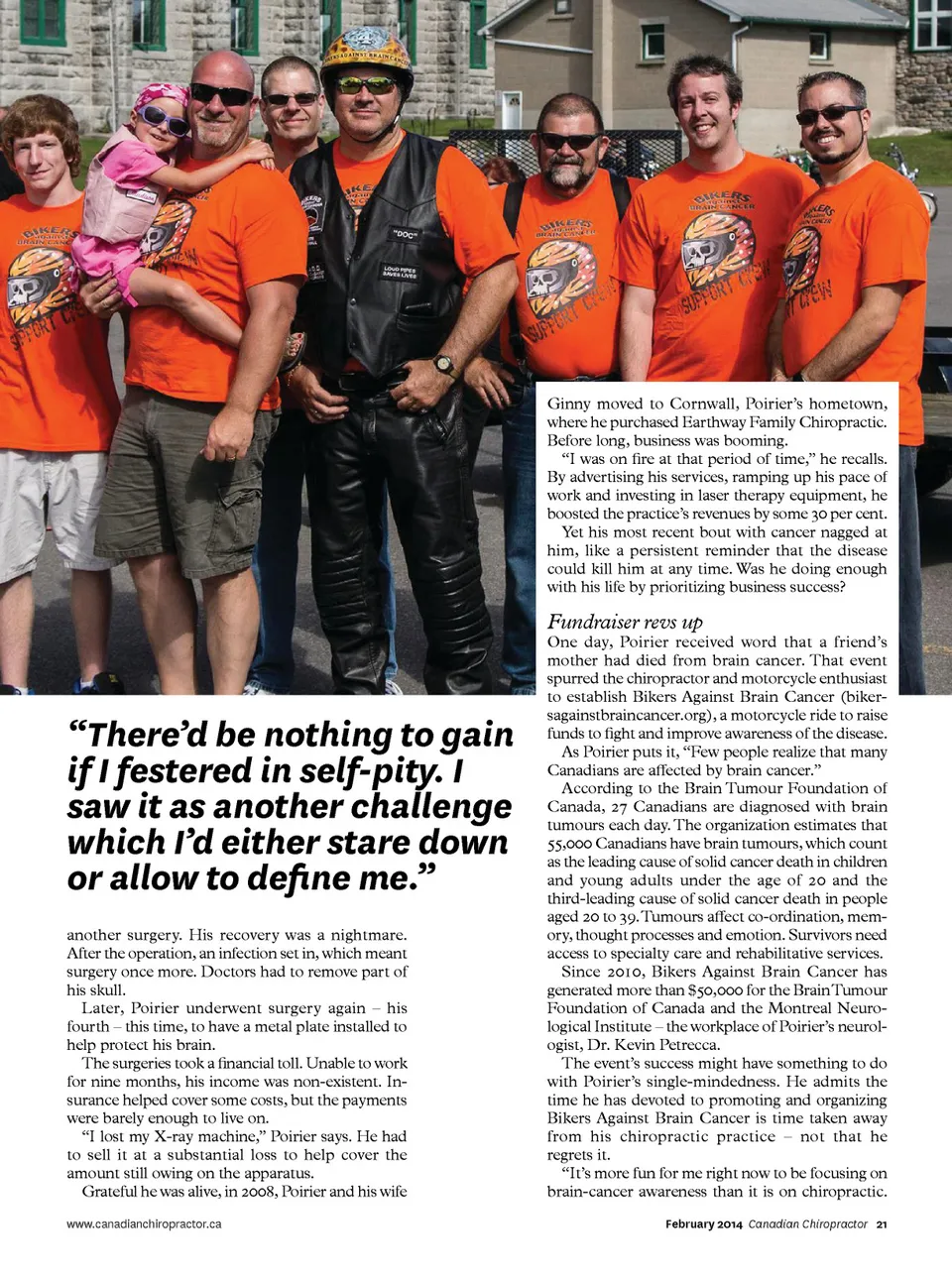
COVER DC sPOTLIGHT Mind of steel D Dr. Paul Poirier has not let his disease stop him from building up his practice B y S tefan D uBowSki Dr. Poirier (in black vest) with members of The Kinsmen Club of Cornwall, a huge supporter of Bikers Against Brain Cancer. With Dr. Poirier are (L-R): Walter Wheeler, Archie Van Hillier, Devan, Jody Archambault – carrying Madison Primeau, poster child for the 2013 ride – Roger Samson, Terry Muir, Jonathan Symington and Ray Eady. r. Paul Poirier has brain cancer. The Cornwall, Ont., chiropractor has undergone four surgeries. He faced a terrible infection after one opera-tion. He recently finished 23 months of chemotherapy, which seems to be keeping the now-inoperable tumour from growing for the time being. Yet Poirier maintains a busy chiropractic practice. He started a charity event. He even trained for a bodybuilding competition. “I don’t feel sick most of the time,” he says. “I just don’t have as much energy as I used to – which is still more than a lot of people.” Positive outlook, tough challenges Every once in a while, we meet exceptional individ-uals – people who stay positive even when they face apparently insurmountable challenges. They don’t just cope. They thrive. Poirier is one of those people. So how does he stay upbeat and energetic despite the cancer? He prioritizes. He invests in his busi-ness. And he keeps busy – very busy. Poirier’s brain cancer fight began in 1995, when he had a seizure and collapsed. This was during his final year of chiropractic study. Doctors diagnosed a mixed glioma brain tumour, which can affect speech, memory and co-ordination. Once they contract the disease, people with this condition live for just 15 years on average. The tumour was removed, but of course, the cancer remained. Poirier steeled himself for a life with the disease. He says he took a particularly SteFAn duboWSki is a freelance writer based in Ottawa. You can reach him at [email protected]. 20 Canadian Chiropractor February 2014 Canadians are diagnosed with brain tumours each day. According to the Brain Tumour Foundation of Canada. 27 self-critical stance on the matter. Recalling the day he was diagnosed: “I had one five-minute pity party. I decided then and there to ‘suck it up, buttercup.’ There’d be nothing to gain if I festered in self-pity. I saw it as another challenge which I’d either stare down or allow to define me.” After the surgery, Poirier went on to finish school and eventually earned his Doctor of Chiropractic degree. Knowing the tumour could return, he started practising with gusto, teaming up with ex-perienced chiropractors in Ottawa, then in New Hampshire, seeking the best advice for developing his own practice. Eventually, he opened a business in Montreal. His career flourished. But the damage from the tumour was apparent from time to time. Poirier would have occasional seizures and blackouts. During one such occurrence in 1997, he crashed his car into a train. With each seizure comes memory loss, which Poirier says is frustrating. It’s usually an hour or so before he can speak again and recognize people. Nonetheless, he maintained his positive outlook, in part by focusing on the here and now. “How do I get through it? I don’t think I’m sick. That’s num-ber one. I go through life just like anybody else.” If only positive thoughts alone could stop a tu-mour from growing. The condition reappeared full force in 2005, requiring that Poirier undergo www.canadianchiropractor.ca
Chiropractic + Naturopathic Doctor February 2014: Page 20