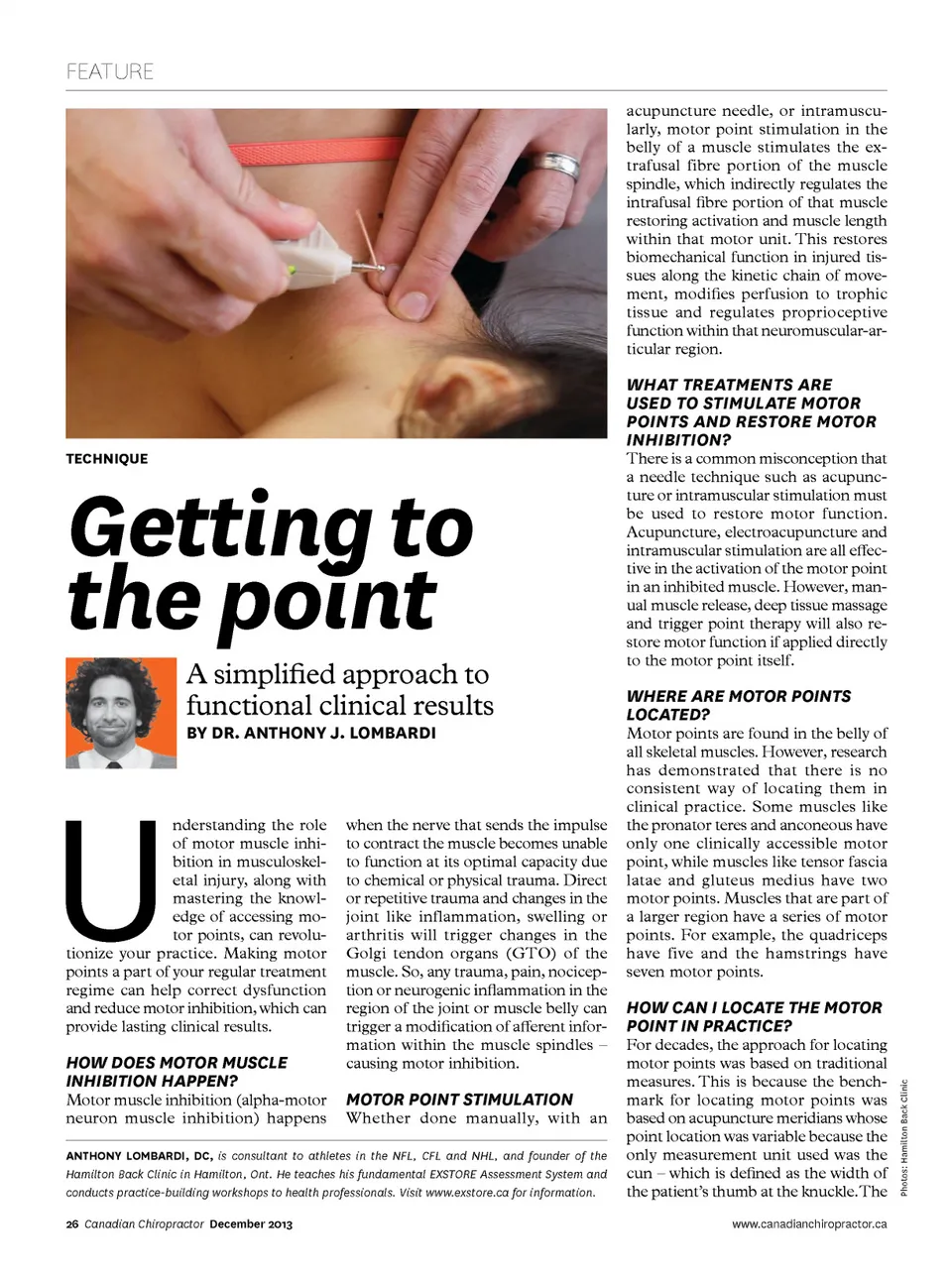
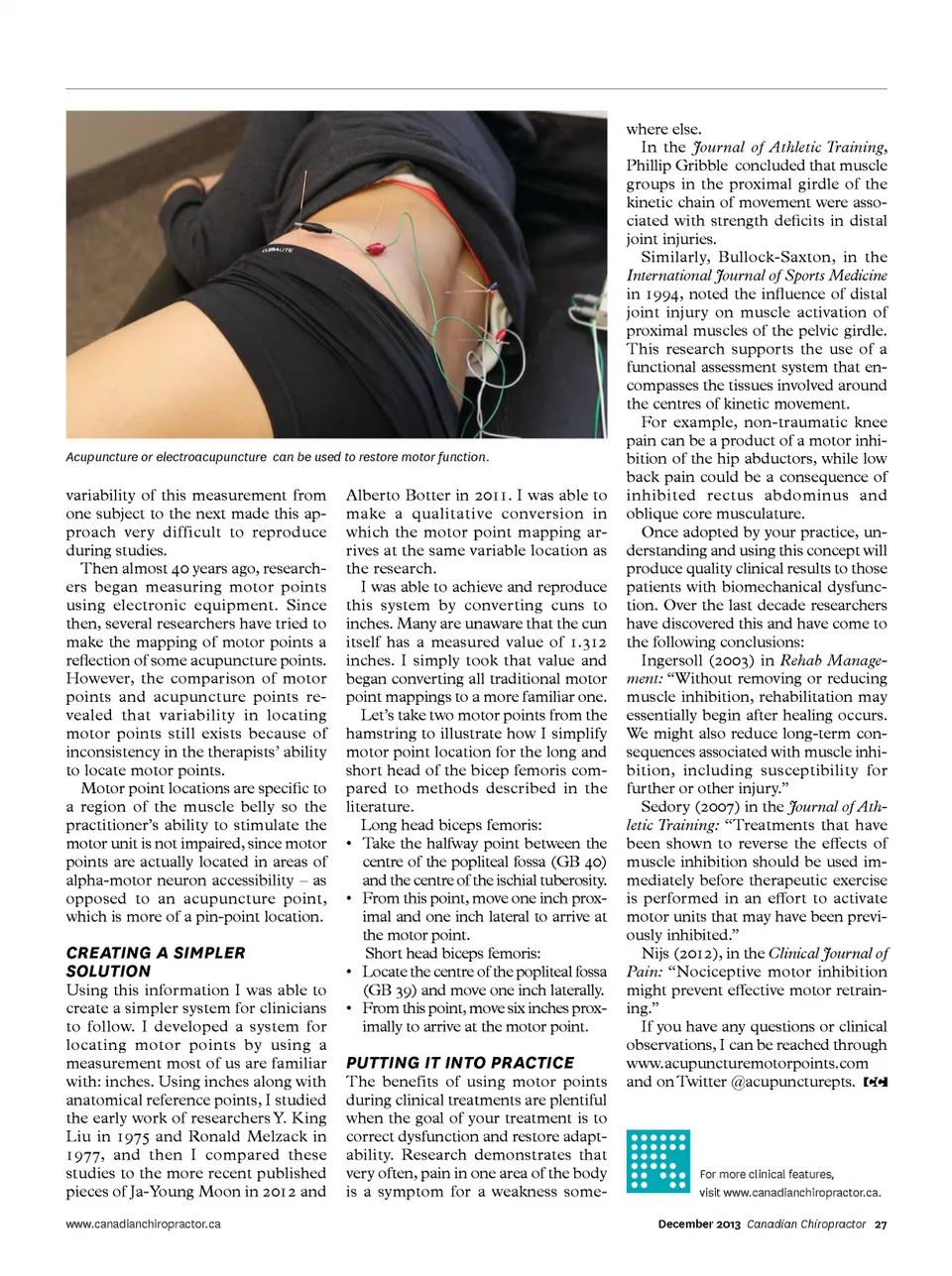
Acupuncture or electroacupuncture can be used to restore motor function. variability of this measurement from one subject to the next made this ap-proach very difficult to reproduce during studies. Then almost 40 years ago, research-ers began measuring motor points using electronic equipment. Since then, several researchers have tried to make the mapping of motor points a reflection of some acupuncture points. However, the comparison of motor points and acupuncture points re-vealed that variability in locating motor points still exists because of inconsistency in the therapists’ ability to locate motor points. Motor point locations are specific to a region of the muscle belly so the practitioner’s ability to stimulate the motor unit is not impaired, since motor points are actually located in areas of alpha-motor neuron accessibility – as opposed to an acupuncture point, which is more of a pin-point location. CreaTiNG a simpler soluTioN Using this information I was able to create a simpler system for clinicians to follow. I developed a system for locating motor points by using a measurement most of us are familiar with: inches. Using inches along with anatomical reference points, I studied the early work of researchers Y. King Liu in 1975 and Ronald Melzack in 1977, and then I compared these studies to the more recent published pieces of Ja-Young Moon in 2012 and www.canadianchiropractor.ca Alberto Botter in 2011. I was able to make a qualitative conversion in which the motor point mapping ar-rives at the same variable location as the research. I was able to achieve and reproduce this system by converting cuns to inches. Many are unaware that the cun itself has a measured value of 1.312 inches. I simply took that value and began converting all traditional motor point mappings to a more familiar one. Let’s take two motor points from the hamstring to illustrate how I simplify motor point location for the long and short head of the bicep femoris com-pared to methods described in the literature. Long head biceps femoris: • Take the halfway point between the centre of the popliteal fossa (GB 40) and the centre of the ischial tuberosity. • From this point, move one inch prox-imal and one inch lateral to arrive at the motor point. Short head biceps femoris: • Locate the centre of the popliteal fossa (GB 39) and move one inch laterally. • From this point, move six inches prox-imally to arrive at the motor point. puTTiNG iT iNTo praCTiCe The benefits of using motor points during clinical treatments are plentiful when the goal of your treatment is to correct dysfunction and restore adapt-ability. Research demonstrates that very often, pain in one area of the body is a symptom for a weakness some-where else. In the Journal of Athletic Training , Phillip Gribble concluded that muscle groups in the proximal girdle of the kinetic chain of movement were asso-ciated with strength deficits in distal joint injuries. Similarly, Bullock-Saxton, in the International Journal of Sports Medicine in 1994, noted the influence of distal joint injury on muscle activation of proximal muscles of the pelvic girdle. This research supports the use of a functional assessment system that en-compasses the tissues involved around the centres of kinetic movement. For example, non-traumatic knee pain can be a product of a motor inhi-bition of the hip abductors, while low back pain could be a consequence of inhibited rectus abdominus and oblique core musculature. Once adopted by your practice, un-derstanding and using this concept will produce quality clinical results to those patients with biomechanical dysfunc-tion. Over the last decade researchers have discovered this and have come to the following conclusions: Ingersoll (2003) in Rehab Manage-ment: “Without removing or reducing muscle inhibition, rehabilitation may essentially begin after healing occurs. We might also reduce long-term con-sequences associated with muscle inhi-bition, including susceptibility for further or other injury.” Sedory (2007) in the Journal of Ath-letic Training: “Treatments that have been shown to reverse the effects of muscle inhibition should be used im-mediately before therapeutic exercise is performed in an effort to activate motor units that may have been previ-ously inhibited.” Nijs (2012), in the Clinical Journal of Pain: “Nociceptive motor inhibition might prevent effective motor retrain-ing.” If you have any questions or clinical observations, I can be reached through www.acupuncturemotorpoints.com and on Twitter @acupuncturepts. For more clinical features, visit www.canadianchiropractor.ca. December 2013 Canadian Chiropractor 27
Chiropractic + Naturopathic Doctor December 2013: Page 27