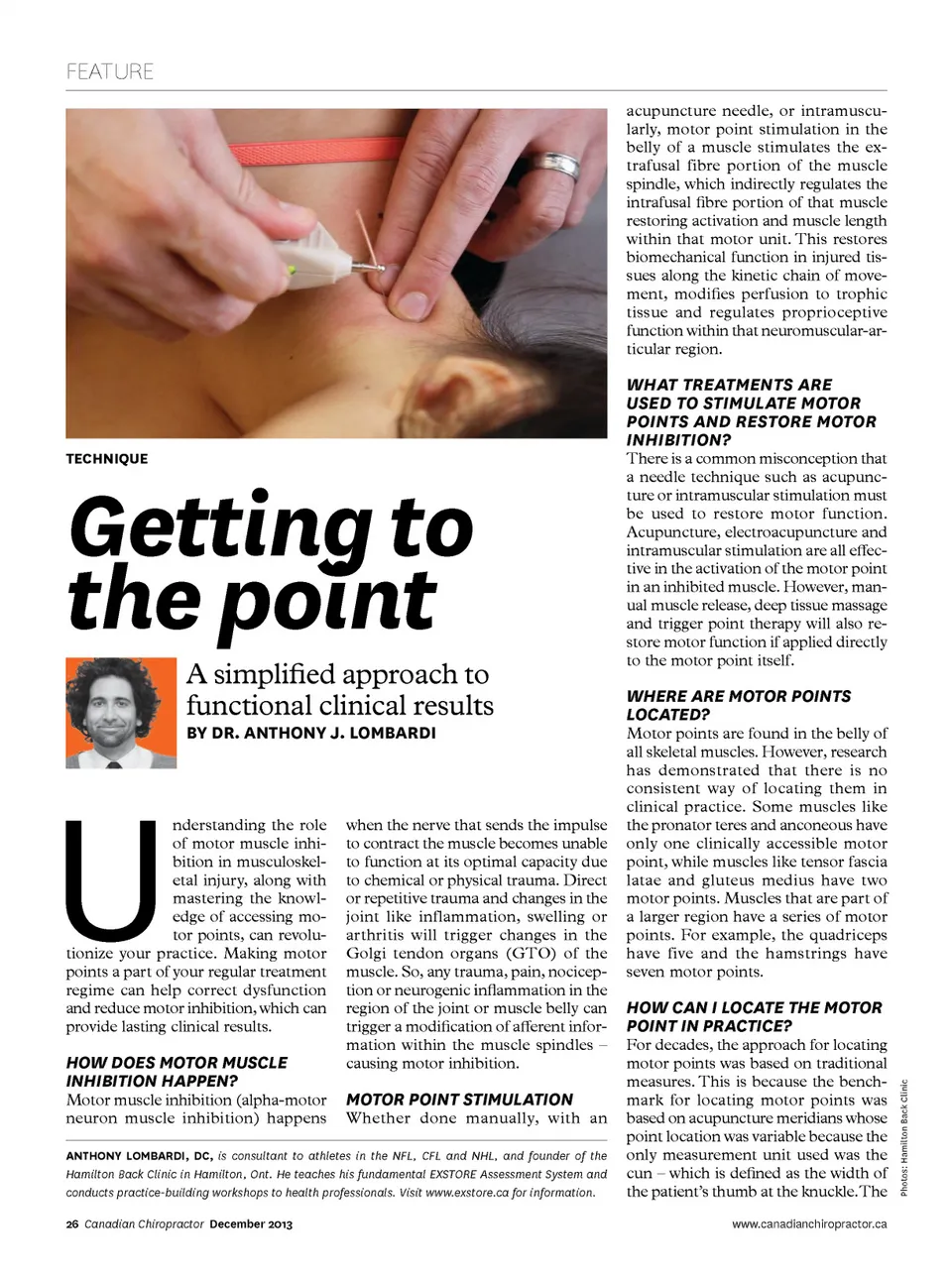
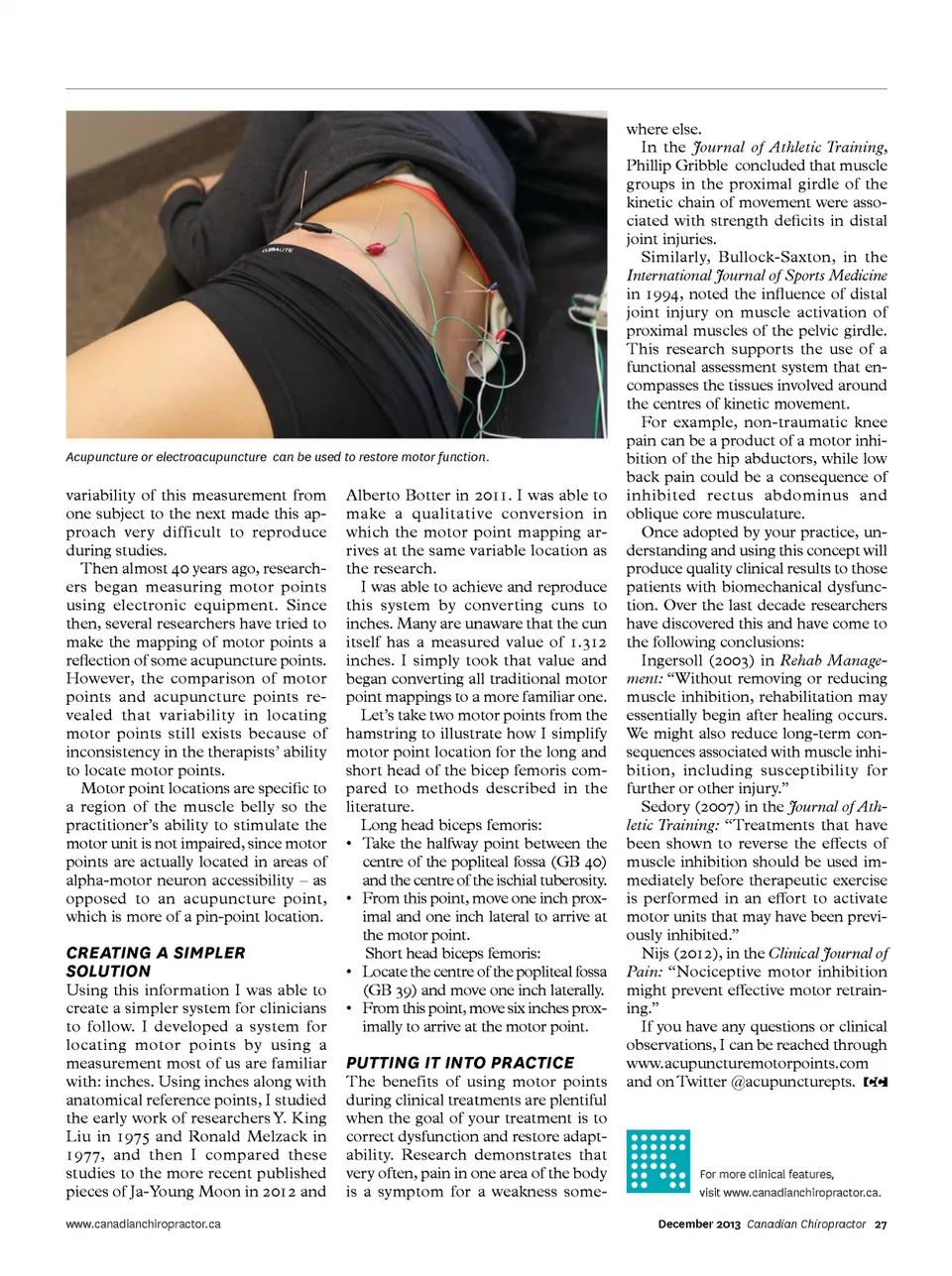
FEATURE acupuncture needle, or intramuscu-larly, motor point stimulation in the belly of a muscle stimulates the ex-trafusal fibre portion of the muscle spindle, which indirectly regulates the intrafusal fibre portion of that muscle restoring activation and muscle length within that motor unit. This restores biomechanical function in injured tis-sues along the kinetic chain of move-ment, modifies perfusion to trophic tissue and regulates proprioceptive function within that neuromuscular-ar-ticular region. TECHNIQUE wHaT TreaTmeNTs are used To sTimulaTe moTor poiNTs aNd resTore moTor iNHibiTioN? Getting to the point A simplified approach to functional clinical results by Dr. Anthony J. lombArDi There is a common misconception that a needle technique such as acupunc-ture or intramuscular stimulation must be used to restore motor function. Acupuncture, electroacupuncture and intramuscular stimulation are all effec-tive in the activation of the motor point in an inhibited muscle. However, man-ual muscle release, deep tissue massage and trigger point therapy will also re-store motor function if applied directly to the motor point itself. wHere are moTor poiNTs loCaTed? U nderstanding the role of motor muscle inhi-bition in musculoskel-etal injury, along with mastering the knowl-edge of accessing mo-tor points, can revolu-tionize your practice. Making motor points a part of your regular treatment regime can help correct dysfunction and reduce motor inhibition, which can provide lasting clinical results. Motor muscle inhibition (alpha-motor neuron muscle inhibition) happens moTor poiNT sTimulaTioN Whether done manually, with an Anthony lombArDi, DC, is consultant to athletes in the NFL, CFL and NHL, and founder of the Hamilton Back Clinic in Hamilton, Ont. He teaches his fundamental EXSTORE Assessment System and conducts practice-building workshops to health professionals. Visit www.exstore.ca for information. 26 Canadian Chiropractor December 2013 www.canadianchiropractor.ca Photos: Hamilton Back Clinic How does moTor musCle iNHibiTioN HappeN? when the nerve that sends the impulse to contract the muscle becomes unable to function at its optimal capacity due to chemical or physical trauma. Direct or repetitive trauma and changes in the joint like inflammation, swelling or arthritis will trigger changes in the Golgi tendon organs (GTO) of the muscle. So, any trauma, pain, nocicep-tion or neurogenic inflammation in the region of the joint or muscle belly can trigger a modification of afferent infor-mation within the muscle spindles – causing motor inhibition. Motor points are found in the belly of all skeletal muscles. However, research has demonstrated that there is no consistent way of locating them in clinical practice. Some muscles like the pronator teres and anconeous have only one clinically accessible motor point, while muscles like tensor fascia latae and gluteus medius have two motor points. Muscles that are part of a larger region have a series of motor points. For example, the quadriceps have five and the hamstrings have seven motor points. How CaN i loCaTe THe moTor poiNT iN praCTiCe? For decades, the approach for locating motor points was based on traditional measures. This is because the bench-mark for locating motor points was based on acupuncture meridians whose point location was variable because the only measurement unit used was the cun – which is defined as the width of the patient’s thumb at the knuckle. The
Chiropractic + Naturopathic Doctor December 2013: Page 26