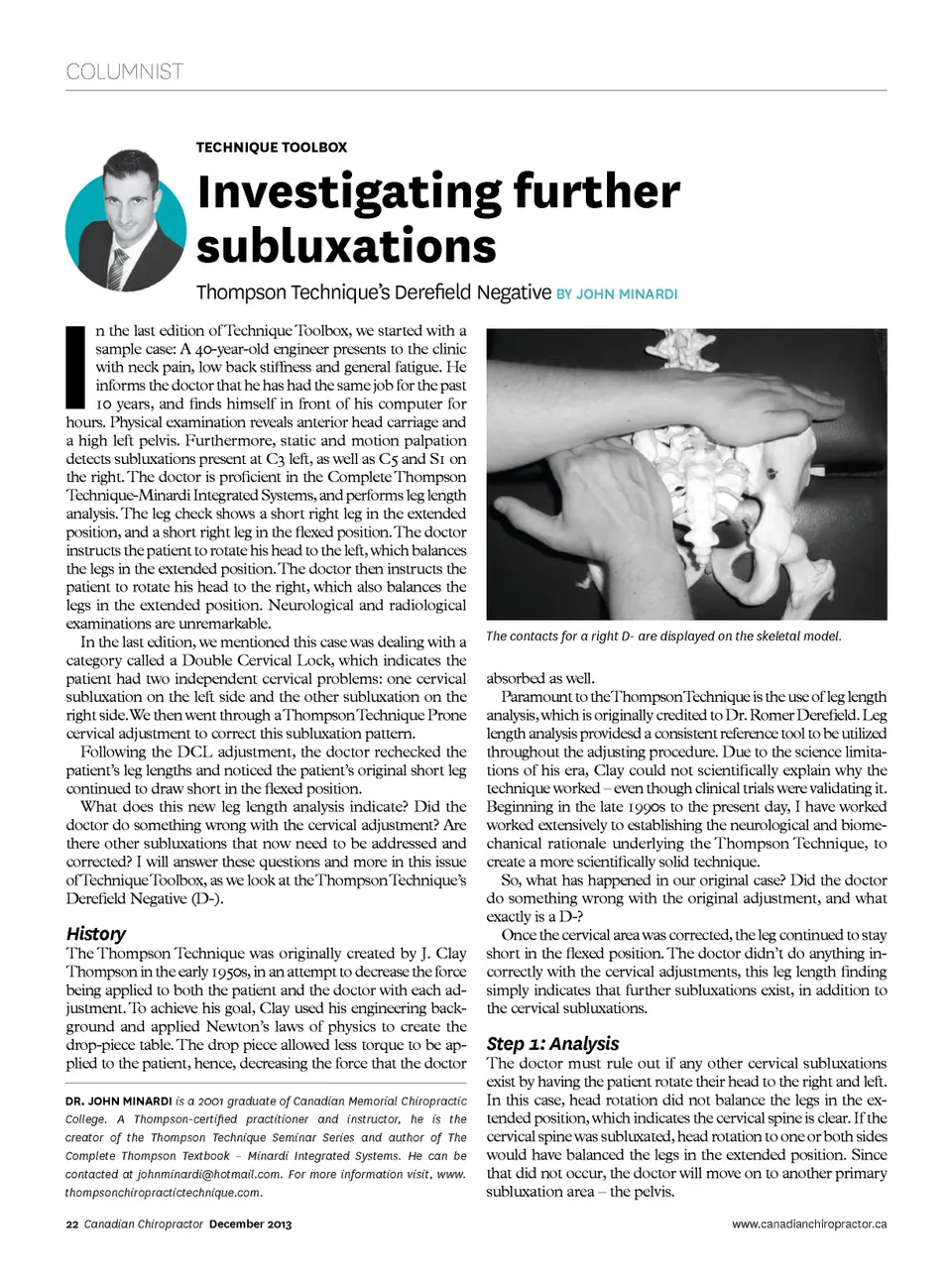
In this case, the right leg appeared short in the extended position and remained short in the flexed position. This indi-cates that a possible D-exists – provided that one of the fol-lowing tender points are elicited: • ipsilateral medial-proximal tibia • ipsilateral ischial tuberosity • ipsilateral PSIS • ipsilateral pubic bone • contralateral erector spinae from T2-T6 Note that ipsilateral and contralateral are referenced in re-lation to the short leg. Please remember that only one of the aforementioned tender points needs to be elicited, not all of them. If one tender point is present, this verifies that the prob-lem is a D-, which indicates the sacral base has subluxated anterior-inferior (AI) on the ipsilateral short leg side. Step 2: Correction Modified prone sacral adjustment (Image 1) There are several ways of correcting this subluxation. The following is the modified prone sacral adjustment. Patient: Prone. Cross the short leg over the opposite leg to gap the involved joint. Doctor: Opposite side of the subluxation. Table: Pelvic piece in the ready position. Contact: Fleshy hypothenar on opposite sacral notch. Stabilization: PSIS of short leg side, or reinforcing the contact hand. LOC: P-A with torque towards involved side. Repeat three times. It is important for the doctor to note that crossing the af-fected leg over the unaffected leg produces a gapping in the involved SI joint, providing the room necessary to work within the affected joint. The adjustment corrects for both directions of the sublux-ation simultaneously: The P-A thrust and drop-piece component on the opposite sacral apex utilizes the oblique axis of the sacrum, correcting the anteriority of the subluxation. The torque that is implemented rotates the sacrum along its transverse axis, within the coronal plane, correcting the inferiority. Following this adjustment, the patient’s legs returned to balance in the extended position, and remained balanced in the flexed position, indicating that no further subluxations were present. The primary subluxations were detected and corrected, resulting in a balanced nervous system as displayed by the balanced leg length analysis. As usual, I have only touched the surface of this technique. If you would like to learn more please go to www.thomp-sonchiropractictechnique.com. If you have any questions, contact me at [email protected]. Until next time. . . adjust with confidence! www.canadianchiropractor.ca Half PAge.indd 1 December 2013 Canadian Chiropractor 23 2013-11-28 10:50 AM
Chiropractic + Naturopathic Doctor December 2013: Page 23