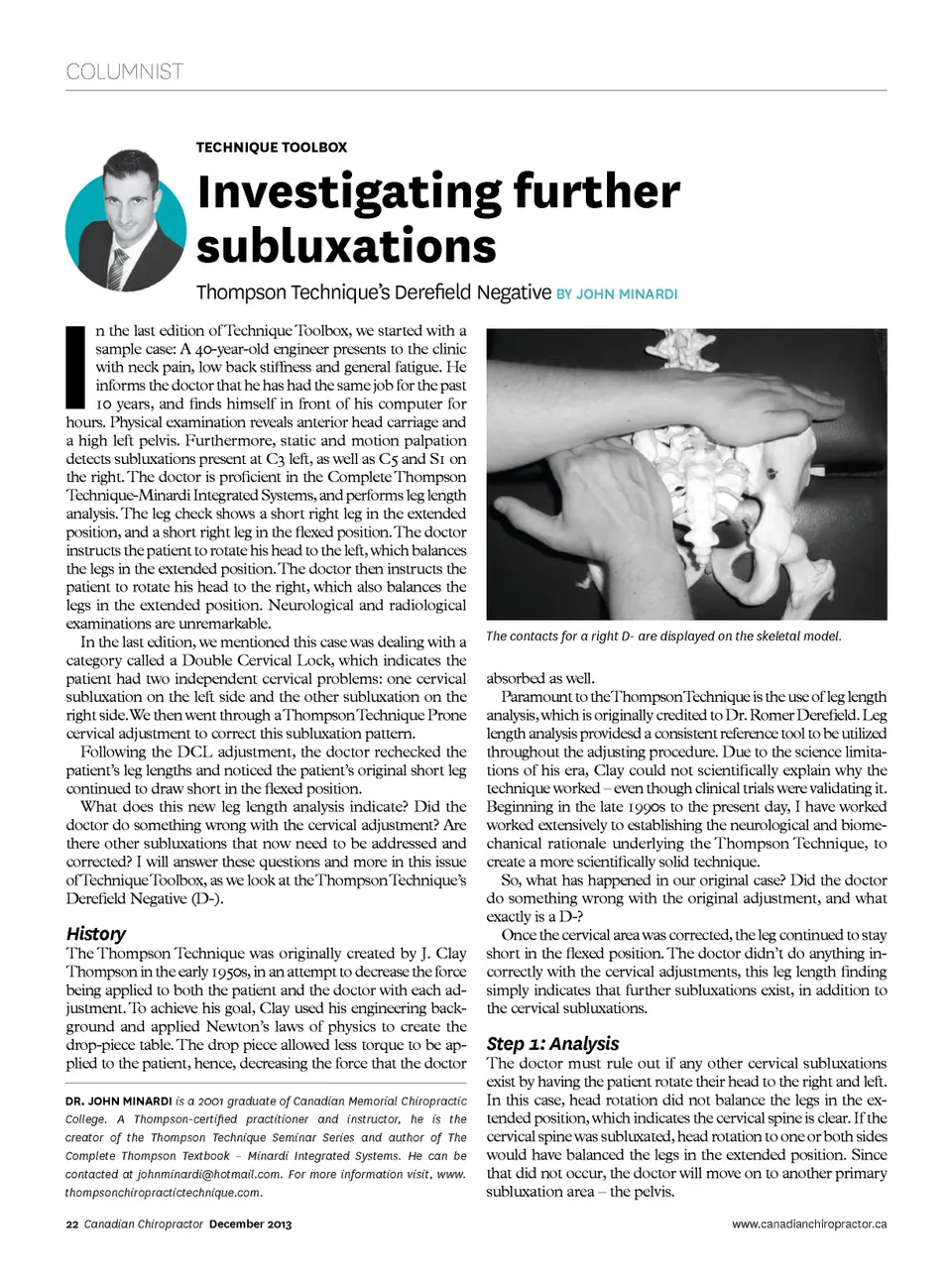
COLUMNIST TECHNIQUE TOOLBOx i Investigating further subluxations Thompson Technique’s Derefield Negative By John MinArdi n the last edition of Technique Toolbox, we started with a sample case: A 40-year-old engineer presents to the clinic with neck pain, low back stiffness and general fatigue. He informs the doctor that he has had the same job for the past 10 years, and finds himself in front of his computer for hours. Physical examination reveals anterior head carriage and a high left pelvis. Furthermore, static and motion palpation detects subluxations present at C3 left, as well as C5 and S1 on the right. The doctor is proficient in the Complete Thompson Technique-Minardi Integrated Systems, and performs leg length analysis. The leg check shows a short right leg in the extended position, and a short right leg in the flexed position. The doctor instructs the patient to rotate his head to the left, which balances the legs in the extended position. The doctor then instructs the patient to rotate his head to the right, which also balances the legs in the extended position. Neurological and radiological examinations are unremarkable. In the last edition, we mentioned this case was dealing with a category called a Double Cervical Lock, which indicates the patient had two independent cervical problems: one cervical subluxation on the left side and the other subluxation on the right side. We then went through a Thompson Technique Prone cervical adjustment to correct this subluxation pattern. Following the DCL adjustment, the doctor rechecked the patient’s leg lengths and noticed the patient’s original short leg continued to draw short in the flexed position. What does this new leg length analysis indicate? Did the doctor do something wrong with the cervical adjustment? Are there other subluxations that now need to be addressed and corrected? I will answer these questions and more in this issue of Technique Toolbox, as we look at the Thompson Technique’s Derefield Negative (D-). The contacts for a right D-are displayed on the skeletal model. History The Thompson Technique was originally created by J. Clay Thompson in the early 1950s, in an attempt to decrease the force being applied to both the patient and the doctor with each ad-justment. To achieve his goal, Clay used his engineering back-ground and applied Newton’s laws of physics to create the drop-piece table. The drop piece allowed less torque to be ap-plied to the patient, hence, decreasing the force that the doctor Dr. John minArDi is a 2001 graduate of Canadian Memorial Chiropractic College. A Thompson-certified practitioner and instructor, he is the creator of the Thompson Technique Seminar Series and author of The Complete Thompson Textbook – Minardi Integrated Systems. He can be contacted at [email protected]. For more information visit, www. thompsonchiropractictechnique.com. 22 Canadian Chiropractor December 2013 absorbed as well. Paramount to the Thompson Technique is the use of leg length analysis, which is originally credited to Dr. Romer Derefield. Leg length analysis providesd a consistent reference tool to be utilized throughout the adjusting procedure. Due to the science limita-tions of his era, Clay could not scientifically explain why the technique worked – even though clinical trials were validating it. Beginning in the late 1990s to the present day, I have worked worked extensively to establishing the neurological and biome-chanical rationale underlying the Thompson Technique, to create a more scientifically solid technique. So, what has happened in our original case? Did the doctor do something wrong with the original adjustment, and what exactly is a D-? Once the cervical area was corrected, the leg continued to stay short in the flexed position. The doctor didn’t do anything in-correctly with the cervical adjustments, this leg length finding simply indicates that further subluxations exist, in addition to the cervical subluxations. Step 1: Analysis The doctor must rule out if any other cervical subluxations exist by having the patient rotate their head to the right and left. In this case, head rotation did not balance the legs in the ex-tended position, which indicates the cervical spine is clear. If the cervical spine was subluxated, head rotation to one or both sides would have balanced the legs in the extended position. Since that did not occur, the doctor will move on to another primary subluxation area – the pelvis. www.canadianchiropractor.ca
Chiropractic + Naturopathic Doctor December 2013: Page 22