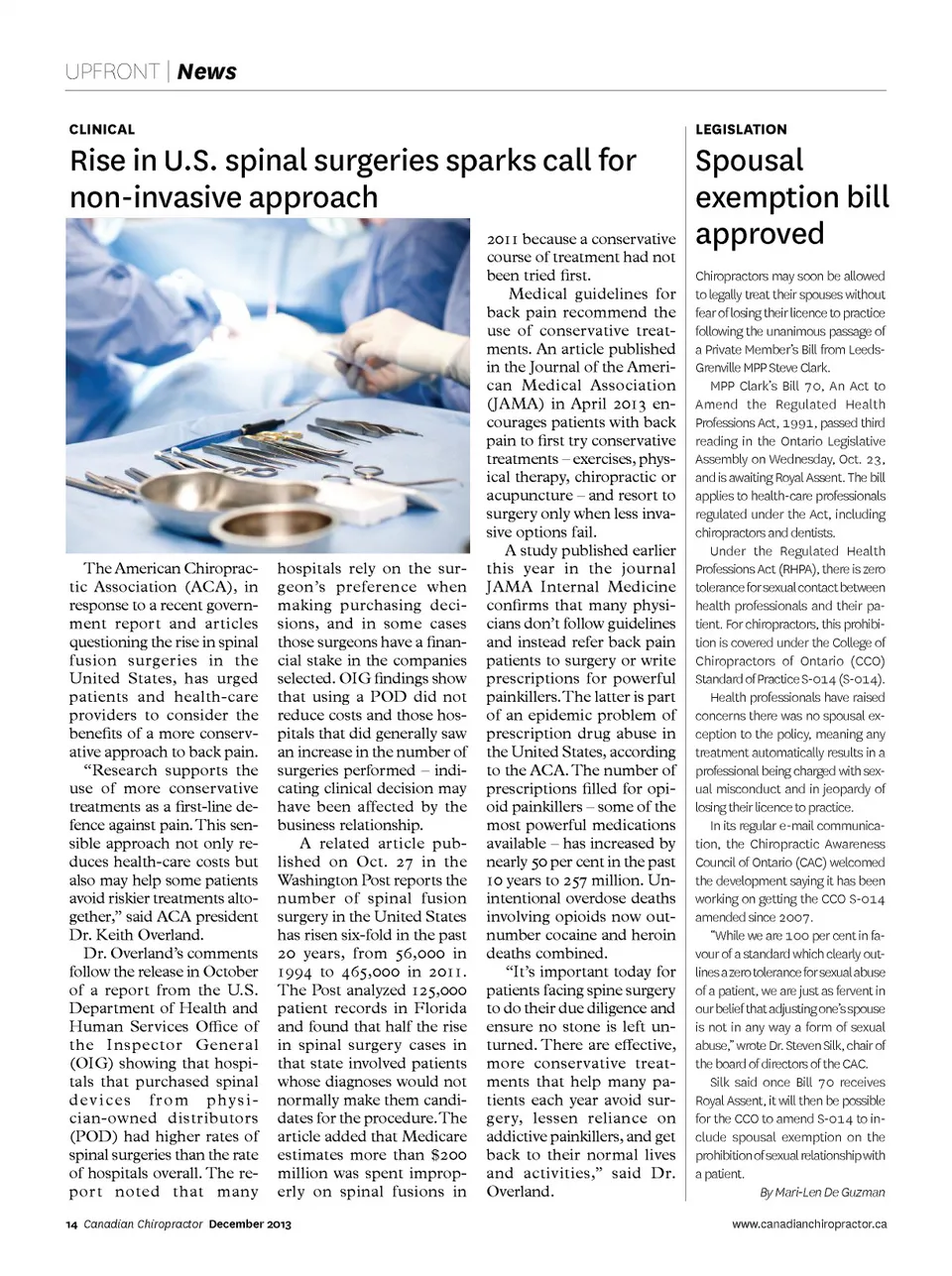
UPFRONT | News CLINICAL Rise in U.S. spinal surgeries sparks call for non-invasive approach 2011 because a conservative course of treatment had not been tried first. Medical guidelines for back pain recommend the use of conservative treat-ments. An article published in the Journal of the Ameri-can Medical Association (JAMA) in April 2013 en-courages patients with back pain to first try conservative treatments – exercises, phys-ical therapy, chiropractic or acupuncture – and resort to surgery only when less inva-sive options fail. A study published earlier this year in the journal JAMA Internal Medicine confirms that many physi-cians don’t follow guidelines and instead refer back pain patients to surgery or write prescriptions for powerful painkillers. The latter is part of an epidemic problem of prescription drug abuse in the United States, according to the ACA. The number of prescriptions filled for opi-oid painkillers – some of the most powerful medications available – has increased by nearly 50 per cent in the past 10 years to 257 million. Un-intentional overdose deaths involving opioids now out-number cocaine and heroin deaths combined. “It’s important today for patients facing spine surgery to do their due diligence and ensure no stone is left un-turned. There are effective, more conservative treat-ments that help many pa-tients each year avoid sur-gery, lessen reliance on addictive painkillers, and get back to their normal lives and activities,” said Dr. Overland. LEgISLATION Spousal exemption bill approved Chiropractors may soon be allowed to legally treat their spouses without fear of losing their licence to practice following the unanimous passage of a Private Member’s Bill from Leeds-Grenville MPP Steve Clark. MPP Clark’s Bill 70, An Act to Amend the Regulated Health Professions Act, 1991, passed third reading in the Ontario Legislative Assembly on Wednesday, Oct. 23, and is awaiting Royal Assent. The bill applies to health-care professionals regulated under the Act, including chiropractors and dentists. Under the Regulated Health Professions Act (RHPA), there is zero tolerance for sexual contact between health professionals and their pa -tient. For chiropractors, this prohibi -tion is covered under the College of Chiropractors of Ontario (CCO) Standard of Practice S-014 (S-014). Health professionals have raised concerns there was no spousal ex -ception to the policy, meaning any treatment automatically results in a professional being charged with sex -ual misconduct and in jeopardy of losing their licence to practice. In its regular e-mail communica -tion, the Chiropractic Awareness Council of Ontario (CAC) welcomed the development saying it has been working on getting the CCO S-014 amended since 2007. “While we are 100 per cent in fa -vour of a standard which clearly out -lines a zero tolerance for sexual abuse of a patient, we are just as fervent in our belief that adjusting one’s spouse is not in any way a form of sexual abuse,” wrote Dr. Steven Silk, chair of the board of directors of the CAC. Silk said once Bill 70 receives Royal Assent, it will then be possible for the CCO to amend S-014 to in -clude spousal exemption on the prohibition of sexual relationship with a patient. By Mari-Len De Guzman www.canadianchiropractor.ca The American Chiroprac-tic Association (ACA), in response to a recent govern-ment report and articles questioning the rise in spinal fusion surgeries in the United States, has urged patients and health-care providers to consider the benefits of a more conserv-ative approach to back pain. “Research supports the use of more conservative treatments as a first-line de-fence against pain. This sen-sible approach not only re-duces health-care costs but also may help some patients avoid riskier treatments alto-gether,” said ACA president Dr. Keith Overland. Dr. Overland’s comments follow the release in October of a report from the U.S. Department of Health and Human Services Office of the Inspector General (OIG) showing that hospi-tals that purchased spinal devices from ph ysi -cian-owned distributors (POD) had higher rates of spinal surgeries than the rate of hospitals overall. The re-por t noted that many hospitals rely on the sur-geon’s preference when making purchasing deci-sions, and in some cases those surgeons have a finan-cial stake in the companies selected. OIG findings show that using a POD did not reduce costs and those hos-pitals that did generally saw an increase in the number of surgeries performed – indi-cating clinical decision may have been affected by the business relationship. A related article pub-lished on Oct. 27 in the Washington Post reports the number of spinal fusion surgery in the United States has risen six-fold in the past 20 years, from 56,000 in 1994 to 465,000 in 2011. The Post analyzed 125,000 patient records in Florida and found that half the rise in spinal surgery cases in that state involved patients whose diagnoses would not normally make them candi-dates for the procedure. The article added that Medicare estimates more than $200 million was spent improp-erly on spinal fusions in 14 Canadian Chiropractor December 2013
Chiropractic + Naturopathic Doctor December 2013: Page 14