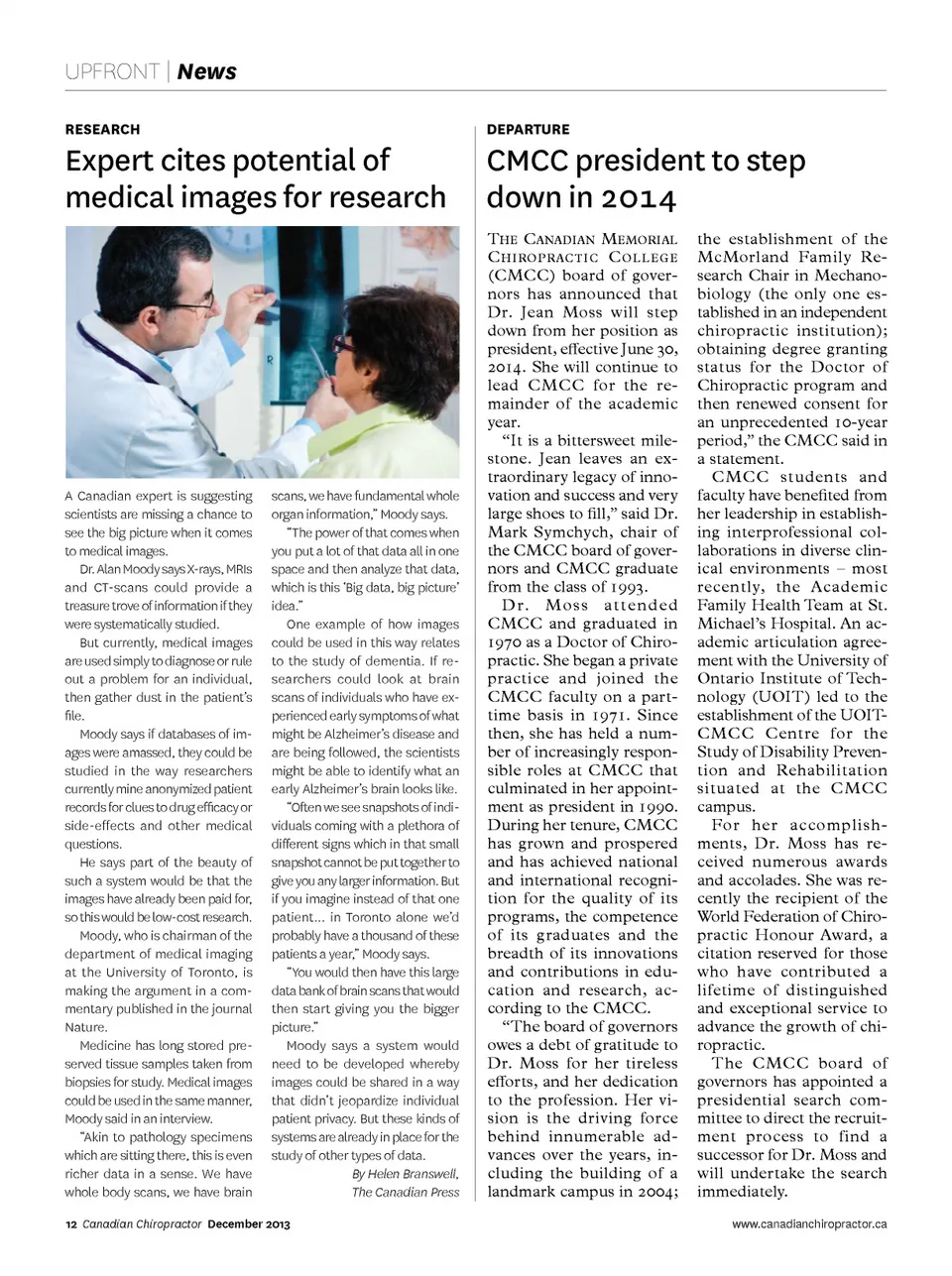
UPFRONT | News RESEARCH Expert cites potential of medical images for research CMCC president to step down in 2014 The Canadian Memorial Chiropractic College (CMCC) board of gover-nors has announced that Dr. Jean Moss will step down from her position as president, effective June 30, 2014. She will continue to lead CMCC for the re-mainder of the academic year. “It is a bittersweet mile-stone. Jean leaves an ex-traordinary legacy of inno-vation and success and very large shoes to fill,” said Dr. Mark Symchych, chair of the CMCC board of gover-nors and CMCC graduate from the class of 1993. Dr . Moss attended CMCC and graduated in 1970 as a Doctor of Chiro-practic. She began a private practice and joined the CMCC faculty on a part-time basis in 1971. Since then, she has held a num-ber of increasingly respon-sible roles at CMCC that culminated in her appoint-ment as president in 1990. During her tenure, CMCC has grown and prospered and has achieved national and international recogni-tion for the quality of its programs, the competence of its graduates and the breadth of its innovations and contributions in edu-cation and research, ac-cording to the CMCC. “The board of governors owes a debt of gratitude to Dr. Moss for her tireless efforts, and her dedication to the profession. Her vi-sion is the driving force behind innumerable ad-vances over the years, in-cluding the building of a landmark campus in 2004; the establishment of the McMorland Family Re-search Chair in Mechano-biology (the only one es-tablished in an independent chiropractic institution); obtaining degree granting status for the Doctor of Chiropractic program and then renewed consent for an unprecedented 10-year period,” the CMCC said in a statement. CMCC students and faculty have benefited from her leadership in establish-ing interprofessional col-laborations in diverse clin-ical environments – most recently, the Academic Family Health Team at St. Michael’s Hospital. An ac-ademic articulation agree-ment with the University of Ontario Institute of Tech-nology (UOIT) led to the establishment of the UOIT-CMCC Centre for the Study of Disability Preven-tion and Rehabilitation situated at the CMCC campus. For her accomplish-ments, Dr. Moss has re-ceived numerous awards and accolades. She was re-cently the recipient of the World Federation of Chiro-practic Honour Award, a citation reserved for those who have contributed a lifetime of distinguished and exceptional service to advance the growth of chi-ropractic. The CMCC board of governors has appointed a presidential search com-mittee to direct the recruit-ment process to find a successor for Dr. Moss and will undertake the search immediately. www.canadianchiropractor.ca DEPARTURE A Canadian expert is suggesting scientists are missing a chance to see the big picture when it comes to medical images. Dr. Alan Moody says X-rays, MRIs and CT-scans could provide a treasure trove of information if they were systematically studied. But currently, medical images are used simply to diagnose or rule out a problem for an individual, then gather dust in the patient’s file. Moody says if databases of im -ages were amassed, they could be studied in the way researchers currently mine anonymized patient records for clues to drug efficacy or side-effects and other medical questions. He says part of the beauty of such a system would be that the images have already been paid for, so this would be low-cost research. Moody, who is chairman of the department of medical imaging at the University of Toronto, is making the argument in a com -mentary published in the journal Nature. Medicine has long stored pre -served tissue samples taken from biopsies for study. Medical images could be used in the same manner, Moody said in an interview. “Akin to pathology specimens which are sitting there, this is even richer data in a sense. We have whole body scans, we have brain scans, we have fundamental whole organ information,” Moody says. “The power of that comes when you put a lot of that data all in one space and then analyze that data, which is this ‘Big data, big picture’ idea.” One example of how images could be used in this way relates to the study of dementia. If re -searchers could look at brain scans of individuals who have ex -perienced early symptoms of what might be Alzheimer’s disease and are being followed, the scientists might be able to identify what an early Alzheimer’s brain looks like. “Often we see snapshots of indi -viduals coming with a plethora of different signs which in that small snapshot cannot be put together to give you any larger information. But if you imagine instead of that one patient... in Toronto alone we’d probably have a thousand of these patients a year,” Moody says. “You would then have this large data bank of brain scans that would then start giving you the bigger picture.” Moody says a system would need to be developed whereby images could be shared in a way that didn’t jeopardize individual patient privacy. But these kinds of systems are already in place for the study of other types of data. By Helen Branswell, The Canadian Press 12 Canadian Chiropractor December 2013
Chiropractic + Naturopathic Doctor December 2013: Page 12