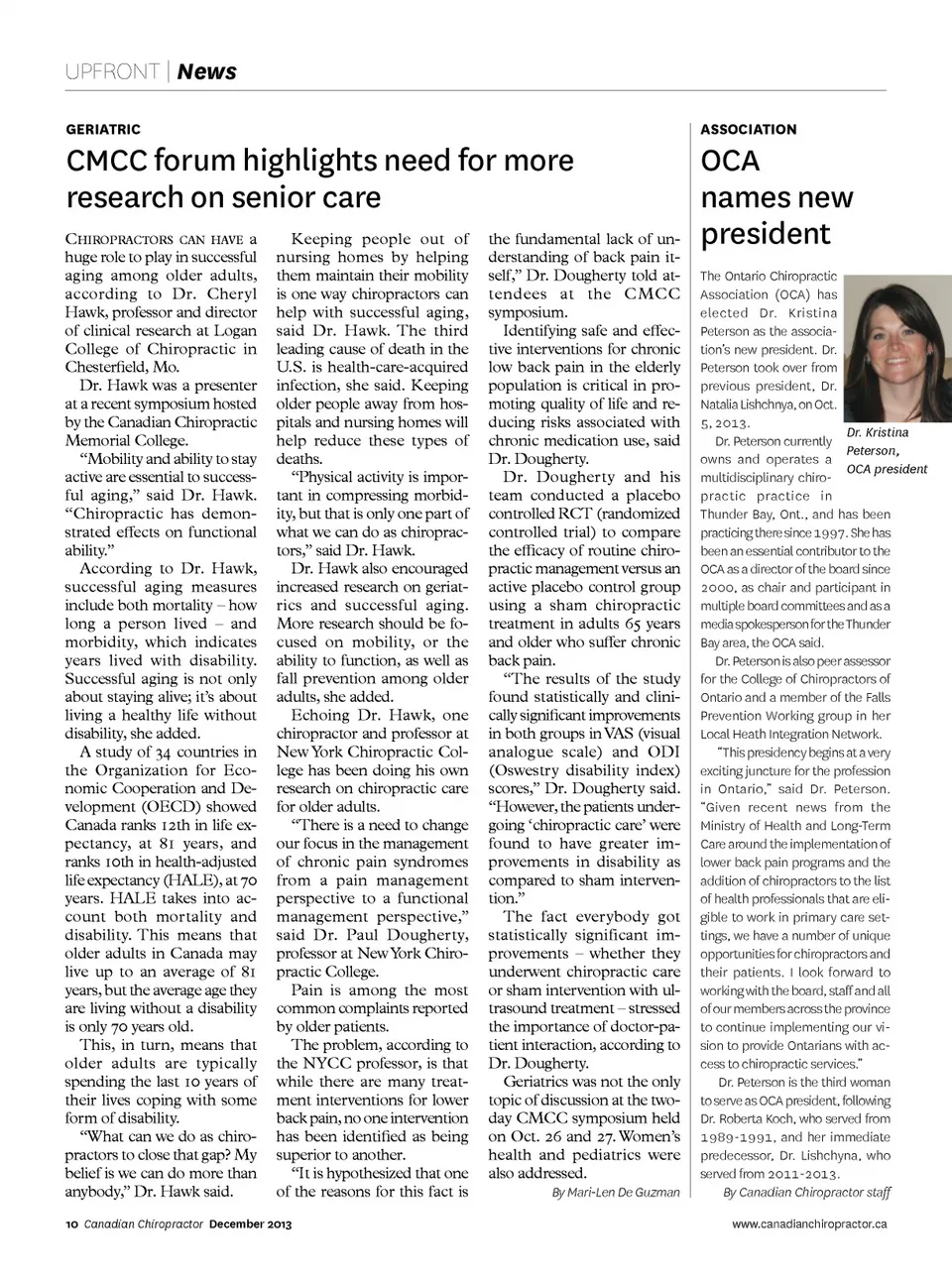
UPFRONT | News gERIATRIC CMCC forum highlights need for more research on senior care Chiropractors can have a huge role to play in successful aging among older adults, according to Dr. Cheryl Hawk, professor and director of clinical research at Logan College of Chiropractic in Chesterfield, Mo. Dr. Hawk was a presenter at a recent symposium hosted by the Canadian Chiropractic Memorial College. “Mobility and ability to stay active are essential to success-ful aging,” said Dr. Hawk. “Chiropractic has demon-strated effects on functional ability.” According to Dr. Hawk, successful aging measures include both mortality – how long a person lived – and morbidity, which indicates years lived with disability. Successful aging is not only about staying alive; it’s about living a healthy life without disability, she added. A study of 34 countries in the Organization for Eco-nomic Cooperation and De-velopment (OECD) showed Canada ranks 12th in life ex-pectancy, at 81 years, and ranks 10th in health-adjusted life expectancy (HALE), at 70 years. HALE takes into ac-count both mortality and disability. This means that older adults in Canada may live up to an average of 81 years, but the average age they are living without a disability is only 70 years old. This, in turn, means that older adults are typically spending the last 10 years of their lives coping with some form of disability. “What can we do as chiro-practors to close that gap? My belief is we can do more than anybody,” Dr. Hawk said. Keeping people out of nursing homes by helping them maintain their mobility is one way chiropractors can help with successful aging, said Dr. Hawk. The third leading cause of death in the U.S. is health-care-acquired infection, she said. Keeping older people away from hos-pitals and nursing homes will help reduce these types of deaths. “Physical activity is impor-tant in compressing morbid-ity, but that is only one part of what we can do as chiroprac-tors,” said Dr. Hawk. Dr. Hawk also encouraged increased research on geriat-rics and successful aging. More research should be fo-cused on mobility, or the ability to function, as well as fall prevention among older adults, she added. Echoing Dr. Hawk, one chiropractor and professor at New York Chiropractic Col-lege has been doing his own research on chiropractic care for older adults. “There is a need to change our focus in the management of chronic pain syndromes from a pain management perspective to a functional management perspective,” said Dr. Paul Dougherty, professor at New York Chiro-practic College. Pain is among the most common complaints reported by older patients. The problem, according to the NYCC professor, is that while there are many treat-ment interventions for lower back pain, no one intervention has been identified as being superior to another. “It is hypothesized that one of the reasons for this fact is the fundamental lack of un-derstanding of back pain it-self,” Dr. Dougherty told at-tendees at the CMCC symposium. Identifying safe and effec-tive interventions for chronic low back pain in the elderly population is critical in pro-moting quality of life and re-ducing risks associated with chronic medication use, said Dr. Dougherty. Dr. Dougherty and his team conducted a placebo controlled RCT (randomized controlled trial) to compare the efficacy of routine chiro-practic management versus an active placebo control group using a sham chiropractic treatment in adults 65 years and older who suffer chronic back pain. “The results of the study found statistically and clini-cally significant improvements in both groups in VAS (visual analogue scale) and ODI (Oswestry disability index) scores,” Dr. Dougherty said. “However, the patients under-going ‘chiropractic care’ were found to have greater im-provements in disability as compared to sham interven-tion.” The fact everybody got statistically significant im-provements – whether they underwent chiropractic care or sham intervention with ul-trasound treatment – stressed the importance of doctor-pa-tient interaction, according to Dr. Dougherty. Geriatrics was not the only topic of discussion at the two-day CMCC symposium held on Oct. 26 and 27. Women’s health and pediatrics were also addressed. By Mari-Len De Guzman ASSOCIATION OCA names new president The Ontario Chiropractic Association (OCA) has elected Dr. Kristina Peterson as the associa -tion’s new president. Dr. Peterson took over from previous president, Dr. Natalia Lishchnya, on Oct. 5, 2013. Dr. Kristina Dr. Peterson currently Peterson, owns and operates a OCA president multidisciplinary chiro -practic practice in Thunder Bay, Ont., and has been practicing there since 1997. She has been an essential contributor to the OCA as a director of the board since 2000, as chair and participant in multiple board committees and as a media spokesperson for the Thunder Bay area, the OCA said. Dr. Peterson is also peer assessor for the College of Chiropractors of Ontario and a member of the Falls Prevention Working group in her Local Heath Integration Network. “This presidency begins at a very exciting juncture for the profession in Ontario,” said Dr. Peterson. “Given recent news from the Ministry of Health and Long-Term Care around the implementation of lower back pain programs and the addition of chiropractors to the list of health professionals that are eli -gible to work in primary care set -tings, we have a number of unique opportunities for chiropractors and their patients. I look forward to working with the board, staff and all of our members across the province to continue implementing our vi -sion to provide Ontarians with ac -cess to chiropractic services.” Dr. Peterson is the third woman to serve as OCA president, following Dr. Roberta Koch, who served from 1989-1991, and her immediate predecessor, Dr. Lishchyna, who served from 2011-2013. By Canadian Chiropractor staff www.canadianchiropractor.ca 10 Canadian Chiropractor December 2013
Chiropractic + Naturopathic Doctor December 2013: Page 10