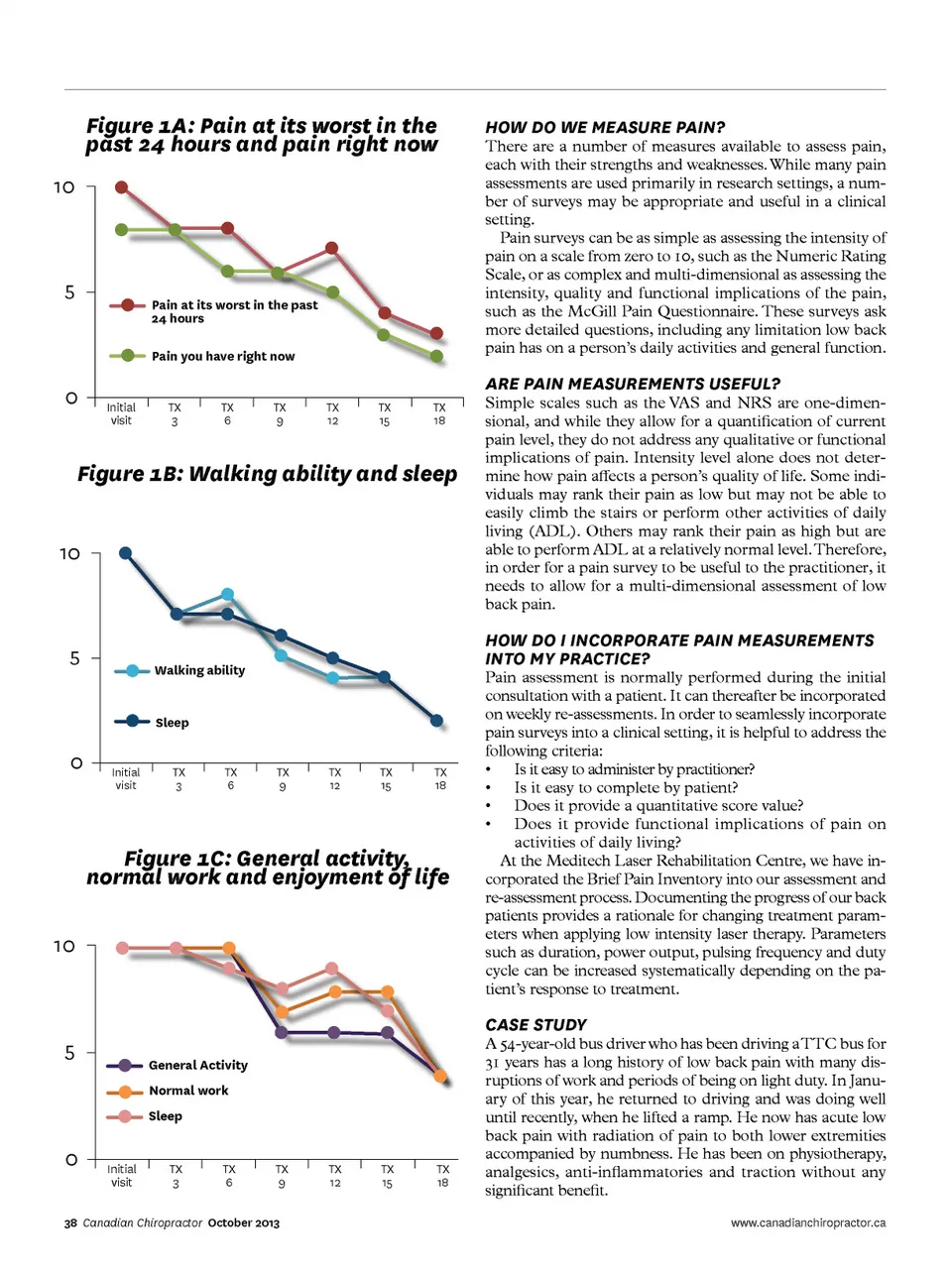
Physical examination: The patient appears to be in significant distress. He is unable to sit or lie on his back. Examination of the lumbar spine reveals a scoliosis with the lumbar apex to the left and acute tenderness from L3-S1. • There is flattening of the lumbar lordosis and significant muscle spasm in the area. • • • Diagnosis : Disc herniation L4-5 with bilateral nerve root compression Discussion: The patient received 18 laser therapy treat-ments over the course of one month. Parameter changes such as pulse frequency and duty cycle were changed every three to four treatments following re-assessment of the pa-tient. As seen in Figure 1A, the patient’s pain level steadily decreased from a level of between eight and 10 out of 10 down to two to three. Pain interfering with sleep and walk-ing ability also steadily decreased from a 10 down to two (Figure 1B). Interestingly, the effect of pain on general ac-tivity, normal work and quality of life stayed at a constant level of between nine and 10 for the first six treatments despite the fact the pain levels were reported as reduced (Figure 1C). These category levels did diminish throughout the treatment program, but had much greater variability and showed a step-wise decrease in value at certain time points such as the sixth and 15th treatment. whaT oTher TesTs CaN i use To doCuMeNT paTieNT progress? While pain scales may provide some insight on how pain is af-fecting a patient’s activities of daily living, there are additional condition-specific surveys available that delve deeper into the implications. For back pain, the Oswestry Disability Index and the Roland-Morris Survey have been used extensively for re-search purposes. In part 2 of this article, we will examine the usefulness and practicality of incorporating condition-specific low back pain surveys into the documentation process of patient progress. Systematically documenting patient progress through pain surveys allows for a more detailed examination of how a patient is responding to a current line of treatment. When dealing with low back pain, functional implications of pain on activities of daily living are particularly important and may alter the param-eters of treatment such as in the case of laser therapy. For more clinical features, visit www.canadianchiropractor.ca. interested in studying chiropractic abroad? We are touring Canada in October 2013 speaking with students about studying chiropractic abroad in New Zealand. The New Zealand College of Chiropractic is internationally recognised and has the highest graduating clinical requirements of any chiropractic college in the world, making it a great choice for Canadian students. Come along to one of our information sessions with your prospective students. • Revolution Health, Vancouver, 21 October, 7-8.30pm, 405 West 5th Avenue, V5Y 3P1 • South Side Chiropractic, Edmonton, 22 October, 7.30-9pm, 7906B - 104 St, Edmonton, T6E 4C8 • University of Western Ontario, London, 23 October, 7-8.30pm, Room 373 University Community Centre, 1151 Richmond Street, N6A 3K7 • Glebe Chiropractic, Ottawa 25 October, 7-8.30pm, (Inside 5th Ave Court) Unit 7-99 Fifth Ave, K1S 5K4 Know someone Tel: +64 9 526 6789 [email protected] www.chiropractic.ac.nz www.canadianchiropractor.ca October 2013 Canadian Chiropractor 39
Chiropractic + Naturopathic Doctor October 2013: Page 39