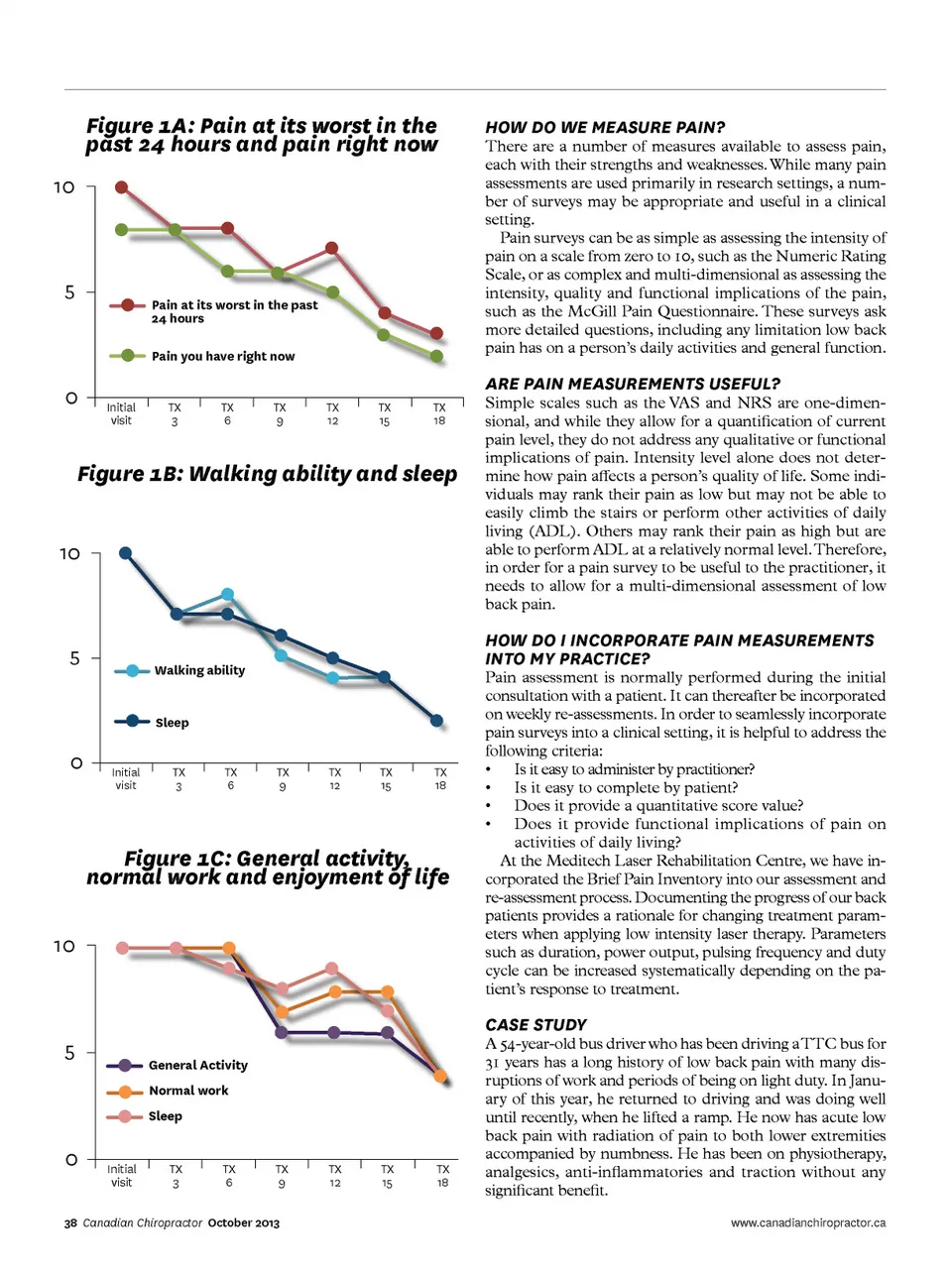
Figure 1A: pain at its worst in the past 24 hours and pain right now 10 how do we Measure paiN? 10 5 Pain at its worst in the past 24 hours Pain you have right now There are a number of measures available to assess pain, each with their strengths and weaknesses. While many pain assessments are used primarily in research settings, a num-ber of surveys may be appropriate and useful in a clinical setting. Pain surveys can be as simple as assessing the intensity of pain on a scale from zero to 10, such as the Numeric Rating Scale, or as complex and multi-dimensional as assessing the intensity, quality and functional implications of the pain, such as the McGill Pain Questionnaire. These surveys ask more detailed questions, including any limitation low back pain has on a person’s daily activities and general function. 5 10 0 Initial visit Pain in the TX at its worst TX TX past TX 24 3 hours 6 9 12 Pain you have right now are paiN MeasureMeNTs useFul? TX 15 TX 18 10 5 0 10 5 Figure 1B: Walking ability and sleep Initial TX TX TX TX at its worst visit Pain 3 6 in the 9 past 12 24 hours TX 15 TX 18 Pain you have right now Walking ability Initial visit Initial visit 0 5 0 10 Sleep 3 TX 3 TX TX 6 TX 6 TX 9 TX 9 TX 12 TX 12 TX 15 TX 15 TX 18 TX 18 Simple scales such as the VAS and NRS are one-dimen-sional, and while they allow for a quantification of current pain level, they do not address any qualitative or functional implications of pain. Intensity level alone does not deter-mine how pain affects a person’s quality of life. Some indi-viduals may rank their pain as low but may not be able to easily climb the stairs or perform other activities of daily living (ADL). Others may rank their pain as high but are able to perform ADL at a relatively normal level. Therefore, in order for a pain survey to be useful to the practitioner, it needs to allow for a multi-dimensional assessment of low back pain. Walking ability Sleep how do i iNCorporaTe paiN MeasureMeNTs iNTo My praCTiCe? 10 0 5 10 5 Initial TX TX visit Walking 3 6 ability TX 9 TX 12 TX 15 TX 18 Figure 1c: General activity, Normal work normal work and enjoyment of life 0 Initial TX TX TX TX TX TX 5 0 10 visit Sleep General Activity Sleep 3 6 9 12 15 18 Initial visit General Activity 3 6 Normal work TX TX TX 9 TX 12 TX 15 TX 18 Sleep Pain assessment is normally performed during the initial consultation with a patient. It can thereafter be incorporated on weekly re-assessments. In order to seamlessly incorporate pain surveys into a clinical setting, it is helpful to address the following criteria: • Is it easy to administer by practitioner? • Is it easy to complete by patient? • Does it provide a quantitative score value? • Does it provide functional implications of pain on activities of daily living? At the Meditech Laser Rehabilitation Centre, we have in-corporated the Brief Pain Inventory into our assessment and re-assessment process. Documenting the progress of our back patients provides a rationale for changing treatment param-eters when applying low intensity laser therapy. Parameters such as duration, power output, pulsing frequency and duty cycle can be increased systematically depending on the pa-tient’s response to treatment. 0 5 Initial visit General Activity Normal work Sleep TX 3 TX 6 TX 9 TX 12 TX 15 TX 18 Case sTudy 0 Initial visit TX 3 TX 6 TX 9 TX 12 TX 15 TX 18 A 54-year-old bus driver who has been driving a TTC bus for 31 years has a long history of low back pain with many dis-ruptions of work and periods of being on light duty. In Janu-ary of this year, he returned to driving and was doing well until recently, when he lifted a ramp. He now has acute low back pain with radiation of pain to both lower extremities accompanied by numbness. He has been on physiotherapy, analgesics, anti-inflammatories and traction without any significant benefit. www.canadianchiropractor.ca 38 Canadian Chiropractor October 2013
Chiropractic + Naturopathic Doctor October 2013: Page 38