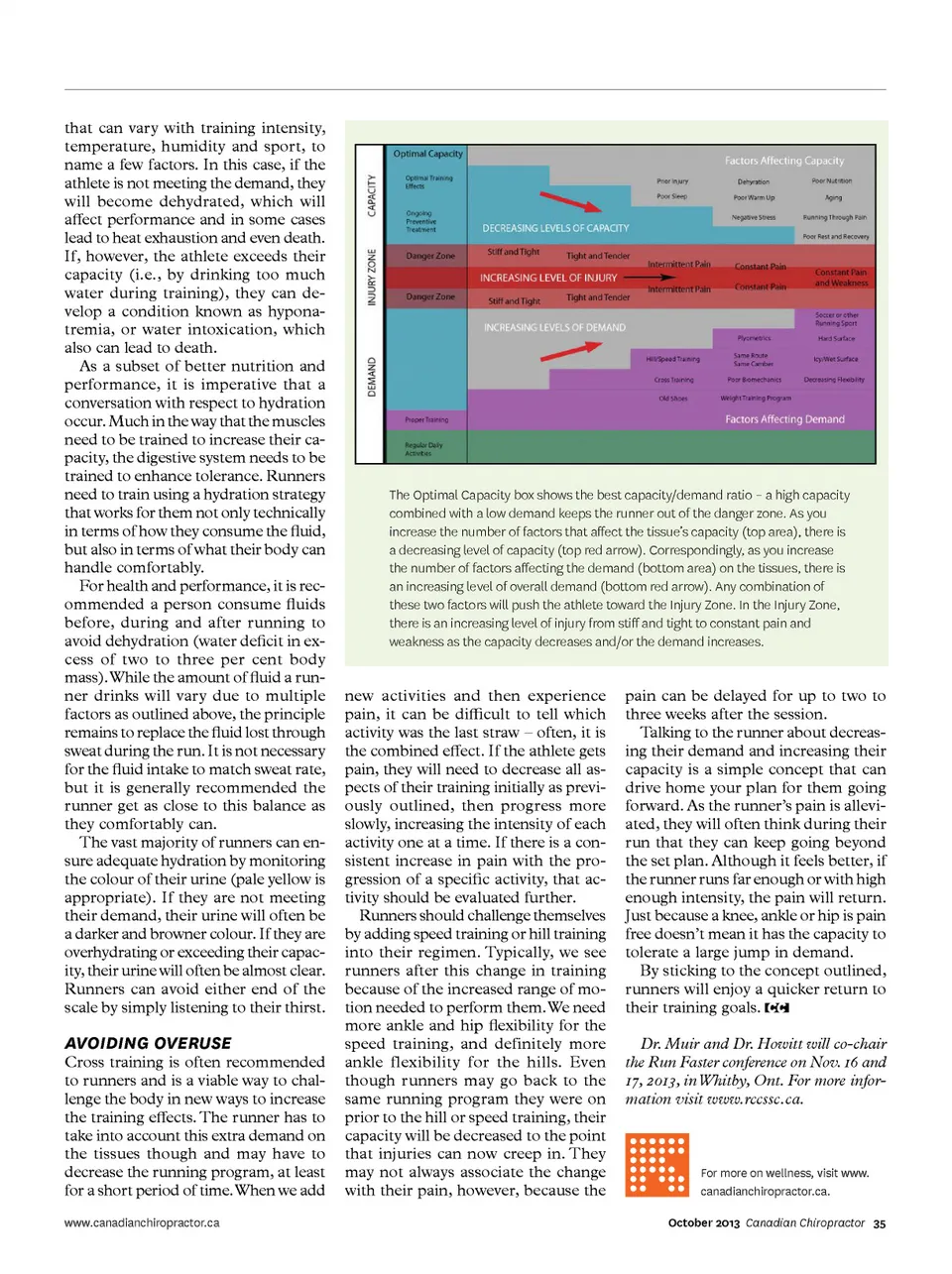
that can vary with training intensity, temperature, humidity and sport, to name a few factors. In this case, if the athlete is not meeting the demand, they will become dehydrated, which will affect performance and in some cases lead to heat exhaustion and even death. If, however, the athlete exceeds their capacity (i.e., by drinking too much water during training), they can de-velop a condition known as hypona-tremia, or water intoxication, which also can lead to death. As a subset of better nutrition and performance, it is imperative that a conversation with respect to hydration occur. Much in the way that the muscles need to be trained to increase their ca-pacity, the digestive system needs to be trained to enhance tolerance. Runners need to train using a hydration strategy that works for them not only technically in terms of how they consume the fluid, but also in terms of what their body can handle comfortably. For health and performance, it is rec-ommended a person consume fluids before, during and after running to avoid dehydration (water deficit in ex-cess of two to three per cent body mass). While the amount of fluid a run-ner drinks will vary due to multiple factors as outlined above, the principle remains to replace the fluid lost through sweat during the run. It is not necessary for the fluid intake to match sweat rate, but it is generally recommended the runner get as close to this balance as they comfortably can. The vast majority of runners can en-sure adequate hydration by monitoring the colour of their urine (pale yellow is appropriate). If they are not meeting their demand, their urine will often be a darker and browner colour. If they are overhydrating or exceeding their capac-ity, their urine will often be almost clear. Runners can avoid either end of the scale by simply listening to their thirst. The Optimal Capacity box shows the best capacity/demand ratio – a high capacity combined with a low demand keeps the runner out of the danger zone. As you increase the number of factors that affect the tissue’s capacity (top area), there is a decreasing level of capacity (top red arrow). Correspondingly, as you increase the number of factors affecting the demand (bottom area) on the tissues, there is an increasing level of overall demand (bottom red arrow). Any combination of these two factors will push the athlete toward the Injury Zone. In the Injury Zone, there is an increasing level of injury from stiff and tight to constant pain and weakness as the capacity decreases and/or the demand increases. avoidiNg overuse Cross training is often recommended to runners and is a viable way to chal-lenge the body in new ways to increase the training effects. The runner has to take into account this extra demand on the tissues though and may have to decrease the running program, at least for a short period of time. When we add www.canadianchiropractor.ca new activities and then experience pain, it can be difficult to tell which activity was the last straw – often, it is the combined effect. If the athlete gets pain, they will need to decrease all as-pects of their training initially as previ-ously outlined, then progress more slowly, increasing the intensity of each activity one at a time. If there is a con-sistent increase in pain with the pro-gression of a specific activity, that ac-tivity should be evaluated further. Runners should challenge themselves by adding speed training or hill training into their regimen. Typically, we see runners after this change in training because of the increased range of mo-tion needed to perform them. We need more ankle and hip flexibility for the speed training, and definitely more ankle flexibility for the hills. Even though runners may go back to the same running program they were on prior to the hill or speed training, their capacity will be decreased to the point that injuries can now creep in. They may not always associate the change with their pain, however, because the pain can be delayed for up to two to three weeks after the session. Talking to the runner about decreas-ing their demand and increasing their capacity is a simple concept that can drive home your plan for them going forward. As the runner’s pain is allevi-ated, they will often think during their run that they can keep going beyond the set plan. Although it feels better, if the runner runs far enough or with high enough intensity, the pain will return. Just because a knee, ankle or hip is pain free doesn’t mean it has the capacity to tolerate a large jump in demand. By sticking to the concept outlined, runners will enjoy a quicker return to their training goals. Dr. Muir and Dr. Howitt will co-chair the Run Faster conference on Nov. 16 and 17, 2013, in Whitby, Ont. For more infor-mation visit www.rccssc.ca. For more on wellness, visit www. canadianchiropractor.ca. October 2013 Canadian Chiropractor 35
Chiropractic + Naturopathic Doctor October 2013: Page 35