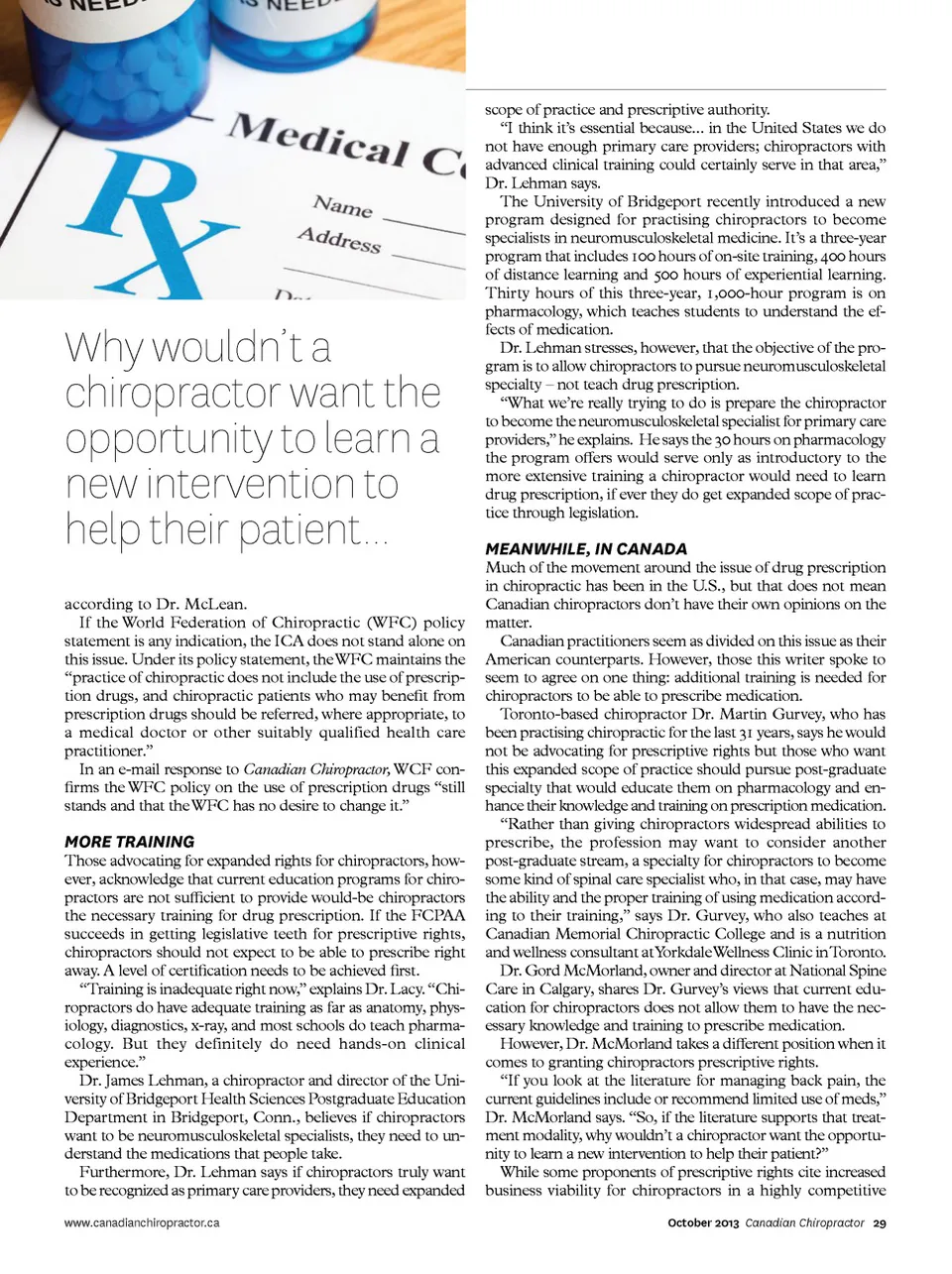
Why wouldn’t a chiropractor want the opportunity to learn a new intervention to help their patient... according to Dr. McLean. If the World Federation of Chiropractic (WFC) policy statement is any indication, the ICA does not stand alone on this issue. Under its policy statement, the WFC maintains the “practice of chiropractic does not include the use of prescrip-tion drugs, and chiropractic patients who may benefit from prescription drugs should be referred, where appropriate, to a medical doctor or other suitably qualified health care practitioner.” In an e-mail response to Canadian Chiropractor, WCF con-firms the WFC policy on the use of prescription drugs “still stands and that the WFC has no desire to change it.” scope of practice and prescriptive authority. “I think it’s essential because... in the United States we do not have enough primary care providers; chiropractors with advanced clinical training could certainly serve in that area,” Dr. Lehman says. The University of Bridgeport recently introduced a new program designed for practising chiropractors to become specialists in neuromusculoskeletal medicine. It’s a three-year program that includes 100 hours of on-site training, 400 hours of distance learning and 500 hours of experiential learning. Thirty hours of this three-year, 1,000-hour program is on pharmacology, which teaches students to understand the ef-fects of medication. Dr. Lehman stresses, however, that the objective of the pro-gram is to allow chiropractors to pursue neuromusculoskeletal specialty – not teach drug prescription. “What we’re really trying to do is prepare the chiropractor to become the neuromusculoskeletal specialist for primary care providers,” he explains. He says the 30 hours on pharmacology the program offers would serve only as introductory to the more extensive training a chiropractor would need to learn drug prescription, if ever they do get expanded scope of prac-tice through legislation. MeaNwhile, iN CaNada More TraiNiNg Those advocating for expanded rights for chiropractors, how-ever, acknowledge that current education programs for chiro-practors are not sufficient to provide would-be chiropractors the necessary training for drug prescription. If the FCPAA succeeds in getting legislative teeth for prescriptive rights, chiropractors should not expect to be able to prescribe right away. A level of certification needs to be achieved first. “Training is inadequate right now,” explains Dr. Lacy. “Chi-ropractors do have adequate training as far as anatomy, phys-iology, diagnostics, x-ray, and most schools do teach pharma-cology. But they definitely do need hands-on clinical experience.” Dr. James Lehman, a chiropractor and director of the Uni-versity of Bridgeport Health Sciences Postgraduate Education Department in Bridgeport, Conn., believes if chiropractors want to be neuromusculoskeletal specialists, they need to un-derstand the medications that people take. Furthermore, Dr. Lehman says if chiropractors truly want to be recognized as primary care providers, they need expanded www.canadianchiropractor.ca Much of the movement around the issue of drug prescription in chiropractic has been in the U.S., but that does not mean Canadian chiropractors don’t have their own opinions on the matter. Canadian practitioners seem as divided on this issue as their American counterparts. However, those this writer spoke to seem to agree on one thing: additional training is needed for chiropractors to be able to prescribe medication. Toronto-based chiropractor Dr. Martin Gurvey, who has been practising chiropractic for the last 31 years, says he would not be advocating for prescriptive rights but those who want this expanded scope of practice should pursue post-graduate specialty that would educate them on pharmacology and en-hance their knowledge and training on prescription medication. “Rather than giving chiropractors widespread abilities to prescribe, the profession may want to consider another post-graduate stream, a specialty for chiropractors to become some kind of spinal care specialist who, in that case, may have the ability and the proper training of using medication accord-ing to their training,” says Dr. Gurvey, who also teaches at Canadian Memorial Chiropractic College and is a nutrition and wellness consultant at Yorkdale Wellness Clinic in Toronto. Dr. Gord McMorland, owner and director at National Spine Care in Calgary, shares Dr. Gurvey’s views that current edu-cation for chiropractors does not allow them to have the nec-essary knowledge and training to prescribe medication. However, Dr. McMorland takes a different position when it comes to granting chiropractors prescriptive rights. “If you look at the literature for managing back pain, the current guidelines include or recommend limited use of meds,” Dr. McMorland says. “So, if the literature supports that treat-ment modality, why wouldn’t a chiropractor want the opportu-nity to learn a new intervention to help their patient?” While some proponents of prescriptive rights cite increased business viability for chiropractors in a highly competitive October 2013 Canadian Chiropractor 29
Chiropractic + Naturopathic Doctor October 2013: Page 29