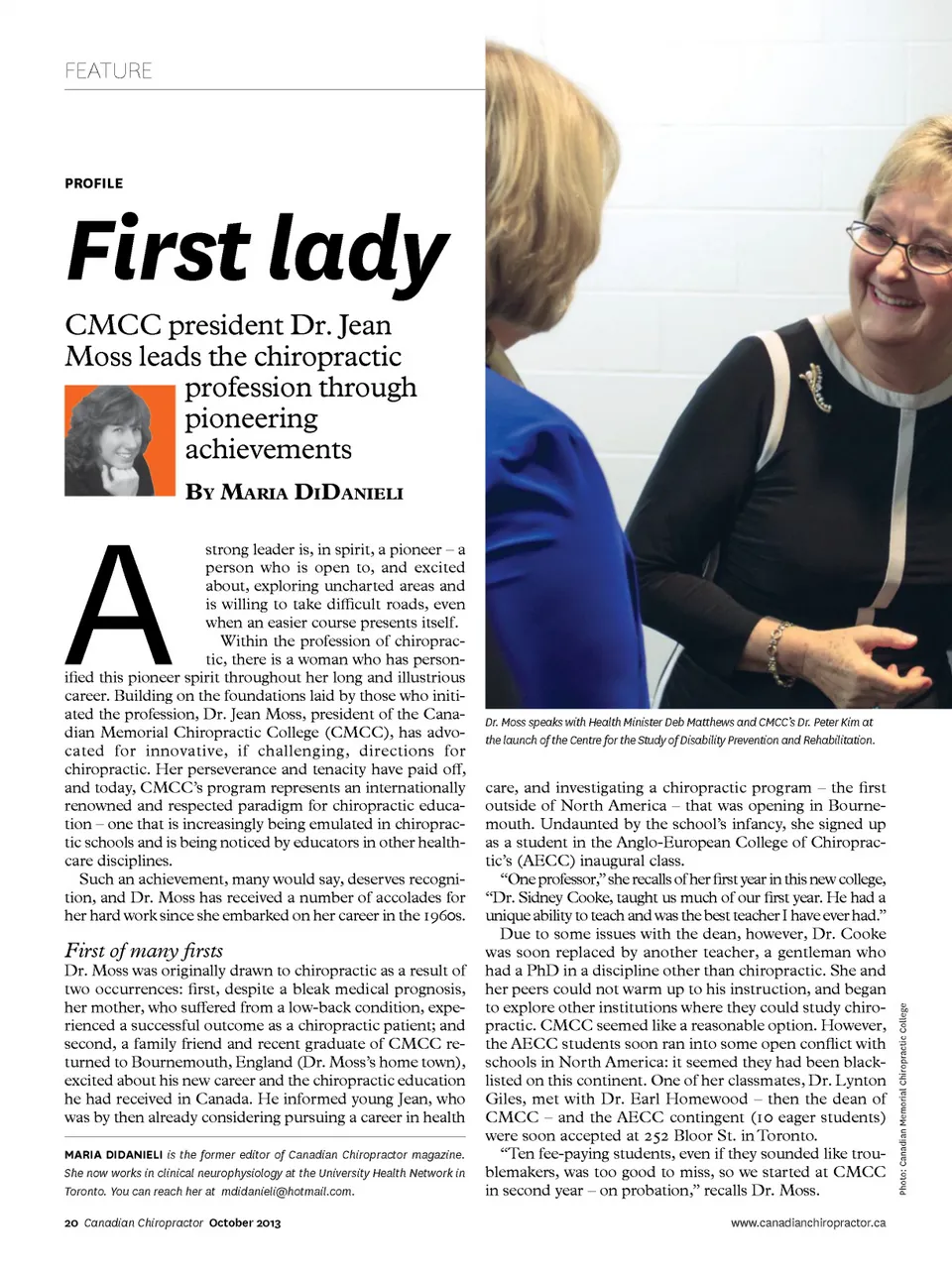
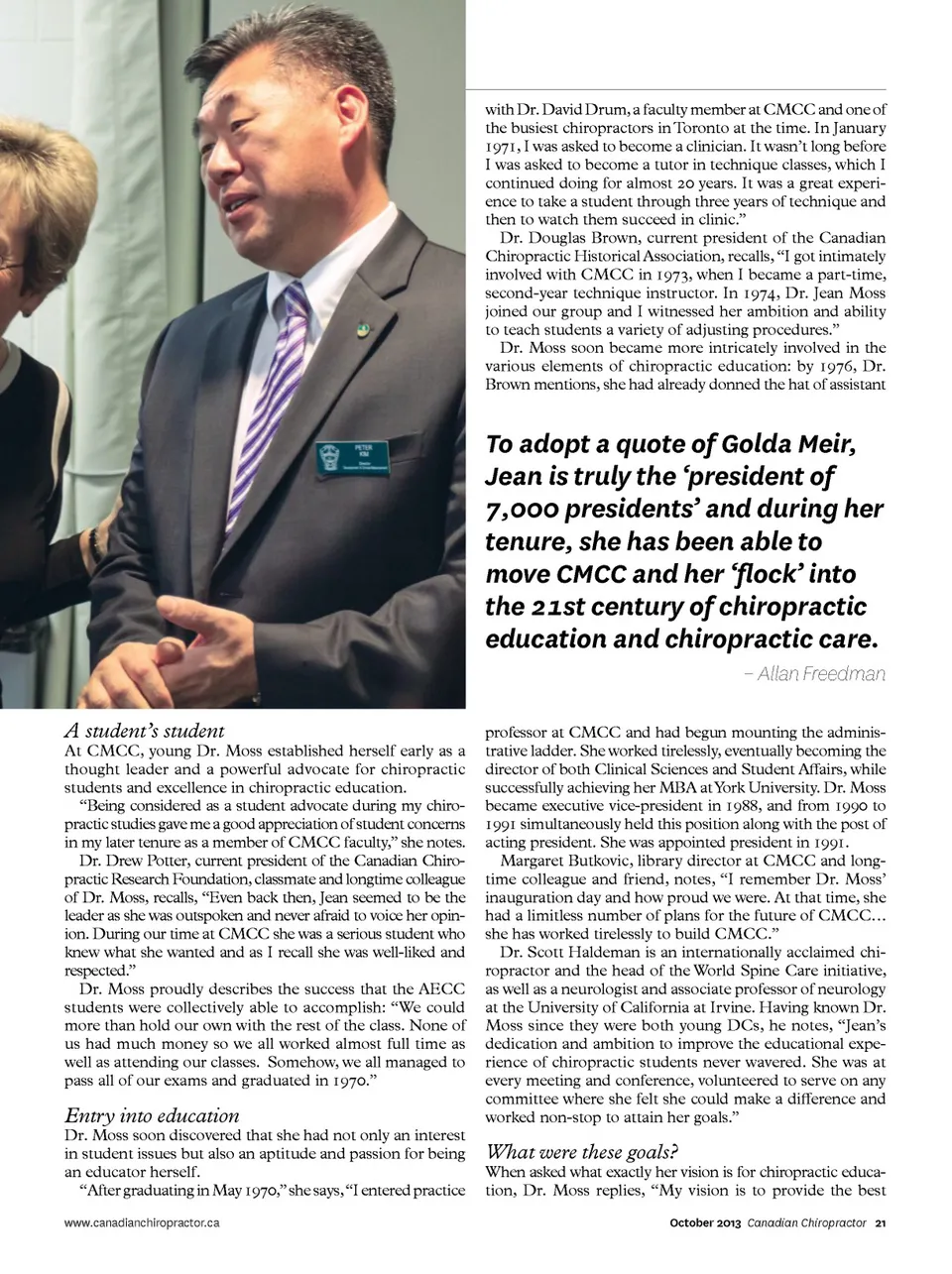
with Dr. David Drum, a faculty member at CMCC and one of the busiest chiropractors in Toronto at the time. In January 1971, I was asked to become a clinician. It wasn’t long before I was asked to become a tutor in technique classes, which I continued doing for almost 20 years. It was a great experi-ence to take a student through three years of technique and then to watch them succeed in clinic.” Dr. Douglas Brown, current president of the Canadian Chiropractic Historical Association, recalls, “I got intimately involved with CMCC in 1973, when I became a part-time, second-year technique instructor. In 1974, Dr. Jean Moss joined our group and I witnessed her ambition and ability to teach students a variety of adjusting procedures.” Dr. Moss soon became more intricately involved in the various elements of chiropractic education: by 1976, Dr. Brown mentions, she had already donned the hat of assistant To adopt a quote of Golda Meir, Jean is truly the ‘president of 7,000 presidents’ and during her tenure, she has been able to move CMCC and her ‘flock’ into the 21st century of chiropractic education and chiropractic care. – Allan Freedman A student’s student At CMCC, young Dr. Moss established herself early as a thought leader and a powerful advocate for chiropractic students and excellence in chiropractic education. “Being considered as a student advocate during my chiro-practic studies gave me a good appreciation of student concerns in my later tenure as a member of CMCC faculty,” she notes. Dr. Drew Potter, current president of the Canadian Chiro-practic Research Foundation, classmate and longtime colleague of Dr. Moss, recalls, “Even back then, Jean seemed to be the leader as she was outspoken and never afraid to voice her opin-ion. During our time at CMCC she was a serious student who knew what she wanted and as I recall she was well-liked and respected.” Dr. Moss proudly describes the success that the AECC students were collectively able to accomplish: “We could more than hold our own with the rest of the class. None of us had much money so we all worked almost full time as well as attending our classes. Somehow, we all managed to pass all of our exams and graduated in 1970.” professor at CMCC and had begun mounting the adminis-trative ladder. She worked tirelessly, eventually becoming the director of both Clinical Sciences and Student Affairs, while successfully achieving her MBA at York University. Dr. Moss became executive vice-president in 1988, and from 1990 to 1991 simultaneously held this position along with the post of acting president. She was appointed president in 1991. Margaret Butkovic, library director at CMCC and long-time colleague and friend, notes, “I remember Dr. Moss’ inauguration day and how proud we were. At that time, she had a limitless number of plans for the future of CMCC… she has worked tirelessly to build CMCC.” Dr. Scott Haldeman is an internationally acclaimed chi-ropractor and the head of the World Spine Care initiative, as well as a neurologist and associate professor of neurology at the University of California at Irvine. Having known Dr. Moss since they were both young DCs, he notes, “Jean’s dedication and ambition to improve the educational expe-rience of chiropractic students never wavered. She was at every meeting and conference, volunteered to serve on any committee where she felt she could make a difference and worked non-stop to attain her goals.” Entry into education Dr. Moss soon discovered that she had not only an interest in student issues but also an aptitude and passion for being an educator herself. “After graduating in May 1970,” she says, “I entered practice www.canadianchiropractor.ca What were these goals? When asked what exactly her vision is for chiropractic educa-tion, Dr. Moss replies, “My vision is to provide the best October 2013 Canadian Chiropractor 21
Chiropractic + Naturopathic Doctor October 2013: Page 21