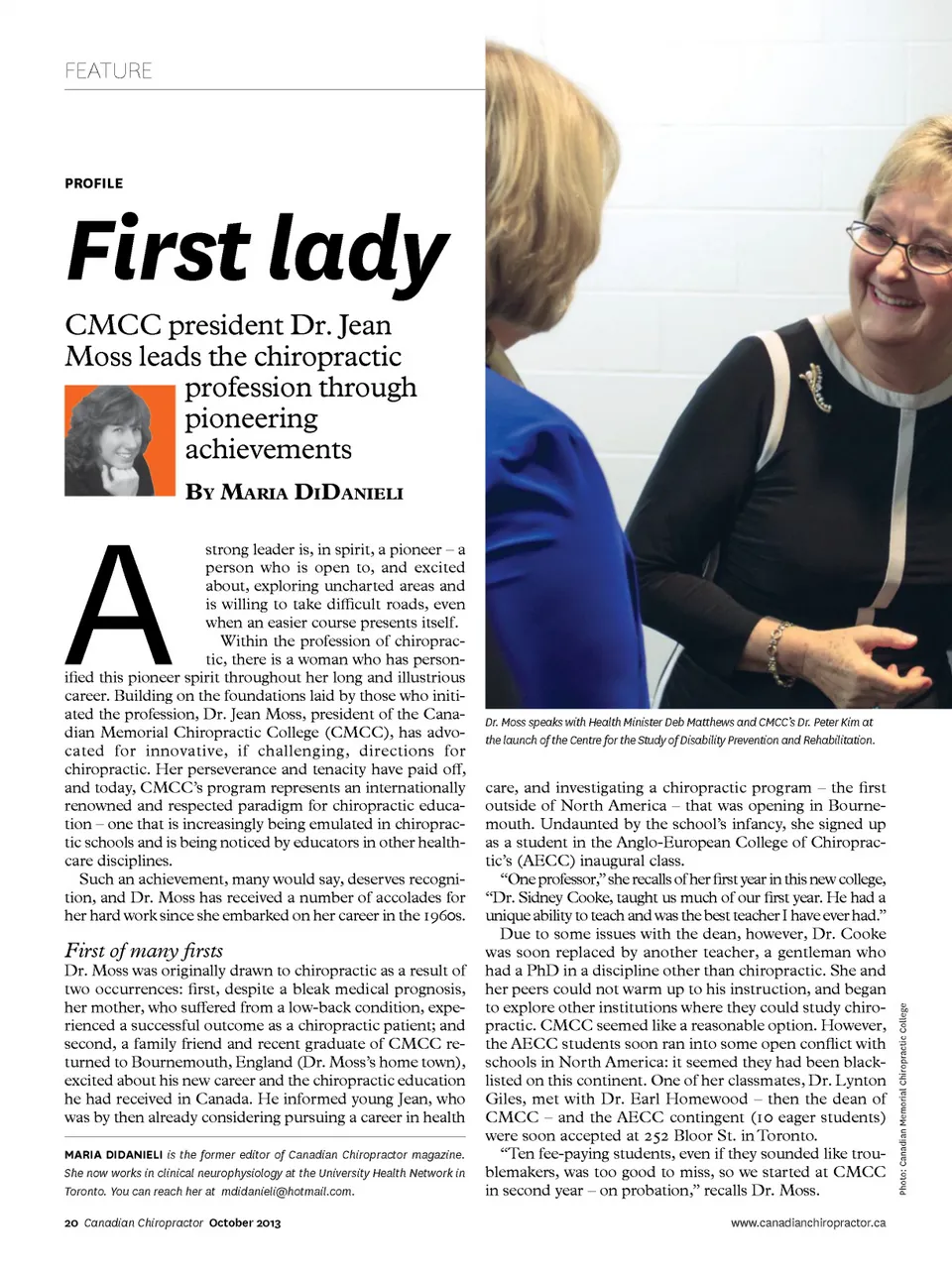
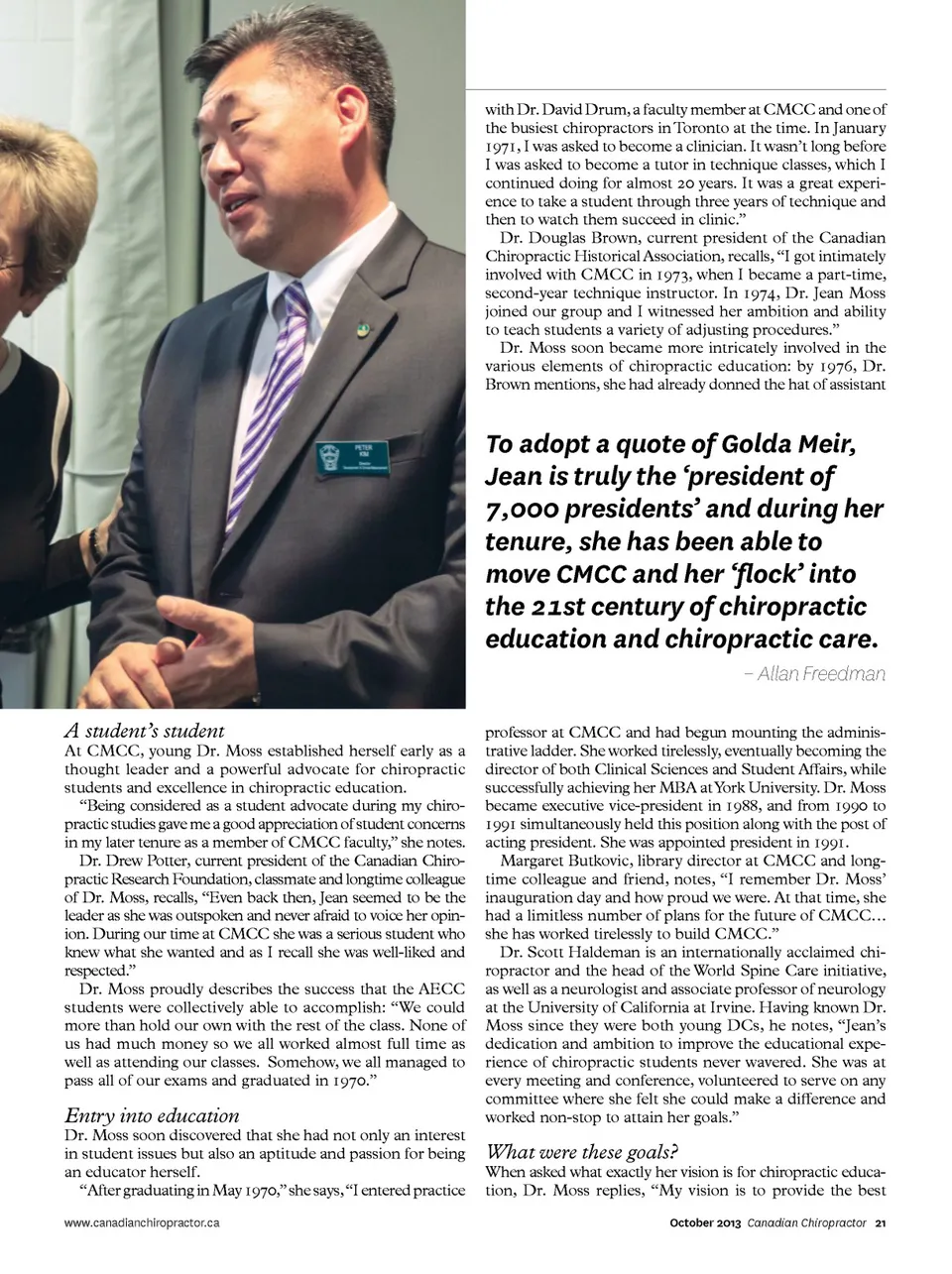
FEATURE PROFILE First lady CMCC president Dr. Jean Moss leads the chiropractic profession through pioneering achievements A B y M aria D i D anieli strong leader is, in spirit, a pioneer – a person who is open to, and excited about, exploring uncharted areas and is willing to take difficult roads, even when an easier course presents itself. Within the profession of chiroprac-tic, there is a woman who has person-ified this pioneer spirit throughout her long and illustrious career. Building on the foundations laid by those who initi-ated the profession, Dr. Jean Moss, president of the Cana-dian Memorial Chiropractic College (CMCC), has advo-cated for innovative, if challenging, directions for chiropractic. Her perseverance and tenacity have paid off, and today, CMCC’s program represents an internationally renowned and respected paradigm for chiropractic educa-tion – one that is increasingly being emulated in chiroprac-tic schools and is being noticed by educators in other health-care disciplines. Such an achievement, many would say, deserves recogni-tion, and Dr. Moss has received a number of accolades for her hard work since she embarked on her career in the 1960s. Dr. Moss speaks with Health Minister Deb Matthews and CMCC’s Dr. Peter Kim at the launch of the Centre for the Study of Disability Prevention and Rehabilitation. First of many firsts mAriA didAnieLi is the former editor of Canadian Chiropractor magazine. She now works in clinical neurophysiology at the University Health Network in Toronto. You can reach her at [email protected]. 20 Canadian Chiropractor October 2013 www.canadianchiropractor.ca Photo: Canadian Memorial Chiropractic College Dr. Moss was originally drawn to chiropractic as a result of two occurrences: first, despite a bleak medical prognosis, her mother, who suffered from a low-back condition, expe-rienced a successful outcome as a chiropractic patient; and second, a family friend and recent graduate of CMCC re-turned to Bournemouth, England (Dr. Moss’s home town), excited about his new career and the chiropractic education he had received in Canada. He informed young Jean, who was by then already considering pursuing a career in health care, and investigating a chiropractic program – the first outside of North America – that was opening in Bourne-mouth. Undaunted by the school’s infancy, she signed up as a student in the Anglo-European College of Chiroprac-tic’s (AECC) inaugural class. “One professor,” she recalls of her first year in this new college, “Dr. Sidney Cooke, taught us much of our first year. He had a unique ability to teach and was the best teacher I have ever had.” Due to some issues with the dean, however, Dr. Cooke was soon replaced by another teacher, a gentleman who had a PhD in a discipline other than chiropractic. She and her peers could not warm up to his instruction, and began to explore other institutions where they could study chiro-practic. CMCC seemed like a reasonable option. However, the AECC students soon ran into some open conflict with schools in North America: it seemed they had been black-listed on this continent. One of her classmates, Dr. Lynton Giles, met with Dr. Earl Homewood – then the dean of CMCC – and the AECC contingent (10 eager students) were soon accepted at 252 Bloor St. in Toronto. “Ten fee-paying students, even if they sounded like trou-blemakers, was too good to miss, so we started at CMCC in second year – on probation,” recalls Dr. Moss.
Chiropractic + Naturopathic Doctor October 2013: Page 20