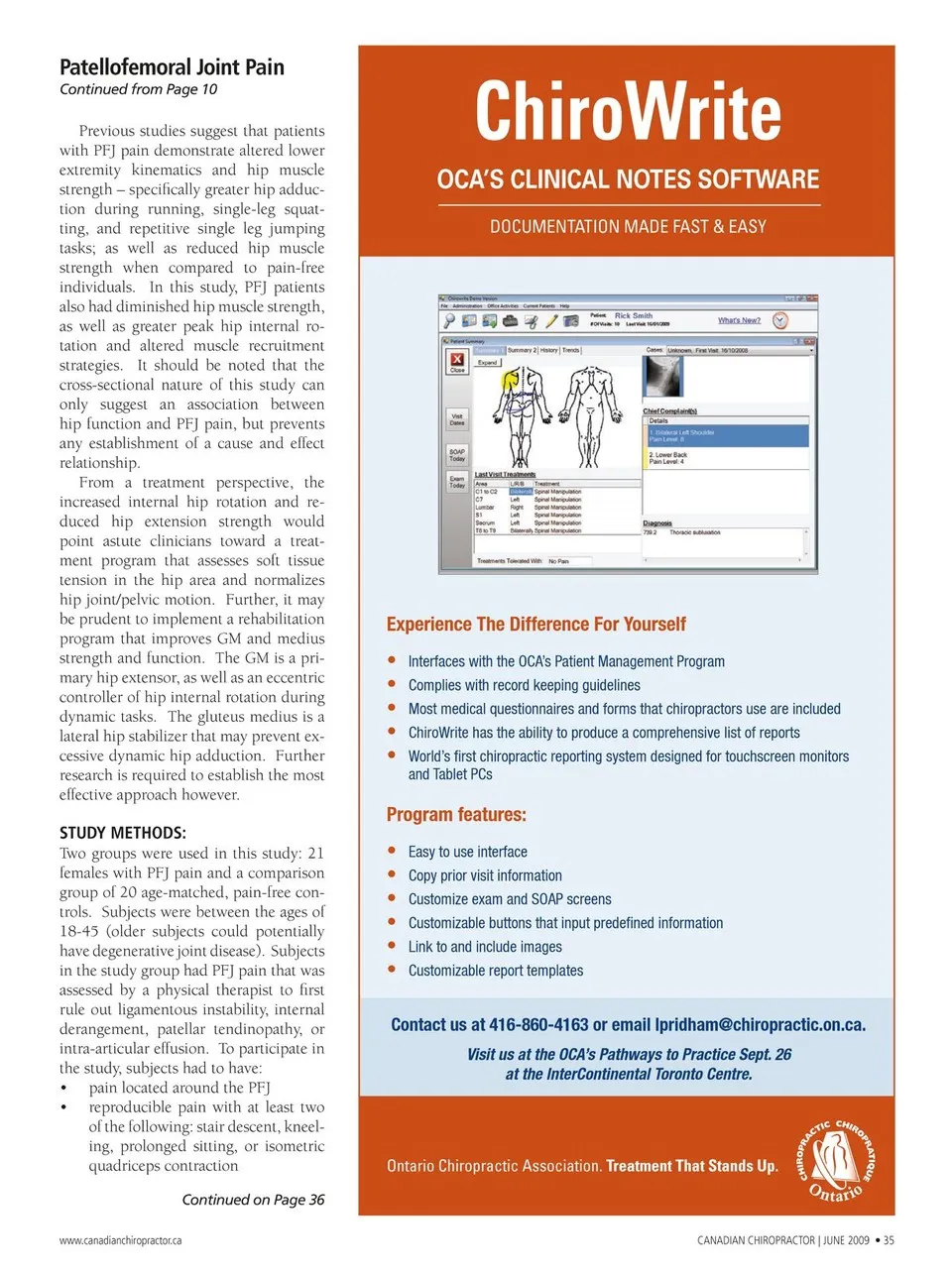
Patellofemoral Joint Pain Continued from Page 10 Previous studies suggest that patients with PFJ pain demonstrate altered lower extremity kinematics and hip muscle strength – specifically greater hip adduc- tion during running, single-leg squat- ting, and repetitive single leg jumping tasks; as well as reduced hip muscle strength when compared to pain-free individuals. In this study, PFJ patients also had diminished hip muscle strength, as well as greater peak hip internal ro- tation and altered muscle recruitment strategies. It should be noted that the cross-sectional nature of this study can only suggest an association between hip function and PFJ pain, but prevents any establishment of a cause and effect relationship. From a treatment perspective, the increased internal hip rotation and re- duced hip extension strength would point astute clinicians toward a treat- ment program that assesses soft tissue tension in the hip area and normalizes hip joint/pelvic motion. Further, it may be prudent to implement a rehabilitation program that improves GM and medius strength and function. The GM is a pri- mary hip extensor, as well as an eccentric controller of hip internal rotation during dynamic tasks. The gluteus medius is a lateral hip stabilizer that may prevent ex- cessive dynamic hip adduction. Further research is required to establish the most effective approach however. STuDY METhODS: Two groups were used in this study: 21 females with PFJ pain and a comparison group of 20 age-matched, pain-free con- trols. Subjects were between the ages of 18-45 (older subjects could potentially have degenerative joint disease). Subjects in the study group had PFJ pain that was assessed by a physical therapist to first rule out ligamentous instability, internal derangement, patellar tendinopathy, or intra-articular effusion. To participate in the study, subjects had to have: • pain located around the PFJ • reproducible pain with at least two of the following: stair descent, kneel- ing, prolonged sitting, or isometric quadriceps contraction Continued on Page 36 www.canadianchiropractor.ca CANAdiAN ChirOPrACTOr | JUNE 2009 • 35 ChiroWrite OCA’S CLINICAL NOTES SOFTWARE DOCUMENTATION MADE FAST & EASY Experience The Difference For Yourself • • • • • • • • • • • Interfaces with the OCA’s Patient Management Program Complies with record keeping guidelines Most medical questionnaires and forms that chiropractors use are included ChiroWrite has the ability to produce a comprehensive list of reports World’s first chiropractic reporting system designed for touchscreen monitors and Tablet PCs Program features: Easy to use interface Copy prior visit information Customize exam and SOAP screens Customizable buttons that input predefined information Link to and include images Customizable report templates Contact us at 416-860-4163 or email [email protected]. Visit us at the OCA’s Pathways to Practice Sept. 26 at the InterContinental Toronto Centre. Ontario Chiropractic Association. Treatment That Stands Up.
Chiropractic + Naturopathic Doctor June 2009: Page 35