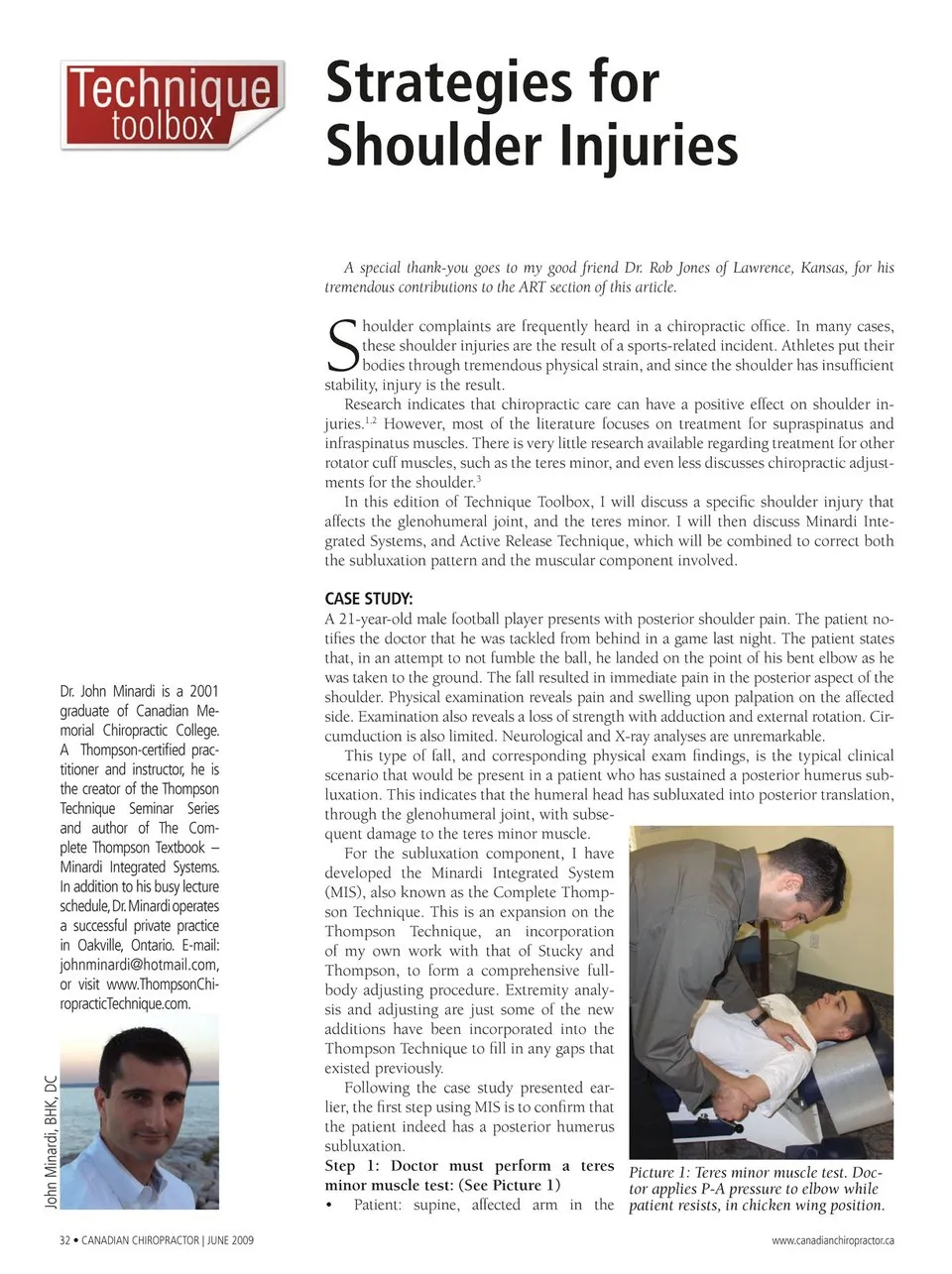
Strategies for Shoulder Injuries A special thank-you goes to my good friend Dr. Rob Jones of Lawrence, Kansas, for his tremendous contributions to the ART section of this article. stability, injury is the result. Research indicates that chiropractic care can have a positive effect on shoulder in- However, most of the literature focuses on treatment for supraspinatus and S Dr. John Minardi is a 2001 graduate of Canadian Me- morial Chiropractic College. A Thompson-certified prac- titioner and instructor, he is the creator of the Thompson Technique Seminar Series and author of The Com- plete Thompson Textbook – Minardi integrated Systems. in addition to his busy lecture schedule, dr. Minardi operates a successful private practice in Oakville, Ontario. E-mail: [email protected], or visit www.ThompsonChi- ropracticTechnique.com. juries.1,2 infraspinatus muscles. There is very little research available regarding treatment for other rotator cuff muscles, such as the teres minor, and even less discusses chiropractic adjust- ments for the shoulder.3 In this edition of Technique Toolbox, I will discuss a specific shoulder injury that affects the glenohumeral joint, and the teres minor. I will then discuss Minardi Inte- grated Systems, and Active Release Technique, which will be combined to correct both the subluxation pattern and the muscular component involved. CASE STuDY: A 21-year-old male football player presents with posterior shoulder pain. The patient no- tifies the doctor that he was tackled from behind in a game last night. The patient states that, in an attempt to not fumble the ball, he landed on the point of his bent elbow as he was taken to the ground. The fall resulted in immediate pain in the posterior aspect of the shoulder. Physical examination reveals pain and swelling upon palpation on the affected side. Examination also reveals a loss of strength with adduction and external rotation. Cir- cumduction is also limited. Neurological and X-ray analyses are unremarkable. This type of fall, and corresponding physical exam findings, is the typical clinical scenario that would be present in a patient who has sustained a posterior humerus sub- luxation. This indicates that the humeral head has subluxated into posterior translation, through the glenohumeral joint, with subse- quent damage to the teres minor muscle. For the subluxation component, I have developed the Minardi Integrated System (MIS), also known as the Complete Thomp- son Technique. This is an expansion on the Thompson Technique, an incorporation of my own work with that of Stucky and Thompson, to form a comprehensive full- body adjusting procedure. Extremity analy- sis and adjusting are just some of the new additions have been incorporated into the Thompson Technique to fill in any gaps that existed previously. Following the case study presented ear- lier, the first step using MIS is to confirm that the patient indeed has a posterior humerus subluxation. Step 1: Doctor must perform a teres minor muscle test: (See Picture 1) • Patient: supine, affected arm in the 32 • CANAdiAN ChirOPrACTOr | JUNE 2009 houlder complaints are frequently heard in a chiropractic office. In many cases, these shoulder injuries are the result of a sports-related incident. Athletes put their bodies through tremendous physical strain, and since the shoulder has insufficient Picture 1: Teres minor muscle test. Doc- tor applies P-A pressure to elbow while patient resists, in chicken wing position. www.canadianchiropractor.ca John Minardi, BhK, dC
Chiropractic + Naturopathic Doctor June 2009: Page 32