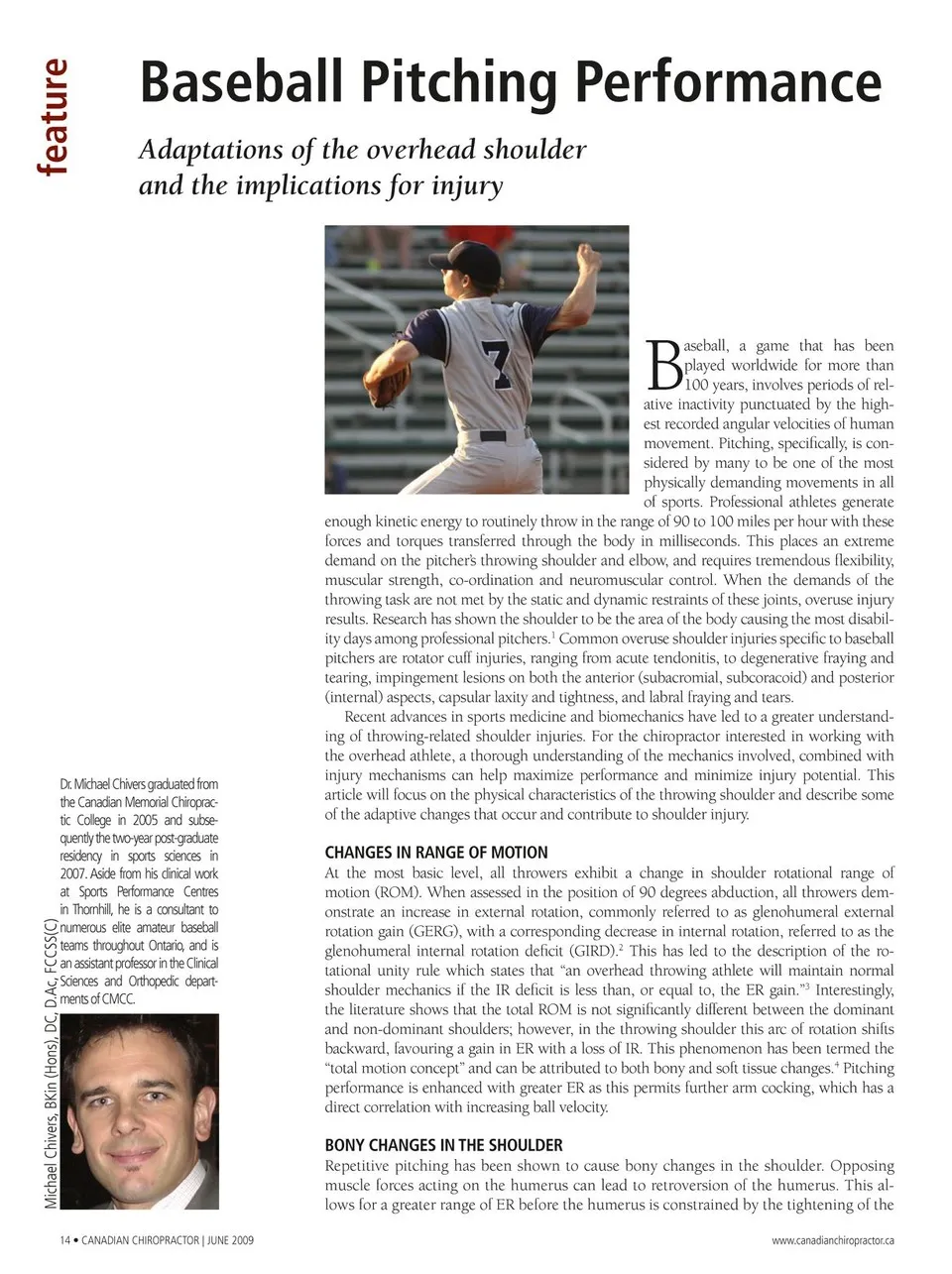
Baseball Pitching Performance Adaptations of the overhead shoulder and the implications for injury ative inactivity punctuated by the high- est recorded angular velocities of human movement. Pitching, specifically, is con- sidered by many to be one of the most physically demanding movements in all of sports. Professional athletes generate B enough kinetic energy to routinely throw in the range of 90 to 100 miles per hour with these forces and torques transferred through the body in milliseconds. This places an extreme demand on the pitcher’s throwing shoulder and elbow, and requires tremendous flexibility, muscular strength, co-ordination and neuromuscular control. When the demands of the throwing task are not met by the static and dynamic restraints of these joints, overuse injury results. Research has shown the shoulder to be the area of the body causing the most disabil- ity days among professional pitchers.1 Common overuse shoulder injuries specific to baseball pitchers are rotator cuff injuries, ranging from acute tendonitis, to degenerative fraying and tearing, impingement lesions on both the anterior (subacromial, subcoracoid) and posterior (internal) aspects, capsular laxity and tightness, and labral fraying and tears. Recent advances in sports medicine and biomechanics have led to a greater understand- dr. Michael Chivers graduated from the Canadian Memorial Chiroprac- tic College in 2005 and subse- quently the two-year post-graduate residency in sports sciences in 2007. Aside from his clinical work at Sports Performance Centres in Thornhill, he is a consultant to numerous elite amateur baseball teams throughout Ontario, and is an assistant professor in the Clinical Sciences and Orthopedic depart- ments of CMCC. ing of throwing-related shoulder injuries. For the chiropractor interested in working with the overhead athlete, a thorough understanding of the mechanics involved, combined with injury mechanisms can help maximize performance and minimize injury potential. This article will focus on the physical characteristics of the throwing shoulder and describe some of the adaptive changes that occur and contribute to shoulder injury. ChANgES IN RANgE OF MOTION At the most basic level, all throwers exhibit a change in shoulder rotational range of motion (ROM). When assessed in the position of 90 degrees abduction, all throwers dem- onstrate an increase in external rotation, commonly referred to as glenohumeral external rotation gain (GERG), with a corresponding decrease in internal rotation, referred to as the glenohumeral internal rotation deficit (GIRD).2 tational unity rule which states that “an overhead throwing athlete will maintain normal shoulder mechanics if the IR deficit is less than, or equal to, the ER gain.”3 This has led to the description of the ro- Interestingly, the literature shows that the total ROM is not significantly different between the dominant and non-dominant shoulders; however, in the throwing shoulder this arc of rotation shifts backward, favouring a gain in ER with a loss of IR. This phenomenon has been termed the “total motion concept” and can be attributed to both bony and soft tissue changes.4 Pitching performance is enhanced with greater ER as this permits further arm cocking, which has a direct correlation with increasing ball velocity. BONY ChANgES IN ThE ShOuLDER Repetitive pitching has been shown to cause bony changes in the shoulder. Opposing muscle forces acting on the humerus can lead to retroversion of the humerus. This al- lows for a greater range of ER before the humerus is constrained by the tightening of the 14 • CANAdiAN ChirOPrACTOr | JUNE 2009 www.canadianchiropractor.ca aseball, a game that has been played worldwide for more than 100 years, involves periods of rel- Michael Chivers, BKin (hons), dC, d.Ac, FCCSS(C) feature
Chiropractic + Naturopathic Doctor June 2009: Page 14