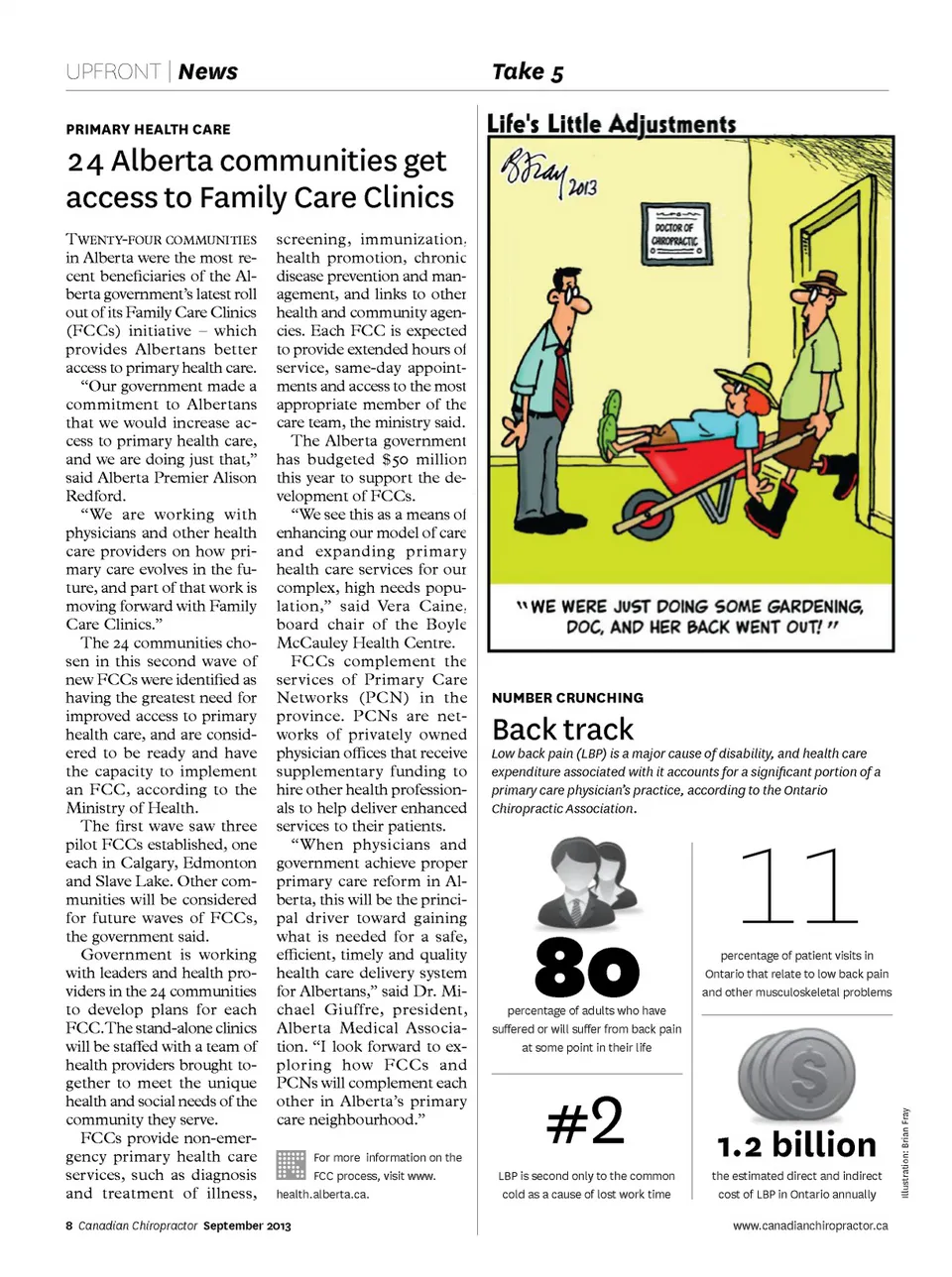
UPFRONT | News PRImARY HEAlTH CARE Take 5 24 Alberta communities get access to Family Care Clinics Twenty-four communities in Alberta were the most re-cent beneficiaries of the Al-berta government’s latest roll out of its Family Care Clinics (FCCs) initiative – which provides Albertans better access to primary health care. “Our government made a commitment to Albertans that we would increase ac-cess to primary health care, and we are doing just that,” said Alberta Premier Alison Redford. “We are working with physicians and other health care providers on how pri-mary care evolves in the fu-ture, and part of that work is moving forward with Family Care Clinics.” The 24 communities cho-sen in this second wave of new FCCs were identified as having the greatest need for improved access to primary health care, and are consid-ered to be ready and have the capacity to implement an FCC, according to the Ministry of Health. The first wave saw three pilot FCCs established, one each in Calgary, Edmonton and Slave Lake. Other com-munities will be considered for future waves of FCCs, the government said. Government is working with leaders and health pro-viders in the 24 communities to develop plans for each FCC. The stand-alone clinics will be staffed with a team of health providers brought to-gether to meet the unique health and social needs of the community they serve. FCCs provide non-emer-gency primary health care services, such as diagnosis and treatment of illness, screening, immunization, health promotion, chronic disease prevention and man-agement, and links to other health and community agen-cies. Each FCC is expected to provide extended hours of service, same-day appoint-ments and access to the most appropriate member of the care team, the ministry said. The Alberta government has budgeted $50 million this year to support the de-velopment of FCCs. “We see this as a means of enhancing our model of care and expanding primar y health care services for our complex, high needs popu-lation,” said Vera Caine, board chair of the Boyle McCauley Health Centre. FCCs complement the services of Primary Care Networks (PCN) in the province. PCNs are net-works of privately owned physician offices that receive supplementary funding to hire other health profession-als to help deliver enhanced services to their patients. “When physicians and government achieve proper primary care reform in Al-berta, this will be the princi-pal driver toward gaining what is needed for a safe, efficient, timely and quality health care delivery system for Albertans,” said Dr. Mi-chael Giuffre, president, Alberta Medical Associa-tion. “I look forward to ex-ploring how FCCs and PCNs will complement each other in Alberta’s primary care neighbourhood.” For more information on the FCC process, visit www. health.alberta.ca. NUmBER CRUNCHINg Low back pain (LBP) is a major cause of disability, and health care expenditure associated with it accounts for a significant portion of a primary care physician’s practice, according to the Ontario Chiropractic Association. Back track percentage of adults who have suffered or will suffer from back pain at some point in their life 80 #2 percentage of patient visits in Ontario that relate to low back pain and other musculoskeletal problems 11 1.2 billion the estimated direct and indirect cost of LBP in Ontario annually www.canadianchiropractor.ca LBP is second only to the common cold as a cause of lost work time 8 Canadian Chiropractor September 2013 Illustration: Brian Fray
Chiropractic + Naturopathic Doctor September 2013: Page 8