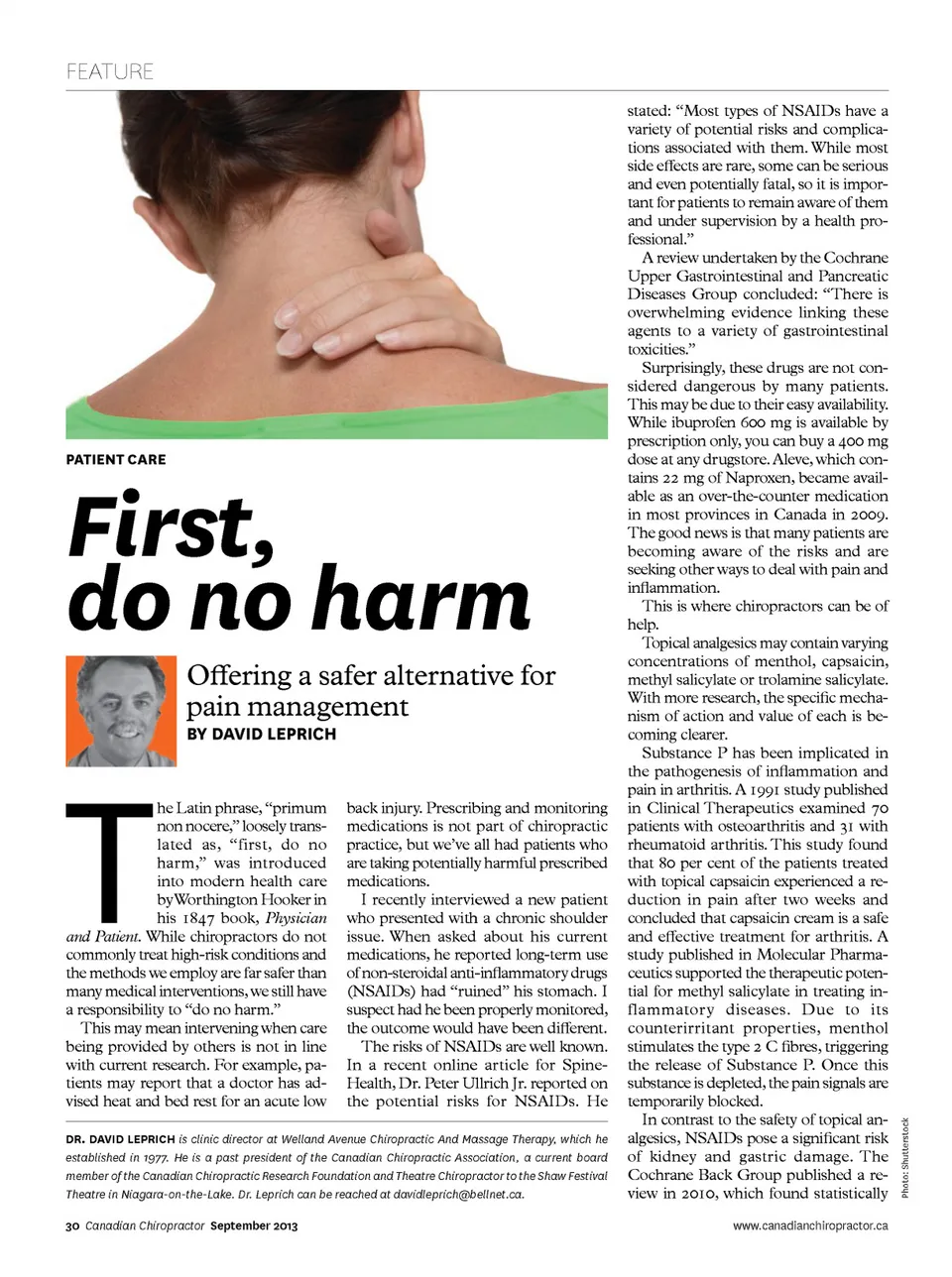
FEATURE stated: “Most types of NSAIDs have a variety of potential risks and complica-tions associated with them. While most side effects are rare, some can be serious and even potentially fatal, so it is impor-tant for patients to remain aware of them and under supervision by a health pro-fessional.” A review undertaken by the Cochrane Upper Gastrointestinal and Pancreatic Diseases Group concluded: “There is overwhelming evidence linking these agents to a variety of gastrointestinal toxicities.” Surprisingly, these drugs are not con-sidered dangerous by many patients. This may be due to their easy availability. While ibuprofen 600 mg is available by prescription only, you can buy a 400 mg dose at any drugstore. Aleve, which con-tains 22 mg of Naproxen, became avail-able as an over-the-counter medication in most provinces in Canada in 2009. The good news is that many patients are becoming aware of the risks and are seeking other ways to deal with pain and inflammation. This is where chiropractors can be of help. Topical analgesics may contain varying concentrations of menthol, capsaicin, methyl salicylate or trolamine salicylate. With more research, the specific mecha-nism of action and value of each is be-coming clearer. Substance P has been implicated in the pathogenesis of inflammation and pain in arthritis. A 1991 study published in Clinical Therapeutics examined 70 patients with osteoarthritis and 31 with rheumatoid arthritis. This study found that 80 per cent of the patients treated with topical capsaicin experienced a re-duction in pain after two weeks and concluded that capsaicin cream is a safe and effective treatment for arthritis. A study published in Molecular Pharma-ceutics supported the therapeutic poten-tial for methyl salicylate in treating in-flammatory diseases. Due to its counterirritant properties, menthol stimulates the type 2 C fibres, triggering the release of Substance P. Once this substance is depleted, the pain signals are temporarily blocked. In contrast to the safety of topical an-algesics, NSAIDs pose a significant risk of kidney and gastric damage. The Cochrane Back Group published a re-view in 2010, which found statistically www.canadianchiropractor.ca PATIENT CARE First, do no harm Offering a safer alternative for pain management T By dAvid LepriCh he Latin phrase, “primum non nocere,” loosely trans-lated as, “first, do no harm,” was introduced into modern health care by Worthington Hooker in his 1847 book, Physician and Patient. While chiropractors do not commonly treat high-risk conditions and the methods we employ are far safer than many medical interventions, we still have a responsibility to “do no harm.” This may mean intervening when care being provided by others is not in line with current research. For example, pa-tients may report that a doctor has ad-vised heat and bed rest for an acute low back injury. Prescribing and monitoring medications is not part of chiropractic practice, but we’ve all had patients who are taking potentially harmful prescribed medications. I recently interviewed a new patient who presented with a chronic shoulder issue. When asked about his current medications, he reported long-term use of non-steroidal anti-inflammatory drugs (NSAIDs) had “ruined” his stomach. I suspect had he been properly monitored, the outcome would have been different. The risks of NSAIDs are well known. In a recent online article for Spine-Health, Dr. Peter Ullrich Jr. reported on the potential risks for NSAIDs. He dr. dAvid LepriCh is clinic director at Welland Avenue Chiropractic And Massage Therapy, which he established in 1977. He is a past president of the Canadian Chiropractic Association, a current board member of the Canadian Chiropractic Research Foundation and Theatre Chiropractor to the Shaw Festival Theatre in Niagara-on-the-Lake. Dr. Leprich can be reached at [email protected]. 30 Canadian Chiropractor September 2013 Photo: Shutterstock
Chiropractic + Naturopathic Doctor September 2013: Page 30