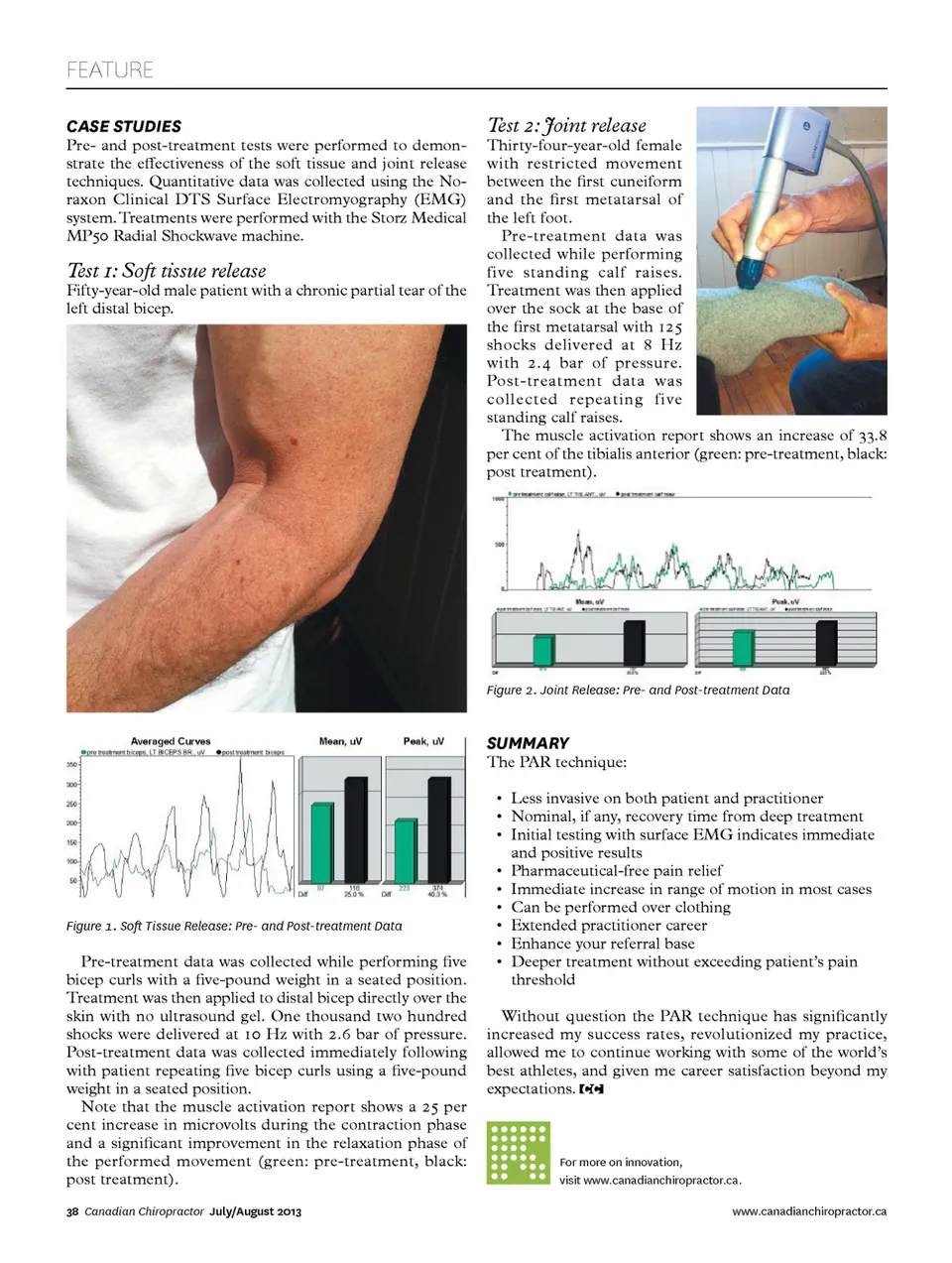
FEATURE CASe StUdieS Pre-and post-treatment tests were performed to demon-strate the effectiveness of the soft tissue and joint release techniques. Quantitative data was collected using the No-raxon Clinical DTS Surface Electromyography (EMG) system. Treatments were performed with the Storz Medical MP50 Radial Shockwave machine. Test 2: Joint release Test 1: Soft tissue release Fifty-year-old male patient with a chronic partial tear of the left distal bicep. Thirty-four-year-old female with restricted movement between the first cuneiform and the first metatarsal of the left foot. Pre-treatment data was collected while performing five standing calf raises. Treatment was then applied over the sock at the base of the first metatarsal with 125 shocks delivered at 8 Hz with 2.4 bar of pressure. Post-treatment data was collected repeating five standing calf raises. The muscle activation report shows an increase of 33.8 per cent of the tibialis anterior (green: pre-treatment, black: post treatment). Figure 2. Joint Release: Pre-and Post-treatment Data SUMMARY The PAR technique: • Less invasive on both patient and practitioner • Nominal, if any, recovery time from deep treatment • Initial testing with surface EMG indicates immediate and positive results • Pharmaceutical-free pain relief • Immediate increase in range of motion in most cases • Can be performed over clothing • Extended practitioner career • Enhance your referral base • Deeper treatment without exceeding patient’s pain threshold Without question the PAR technique has significantly increased my success rates, revolutionized my practice, allowed me to continue working with some of the world’s best athletes, and given me career satisfaction beyond my expectations. Figure 1. Soft Tissue Release: Pre-and Post-treatment Data Pre-treatment data was collected while performing five bicep curls with a five-pound weight in a seated position. Treatment was then applied to distal bicep directly over the skin with no ultrasound gel. One thousand two hundred shocks were delivered at 10 Hz with 2.6 bar of pressure. Post-treatment data was collected immediately following with patient repeating five bicep curls using a five-pound weight in a seated position. Note that the muscle activation report shows a 25 per cent increase in microvolts during the contraction phase and a significant improvement in the relaxation phase of the performed movement (green: pre-treatment, black: post treatment). 38 Canadian Chiropractor July/August 2013 For more on innovation, visit www.canadianchiropractor.ca. www.canadianchiropractor.ca
Chiropractic + Naturopathic Doctor July/August 2013: Page 38