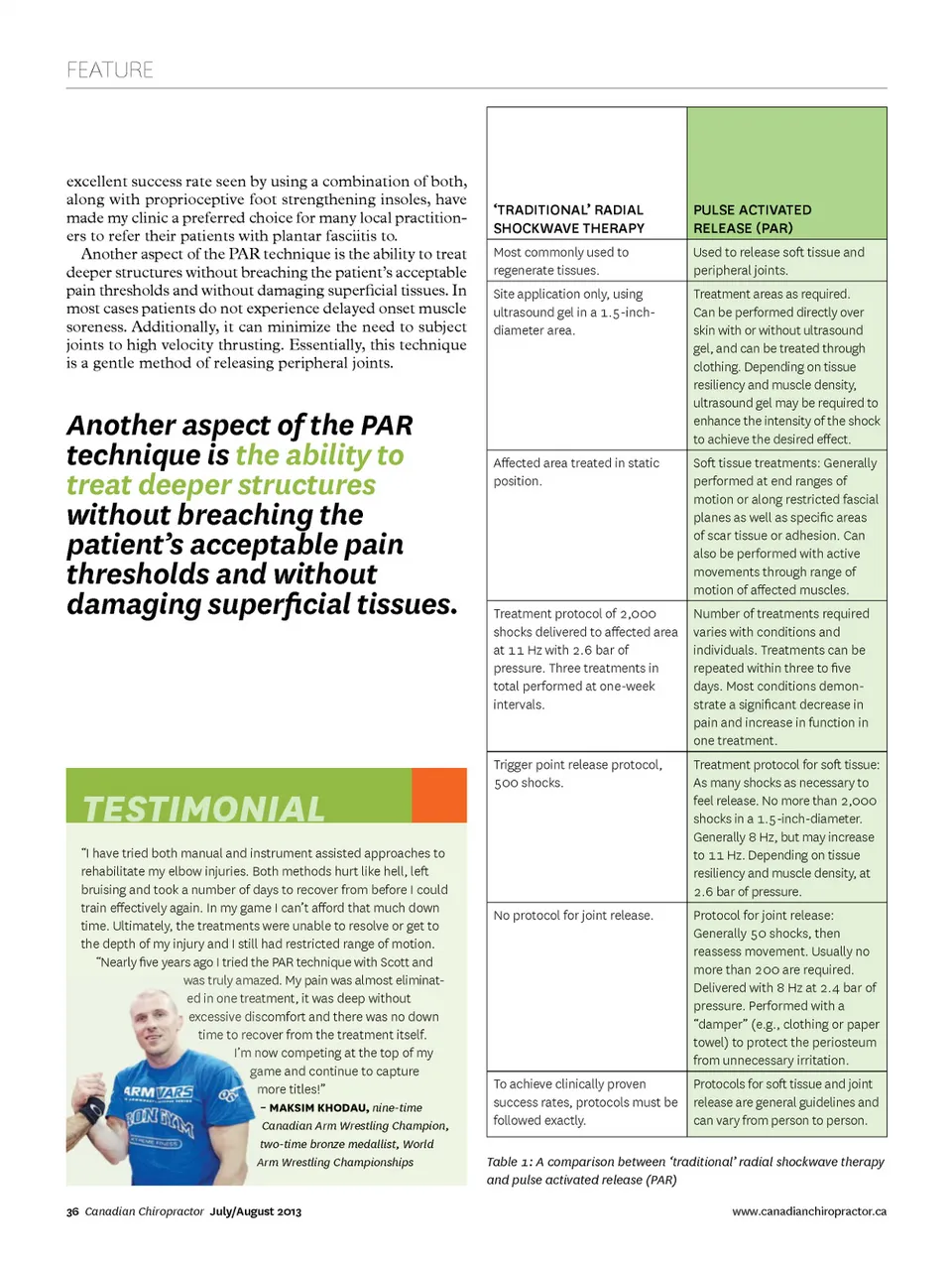
FEATURE excellent success rate seen by using a combination of both, along with proprioceptive foot strengthening insoles, have made my clinic a preferred choice for many local practition-ers to refer their patients with plantar fasciitis to. Another aspect of the PAR technique is the ability to treat deeper structures without breaching the patient’s acceptable pain thresholds and without damaging superfi cial tissues. In most cases patients do not experience delayed onset muscle soreness. Additionally, it can minimize the need to subject joints to high velocity thrusting. Essentially, this technique is a gentle method of releasing peripheral joints. ‘TRADITIONAL’ RADIAL SHOCKWAVE THERAPY Most commonly used to regenerate tissues. Site application only, using ultrasound gel in a .-inch-diameter area. PULSE ACTIVATED RELEASE PAR Used to release soft tissue and peripheral joints. Treatment areas as required. Can be performed directly over skin with or without ultrasound gel, and can be treated through clothing. Depending on tissue resiliency and muscle density, ultrasound gel may be required to enhance the intensity of the shock to achieve the desired eff ect. Soft tissue treatments: Generally performed at end ranges of motion or along restricted fascial planes as well as specifi c areas of scar tissue or adhesion. Can also be performed with active movements through range of motion of aff ected muscles. Number of treatments required varies with conditions and individuals. Treatments can be repeated within three to fi ve days. Most conditions demon-strate a signifi cant decrease in pain and increase in function in one treatment. Treatment protocol for soft tissue: As many shocks as necessary to feel release. No more than , shocks in a .-inch-diameter. Generally Hz, but may increase to Hz. Depending on tissue resiliency and muscle density, at . bar of pressure. Protocol for joint release: Generally shocks, then reassess movement. Usually no more than are required. Delivered with Hz at . bar of pressure. Performed with a “damper” (e.g., clothing or paper towel) to protect the periosteum from unnecessary irritation. Protocols for soft tissue and joint release are general guidelines and can vary from person to person. Another spect of the PAR technique is the bility to tret deeper structures without breching the ptient’s cceptble pin thresholds nd without dmging superfi cil tissues. Aff ected area treated in static position. Treatment protocol of , shocks delivered to aff ected area at Hz with . bar of pressure. Three treatments in total performed at one-week intervals. TESTIMONIAL “I have tried both manual and instrument assisted approaches to rehabilitate my elbow injuries. Both methods hurt like hell, left bruising and took a number of days to recover from before I could train eff ectively again. In my game I can’t aff ord that much down time. Ultimately, the treatments were unable to resolve or get to the depth of my injury and I still had restricted range of motion. “Nearly fi ve years ago I tried the PAR technique with Scott and was truly amazed. My pain was almost eliminat-ed in one treatment, it was deep without excessive discomfort and there was no down time to recover from the treatment itself. I’m now competing at the top of my game and continue to capture more titles!” MAKSIM KHODAU, nine-time Canadian Arm Wrestling Champion, two-time bronze medallist, World Arm Wrestling Championships Trigger point release protocol, shocks. No protocol for joint release. To achieve clinically proven success rates, protocols must be followed exactly. Table : A comparison between ‘traditional’ radial shockwave therapy and pulse activated release (PAR) www.canadianchiropractor.ca 36 Canadian Chiropractor July/August 2013
Chiropractic + Naturopathic Doctor July/August 2013: Page 36