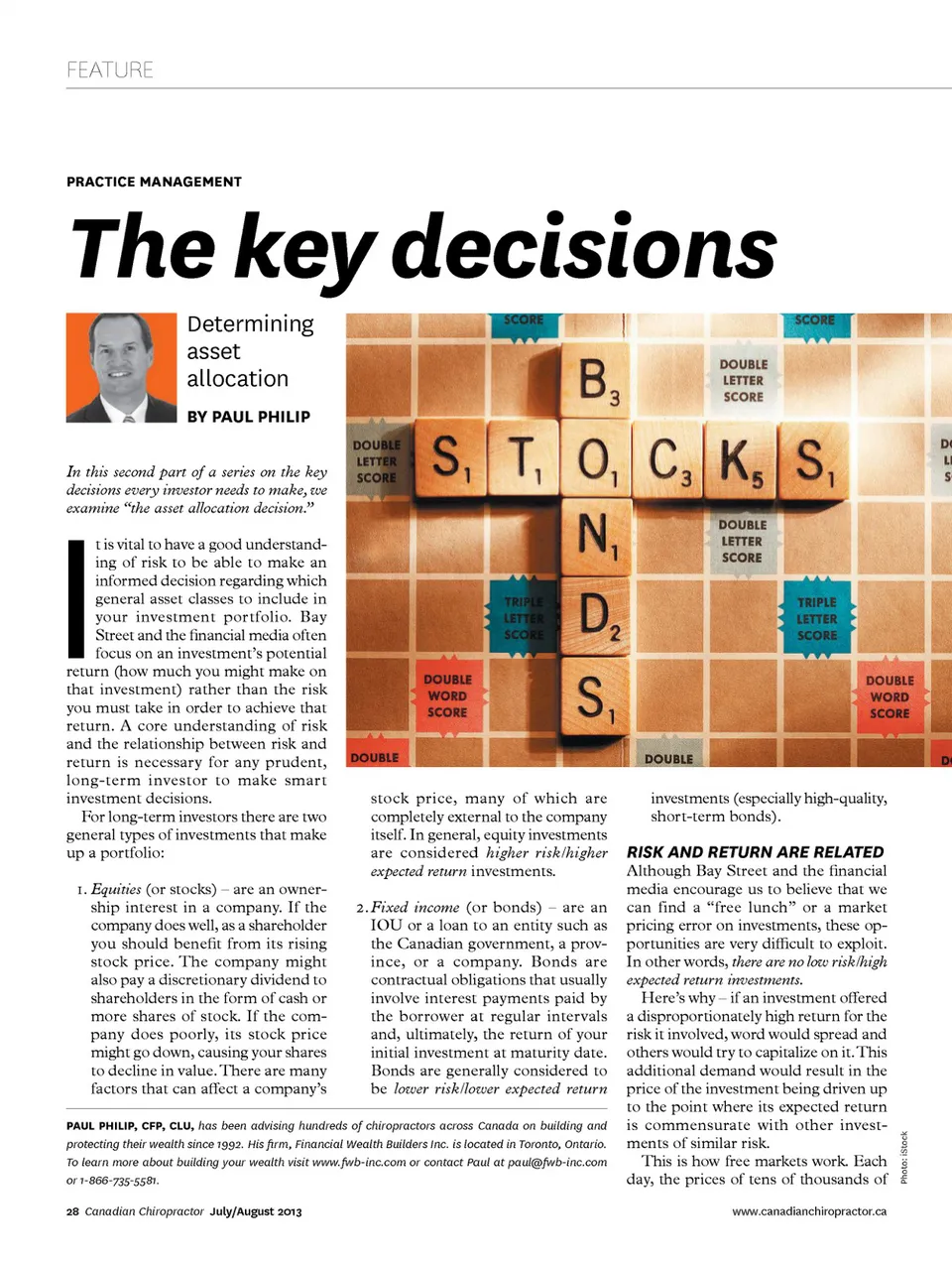
publicly traded stocks and bonds around the world continuously adjust to reflect new information or developments. So if there are very few pricing errors on investments, what will be the pri-mary determinant of your investment performance? Stockbrokers and the financial media would have you believe that investment results are mostly de-termined by how successful you (or they) are at: (1) timing , that is, when to get in and out of the market, or (2) picking the “right” individual stocks and bonds to own, or (3) finding the next top-performing manager or mu-tual fund (or all of the above). Wrong! Study after study shows that these factors actually make a negative contri-bution to the total return level of a di-versified portfolio. For the most part, these activities waste your time, cost you money and reduce your return. The truth is your investment portfolio is just like a bar of soap – the more you touch it, the smaller it will get! It is critical to understand that the primary driver of investment returns is these funds. Any money required in less than one year should be invested in cash equivalents. Bonds (lower risk/lower return) and stocks (higher risk/higher return) Since stocks are riskier than bonds, it follows that they should provide higher returns in the long run. Bonds, there-fore, should be viewed as a tool for reducing the volatility of your portfolio. As such, it makes sense your bond holdings be of higher quality and shorter maturity issues, such as short-term Canadian t-bills, government agencies and the high-quality corporate bonds. These are the safest and least volatile fixed-income asset classes. There are two reasons you should include bonds in your mix: 1. Your emotional tolerance for risk. There will be years when stocks go down 20 per cent, 30 per cent, or more. It can be difficult to with-stand such short-term pain and you want to be sure that you do not set yourself up for failure. Studies have wondering what to do. Investors need to understand their emotional ability to “stomach” occasional down years in equities upfront. With a portfolio that is properly allocated to match your risk toler-ance, you will be more likely to maintain your investment discipline and enjoy better investment returns over the long term. 2. Your age. A younger investor can be a better candidate for an asset mix more heavily weighted toward eq-uities. The younger investor will most likely not need to withdraw money from their investment port-folio for decades – their future earning capacity is their greatest asset – and they should be better able to emotionally withstand the short-term ups and downs of the market. In contrast, a retiree whose earning capacity is limited and who is withdrawing part of their portfo-lio each year for living expenses should not be too exposed to stocks and a potential extended stock market downturn. An older inves-tor may want to lessen the volatility of their portfolio with more expo-sure to bonds. In summary, the biggest determinant of your investment experience hinges on your asset allocation decision. The truth is, for most this is an area where professional guidance should be sought. A qualified advisor will have the tools, experience and perspective to help you determine what’s right for you. It is the advisor’s responsibility to be there not only at the beginning but also as your life unfolds and adjust-ments need to be made along the way. When done right, your advisor will be one of your most important relation-ships in life. Take care to find the right person to fill this important role. No doubt your family’s financial future is important to you. Procrasti-nation kills financial freedom. Make it a priority to learn as much as you can and to take control of your finances today! the truth is your investment portfolio is just like a bar of soap – the more you touch it, the smaller it will get! risk , specifically the riskiness of (and the relationship between) the asset classes you use in your portfolio and how you allocate your investment dol-lars among them. This is the asset allo-cation decision. clearly shown that investors tend to panic and sell at or near the bottom of market decline, causing them to miss the subsequent recovery. For example, in 1973 and 1974 a glob-ally diversified portfolio of stocks would have been down about 19 per cent and 23 per cent, respec-tively. Investors who panicked and sold likely missed the subsequent recovery in 1975 and 1976 when the same portfolio was up approx-imately 41 per cent and 28 per cent, respectively. A similar story unfolded after the market declines of 2000-2002 and 2008. After the 2008 financial cri-sis, those who panicked and “cashed out” missed the significant recovery that has since taken place and many are now still on the side-lines dazed and confused and left How important is it? Approach the asset allocation decision first by focusing on your desired mix of cash, bonds and stocks. This is the single most important investment decision you will make. Cash As a guideline, the percentage of assets invested in cash equivalents – which are safe, easily accessible, short-term in-vestments such as treasury bills, bank CDs, and money market funds (lowest risk/least return) – should be based on how quickly you might need to access www.canadianchiropractor.ca For more on practice management, visit www.canadianchiropractor.ca. July/August 2013 Canadian Chiropractor 29
Chiropractic + Naturopathic Doctor July/August 2013: Page 29