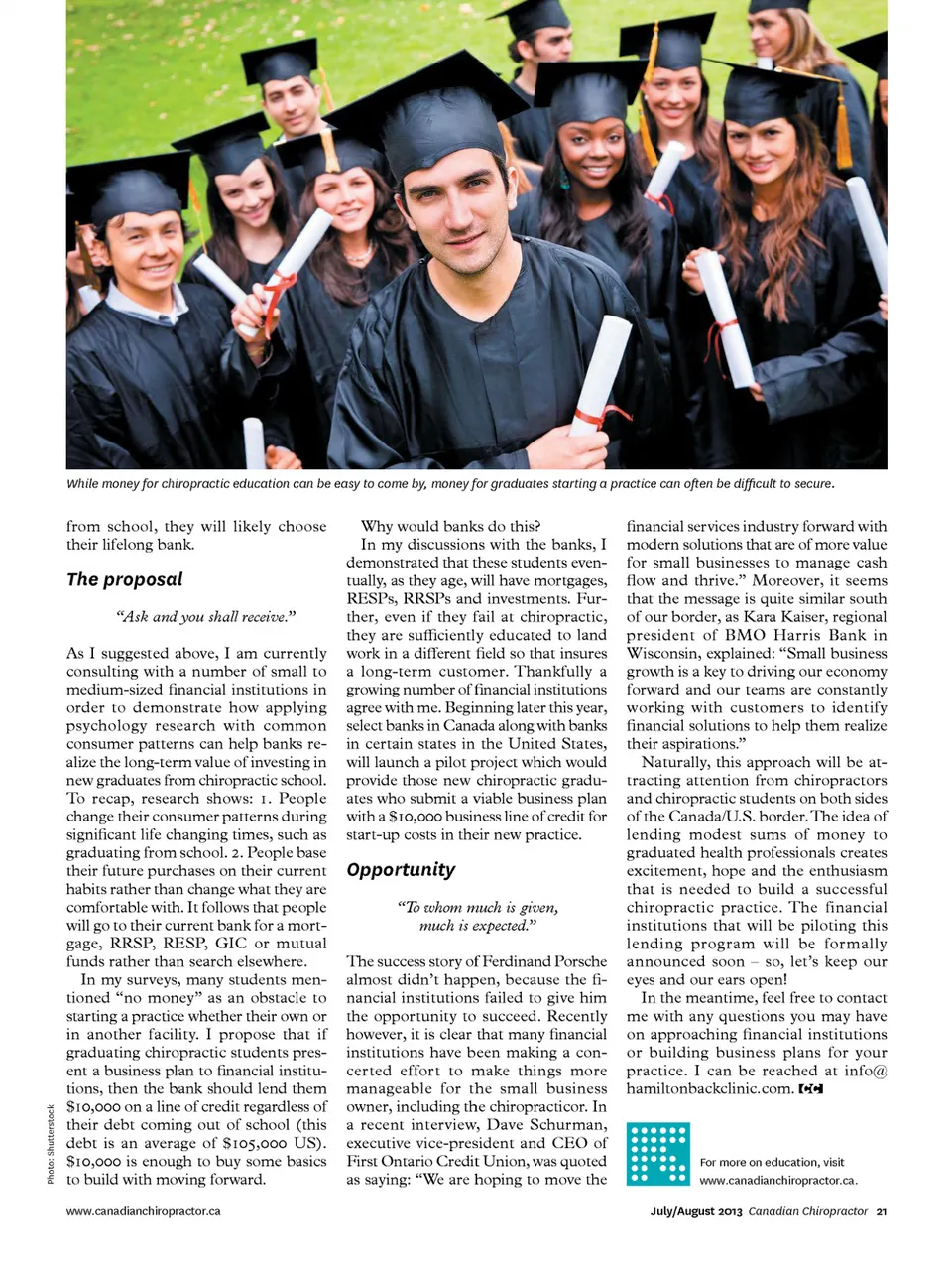
While money for chiropractic education can be easy to come by, money for graduates starting a practice can often be difficult to secure. from school, they will likely choose their lifelong bank. The proposal “Ask and you shall receive. ” As I suggested above, I am currently consulting with a number of small to medium-sized financial institutions in order to demonstrate how applying psychology research with common consumer patterns can help banks re-alize the long-term value of investing in new graduates from chiropractic school. To recap, research shows: 1. People change their consumer patterns during significant life changing times, such as graduating from school. 2. People base their future purchases on their current habits rather than change what they are comfortable with. It follows that people will go to their current bank for a mort-gage, RRSP, RESP, GIC or mutual funds rather than search elsewhere. In my surveys, many students men-tioned “no money” as an obstacle to starting a practice whether their own or in another facility. I propose that if graduating chiropractic students pres-ent a business plan to financial institu-tions, then the bank should lend them $10,000 on a line of credit regardless of their debt coming out of school (this debt is an average of $105,000 US). $10,000 is enough to buy some basics to build with moving forward. www.canadianchiropractor.ca Why would banks do this? In my discussions with the banks, I demonstrated that these students even-tually, as they age, will have mortgages, RESPs, RRSPs and investments. Fur-ther, even if they fail at chiropractic, they are sufficiently educated to land work in a different field so that insures a long-term customer. Thankfully a growing number of financial institutions agree with me. Beginning later this year, select banks in Canada along with banks in certain states in the United States, will launch a pilot project which would provide those new chiropractic gradu-ates who submit a viable business plan with a $10,000 business line of credit for start-up costs in their new practice. Opportunity “To whom much is given, much is expected. ” The success story of Ferdinand Porsche almost didn’t happen, because the fi-nancial institutions failed to give him the opportunity to succeed. Recently however, it is clear that many financial institutions have been making a con-certed effort to make things more manageable for the small business owner, including the chiropracticor. In a recent interview, Dave Schurman, executive vice-president and CEO of First Ontario Credit Union, was quoted as saying: “We are hoping to move the financial services industry forward with modern solutions that are of more value for small businesses to manage cash flow and thrive.” Moreover, it seems that the message is quite similar south of our border, as Kara Kaiser, regional president of BMO Harris Bank in Wisconsin, explained: “Small business growth is a key to driving our economy forward and our teams are constantly working with customers to identify financial solutions to help them realize their aspirations.” Naturally, this approach will be at-tracting attention from chiropractors and chiropractic students on both sides of the Canada/U.S. border. The idea of lending modest sums of money to graduated health professionals creates excitement, hope and the enthusiasm that is needed to build a successful chiropractic practice. The financial institutions that will be piloting this lending program will be formally announced soon – so, let’s keep our eyes and our ears open! In the meantime, feel free to contact me with any questions you may have on approaching financial institutions or building business plans for your practice. I can be reached at info@ hamiltonbackclinic.com. Photo: Shutterstock For more on education, visit www.canadianchiropractor.ca. July/August 2013 Canadian Chiropractor 21
Chiropractic + Naturopathic Doctor July/August 2013: Page 21