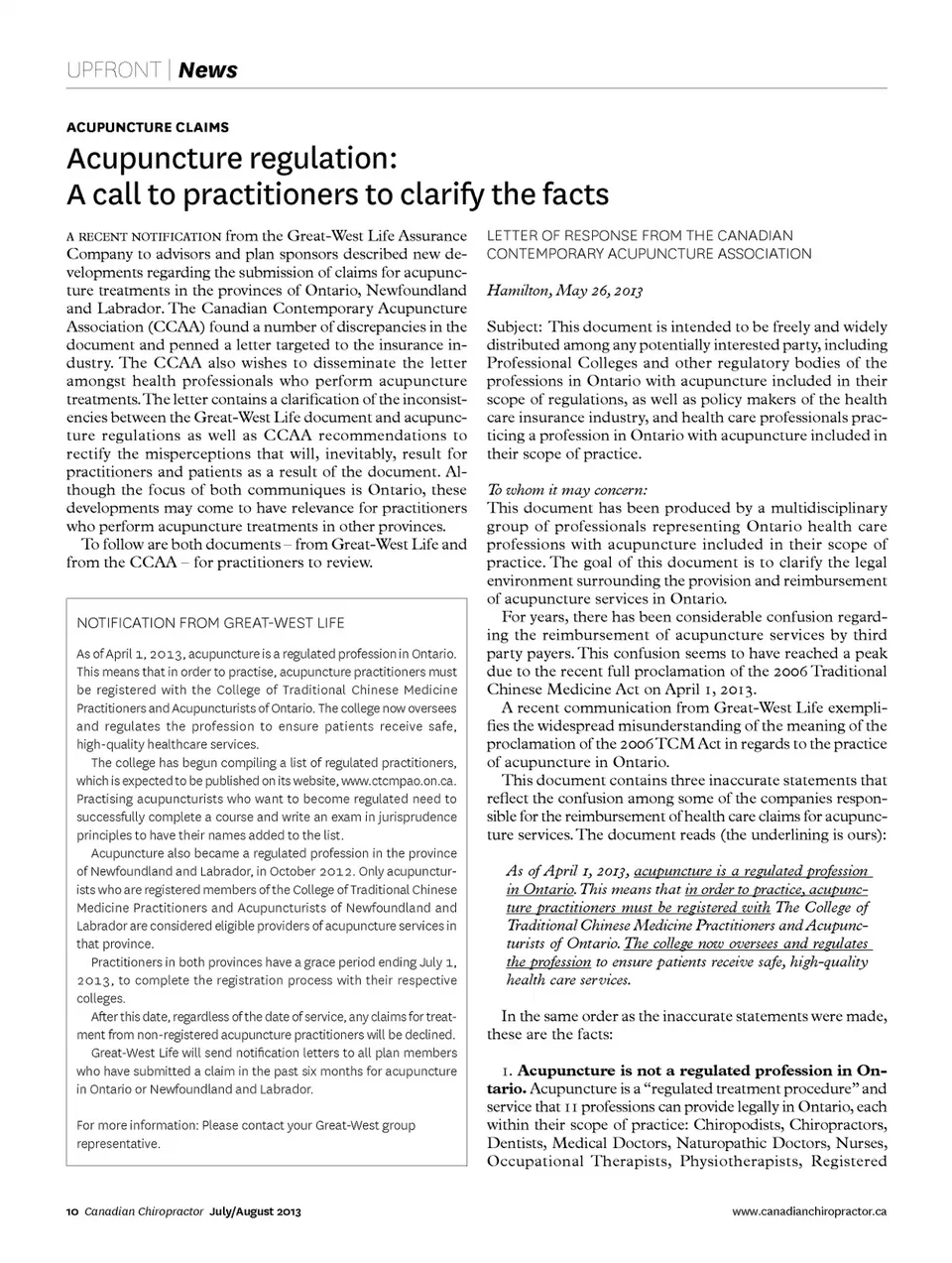
UPFRONT | News ACUPUNCTURE CLAIMS Acupuncture regulation: A call to practitioners to clarify the facts a recent notification from the Great-West Life Assurance Company to advisors and plan sponsors described new de-velopments regarding the submission of claims for acupunc-ture treatments in the provinces of Ontario, Newfoundland and Labrador. The Canadian Contemporary Acupuncture Association (CCAA) found a number of discrepancies in the document and penned a letter targeted to the insurance in-dustry. The CCAA also wishes to disseminate the letter amongst health professionals who perform acupuncture treatments. The letter contains a clarification of the inconsist-encies between the Great-West Life document and acupunc-ture regulations as well as CCAA recommendations to rectify the misperceptions that will, inevitably, result for practitioners and patients as a result of the document. Al-though the focus of both communiques is Ontario, these developments may come to have relevance for practitioners who perform acupuncture treatments in other provinces. To follow are both documents – from Great-West Life and from the CCAA – for practitioners to review. LETTER OF RESPONSE FROM THE CANADIAN CONTEMPORARY ACUPUNCTURE ASSOCIATION Hamilton, May 26, 2013 Subject: This document is intended to be freely and widely distributed among any potentially interested party, including Professional Colleges and other regulatory bodies of the professions in Ontario with acupuncture included in their scope of regulations, as well as policy makers of the health care insurance industry, and health care professionals prac-ticing a profession in Ontario with acupuncture included in their scope of practice. To whom it may concern: This document has been produced by a multidisciplinary group of professionals representing Ontario health care professions with acupuncture included in their scope of practice. The goal of this document is to clarify the legal environment surrounding the provision and reimbursement of acupuncture services in Ontario. For years, there has been considerable confusion regard-ing the reimbursement of acupuncture services by third party payers. This confusion seems to have reached a peak due to the recent full proclamation of the 2006 Traditional Chinese Medicine Act on April 1, 2013. A recent communication from Great-West Life exempli-fies the widespread misunderstanding of the meaning of the proclamation of the 2006 TCM Act in regards to the practice of acupuncture in Ontario. This document contains three inaccurate statements that reflect the confusion among some of the companies respon-sible for the reimbursement of health care claims for acupunc-ture services. The document reads (the underlining is ours): As of April 1, 2013, acupuncture is a regulated profession in Ontario. This means that in order to practice, acupunc-ture practitioners must be registered with The College of Traditional Chinese Medicine Practitioners and Acupunc-turists of Ontario. The college now oversees and regulates the profession to ensure patients receive safe, high-quality health care services. In the same order as the inaccurate statements were made, these are the facts: 1. Acupuncture is not a regulated profession in On-tario. Acupuncture is a “regulated treatment procedure” and service that 11 professions can provide legally in Ontario, each within their scope of practice: Chiropodists, Chiropractors, Dentists, Medical Doctors, Naturopathic Doctors, Nurses, Occupational Therapists, Physiotherapists, Registered www.canadianchiropractor.ca NOTIFICATION FROM GREAT-WEST LIFE As of April 1, 2013, acupuncture is a regulated profession in Ontario. This means that in order to practise, acupuncture practitioners must be registered with the College of Traditional Chinese Medicine Practitioners and Acupuncturists of Ontario. The college now oversees and regulates the profession to ensure patients receive safe, high-quality healthcare services. The college has begun compiling a list of regulated practitioners, which is expected to be published on its website, www.ctcmpao.on.ca. Practising acupuncturists who want to become regulated need to successfully complete a course and write an exam in jurisprudence principles to have their names added to the list. Acupuncture also became a regulated profession in the province of Newfoundland and Labrador, in October 2012. Only acupunctur-ists who are registered members of the College of Traditional Chinese Medicine Practitioners and Acupuncturists of Newfoundland and Labrador are considered eligible providers of acupuncture services in that province. Practitioners in both provinces have a grace period ending July 1, 2013, to complete the registration process with their respective colleges. After this date, regardless of the date of service, any claims for treat-ment from non-registered acupuncture practitioners will be declined. Great-West Life will send notification letters to all plan members who have submitted a claim in the past six months for acupuncture in Ontario or Newfoundland and Labrador. For more information: Please contact your Great-West group representative. 10 Canadian Chiropractor July/August 2013
Chiropractic + Naturopathic Doctor July/August 2013: Page 10