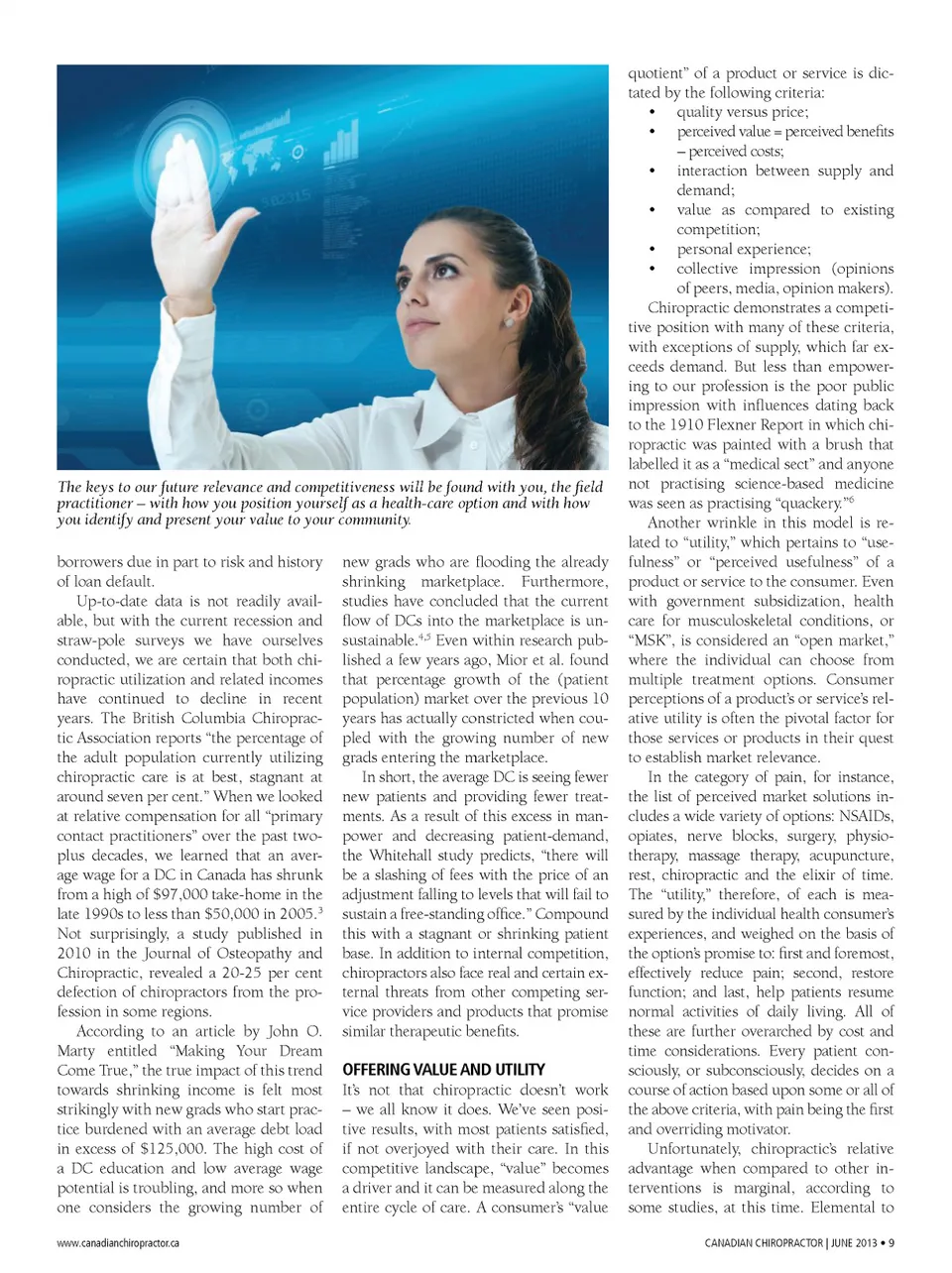
The keys to our future relevance and competitiveness will be found with you, the field practitioner – with how you position yourself as a health-care option and with how you identify and present your value to your community. borrowers due in part to risk and history of loan default. Up-to-date data is not readily avail-able, but with the current recession and straw-pole surveys we have ourselves conducted, we are certain that both chi-ropractic utilization and related incomes have continued to decline in recent years. The British Columbia Chiroprac-tic Association reports “the percentage of the adult population currently utilizing chiropractic care is at best, stagnant at around seven per cent.” When we looked at relative compensation for all “primary contact practitioners” over the past two-plus decades, we learned that an aver-age wage for a DC in Canada has shrunk from a high of $97,000 take-home in the late 1990s to less than $50,000 in 2005. 3 Not surprisingly, a study published in 2010 in the Journal of Osteopathy and Chiropractic, revealed a 20-25 per cent defection of chiropractors from the pro-fession in some regions. According to an article by John O. Marty entitled “Making Your Dream Come True,” the true impact of this trend towards shrinking income is felt most strikingly with new grads who start prac-tice burdened with an average debt load in excess of $125,000. The high cost of a DC education and low average wage potential is troubling, and more so when one considers the growing number of www.canadianchiropractor.ca new grads who are flooding the already shrinking marketplace. Furthermore, studies have concluded that the current flow of DCs into the marketplace is un-sustainable. 4,5 Even within research pub-lished a few years ago, Mior et al. found that percentage growth of the (patient population) market over the previous 10 years has actually constricted when cou-pled with the growing number of new grads entering the marketplace. In short, the average DC is seeing fewer new patients and providing fewer treat-ments. As a result of this excess in man-power and decreasing patient-demand, the Whitehall study predicts, “there will be a slashing of fees with the price of an adjustment falling to levels that will fail to sustain a free-standing office.” Compound this with a stagnant or shrinking patient base. In addition to internal competition, chiropractors also face real and certain ex-ternal threats from other competing ser-vice providers and products that promise similar therapeutic benefits. OFFERING VALUE AND UTILITY It’s not that chiropractic doesn’t work – we all know it does. We’ve seen posi-tive results, with most patients satisfied, if not overjoyed with their care. In this competitive landscape, “value” becomes a driver and it can be measured along the entire cycle of care. A consumer’s “value quotient” of a product or service is dic-tated by the following criteria: • quality versus price; • perceived value = perceived benefits – perceived costs; • interaction between supply and demand; • value as compared to existing competition; • personal experience; • collective impression (opinions of peers, media, opinion makers). Chiropractic demonstrates a competi-tive position with many of these criteria, with exceptions of supply, which far ex-ceeds demand. But less than empower-ing to our profession is the poor public impression with influences dating back to the 1910 Flexner Report in which chi-ropractic was painted with a brush that labelled it as a “medical sect” and anyone not practising science-based medicine was seen as practising “quackery.” 6 Another wrinkle in this model is re-lated to “utility,” which pertains to “use-fulness” or “perceived usefulness” of a product or service to the consumer. Even with government subsidization, health care for musculoskeletal conditions, or “MSK”, is considered an “open market,” where the individual can choose from multiple treatment options. Consumer perceptions of a product’s or service’s rel-ative utility is often the pivotal factor for those services or products in their quest to establish market relevance. In the category of pain, for instance, the list of perceived market solutions in-cludes a wide variety of options: NSAIDs, opiates, nerve blocks, surgery, physio-therapy, massage therapy, acupuncture, rest, chiropractic and the elixir of time. The “utility,” therefore, of each is mea-sured by the individual health consumer’s experiences, and weighed on the basis of the option’s promise to: first and foremost, effectively reduce pain; second, restore function; and last, help patients resume normal activities of daily living. All of these are further overarched by cost and time considerations. Every patient con-sciously, or subconsciously, decides on a course of action based upon some or all of the above criteria, with pain being the first and overriding motivator. Unfortunately, chiropractic’s relative advantage when compared to other in-terventions is marginal, according to some studies, at this time. Elemental to CANADIAN CHIROPRACTOR | JUNE 2013 • 9
Chiropractic + Naturopathic Doctor June 2013 : Page 9